Log in
Sign up for FREE
arrow_back
Library

GTS, Law of Superposition & Index Fossils Quiz 1/21/2022

star
star
star
star
star
Last updated over 3 years ago
15 questions
Required
1
Required
1
Required
1
Required
1
Required
1
Required
1
Required
1
Required
1
Required
1
Required
1
Required
1
3
Required
1
Required
2
3
Question 1
1.

Question 2
2.

Question 3
3.

Question 4
4.

Question 5
5.

Question 6
6.

Question 7
7.

Question 8
8.

Question 9
9.

Question 10
10.

Question 11
11.

Question 12
12.

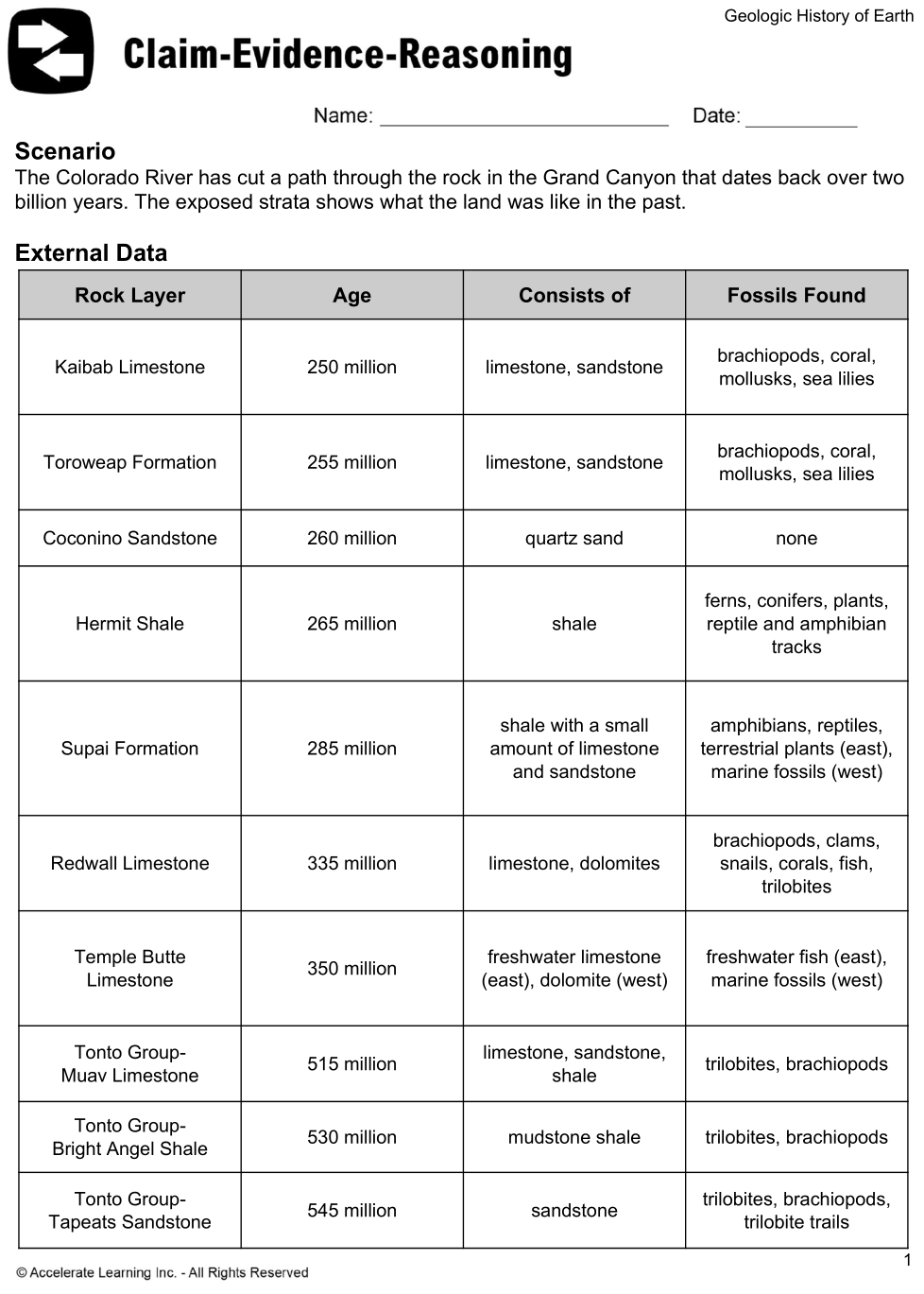
Carefully read through the scenario, chart, and prompt before answering the question.
Prompt: Examine the Hermit Shale strata (265 million years ago) and the Toroweap Formation (255 million years ago). Based on the rock strata and the fossils found in each strata, how did the environment and life in the Grand Canyon change over that period of time?
Question 13
13.

Question 14
14.

BONUS (OPTIONAL) CREDIT

Question 15
15.

Using the claim and evidence you selected, create a reasoning that ties together your claim and evidence.

Scientists are able to gather evidence about Earth's history through-
Rock strata ONLY.
Both rock strata and fossils.
Fossils ONLY.
Based on the Geologic Time Scale, the order of the eras of Earth are-
Paleozoic, Cenozoic, Proterozoic, Archean, and Mesozoic
Archean, Proterozoic, Paleozoic, Mesozoic, and Cenozoic
Cenozoic, Mesozoic, Paleozoic, Proterozoic, and Archean
Which organism are you most likely to find in the Paleozoic era?
Humans
Birds
Dinosaurs
Trilobites
In the Mesozoic era, you will find ALL of the following organisms EXCEPT-
Dinosaurs
Flowering plants
Early mammals
Horses
According to the Law of Superposition-
the youngest rock layers are found at the bottom and the oldest layers at the top.
the youngest rock layers are found at the top and the oldest layers at the bottom.
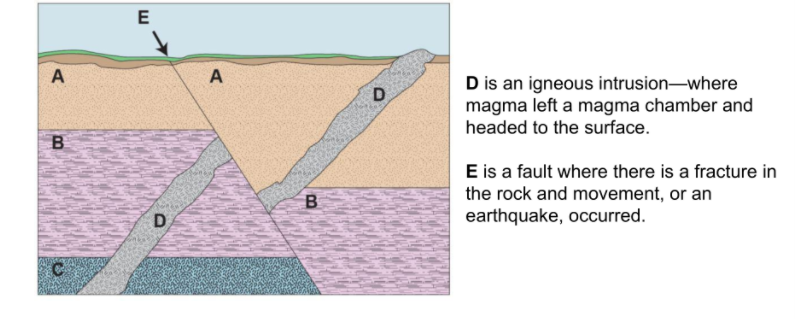
Use the picture above to answer questions 4-7.

Based on the law of superposition, which is the youngest layer?
Layer C
Layer B
Layer A
Layer E
Based on the law of superposition, which is the oldest layer?
Layer C
Layer B
Layer A
Layer E
Based on the law of superposition, when did the fault line occur?
After layer B but before layer A.
Right after layer C.
Before fault line E but after layers A-D.
Based on the Law of Superposition and Principle of Cross-Cutting Relationships, when did the magma intrusion occur?
Before layer C.
After all of the layers formed.
After Layer C but before layer B.
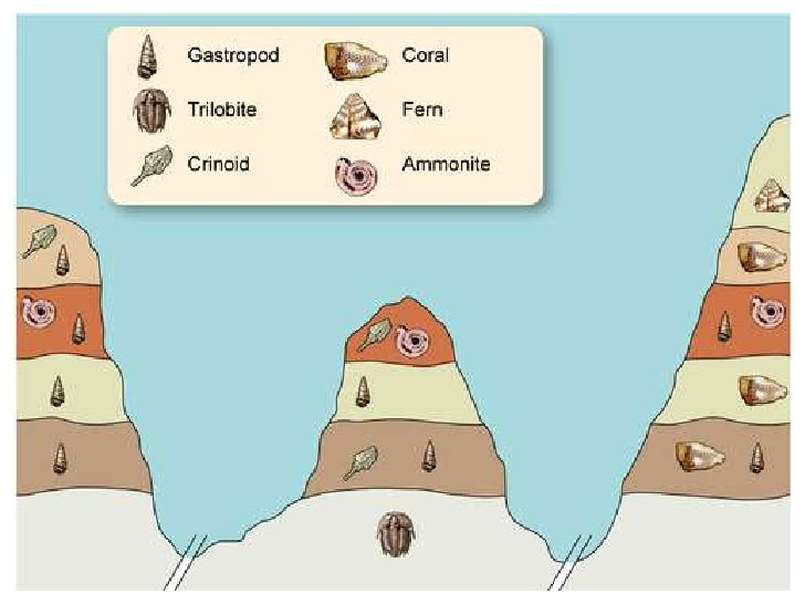
These three hills used to be one hill in the past before they separated. Based on the law of superposition, which fossil is the oldest?

Fern
Ammonite
Trilobite
Coral
Look at the hill on the right. Based on the law of superposition, which fossil is the youngest?

Trilobite
Ammonite
Coral
Fern
An index fossil is a fossil that only shows up in one rock layer (a single rock layer has the same color). Study the three hills and identify the three index fossils.
Fern
Ammonite
Gastropod
Trilobite
Coral
Choose the best claim.
Based on the fossils found in the rock strata, the environment transformed from an aquatic environment to an terrestrial (land) environment with land organisms.
Based on the fossils found in the rock strata, the environment transformed from a terrestrial (land) environment to an aquatic environment with marine organisms.
There was no change in the environment or life in the Grand Canyon between the time period of the Hermit Shale strata and Toroweap Formation strata.
Choose the BEST 2 pieces of evidence that supports your claim.
Based on the law of superposition, the Hermit Shale is older than the Toroweap Formation.
Based on the law of superposition, the Hermit Shale is younger than the Toroweap Formation.
There are fossils of terrestial life in the Toroweap Formation (such as reptiles and ferns) while there are fossils of aquatic life in the Hermit Shale strata (such as coral and sea lilies).
There are fossils of terrestial life in the Hermit Shale strata (such as reptiles and ferns) while there are fossils of aquatic life in the Toroweap Formation (such as coral and sea lilies).