Log in
Sign up for FREE
arrow_back
Library

AP. U.S. History Semester 1 Final Exam: Multiple Choice - SY22

star
star
star
star
star
Last updated almost 2 years ago
40 questions
1
GEO 1.0
KC 1.1.I
1
KC 1.2.I
WOR 1.0
1
KC 1.2.III
WXT 1.0
1
KC 1.2.II
WXT 1.0
1
KC 1.2.I
WOR 1.0
1
GEO 1.0
KC 2.1.II
1
KC 2.1.I
MIG 1.0
1
KC 2.1.II
MIG 1.0
1
KC 2.1.III
WOR 1.0
1
KC 2.2.I
WXT 2.0
1
KC 3.1.II
POL 1.0
1
KC 3.2.III
NAT 1.0
1
KC 3.2.II
NAT 2.0
1
KC 3.2.II
POL 3.0
1
POL 2.0
1
KC 4.3.I
MIG 2.0
1
KC 4.2.I
WXT 3.0
1
KC 4.2.III
MIG 1.0
1
CUL 3.0
KC 4.2.II
1
KC 4.1.III
POL 2.0
Part A: Multiple Choice (40%) ____ / 40 points


Directions: Identify the choice that best completes the statement or answers the question.

Period 1 (1491-1607)
Question 1
1.

Question 2
2.

Question 3
3.

Question 4
4.

Question 5
5.

1
KC 1.2.II
MIG 2.0
1
KC 1.2.II
WXT 2.0
1
KC 1.2.II
WXT 1.0
1
CUL 4.0
KC 2.1.III
1
CUL 1.0
KC 2.1.I
Period 2 (1607-1754)
Question 11
11.

Question 12
12.

Question 13
13.

Question 14
14.

Question 15
15.

1
CUL 4.0
KC 2.1.II
1
CUL 4.0
KC 2.2.I
1
CUL 4.0
KC 2.1.II
1
KC 2.2.II
WXT 1.0
1
KC 2.2.II
WXT 1.0
Period 3 (1754-1800)
Question 21
21.

Question 22
22.

Question 23
23.

Question 24
24.

Question 25
25.

1
KC 3.1.I
WOR 1.0
1
KC 3.1.II
MIG 2.0
1
KC 3.1.II
MIG 2.0
1
KC 3.2.II
NAT 1.0
1
KC 3.1.II
NAT 1.0
Period 4 (1800-1848)
Question 31
31.

Question 32
32.

Question 33
33.

Question 34
34.

Question 35
35.

1
KC 4.3.I
POL 1.0
1
KC 4.3.I
1
KC 4.3.I
MIG 1.0
1
KC 4.3.II
POL 3.0
1
CUL 4.0
MIG 2.0
Where did the largest and most sophisticated civilizations exist in the New World before Columbus arrived?
in the Northeast where the Iroquois Nation presided.
in the Southwest where Anasazis presided.
in Mexico and South America where the Incas, Aztecs, and Mayans presided.
in Cahokia within the Mississippi Valley.
The goal of the Spanish explorations into North America was to
expand the Spanish Empire to include more inhabitants.
seize settlements established by the French.
convert Indians to the Protestant faith.
find treasures in gold and silver.
Columbus called the native peoples he encountered “Indians” because
it was a form of the Spanish word for heathen.
he believed that he found an alternate route to India.
the Vikings had first called them by that name.
that was what they called themselves.
What was Bartolome de Las Casas’ relationship to the encomienda system?
He convinced Moctezuma to provide slaves to Spanish settlements.
He considered it immoral and protested it.
He designed and implemented it.
He performed marriages between Spanish explorers and enslaved native women.
Spain secured its claim to Columbus’ “discoveries” in the ____, dividing the “heathen lands” of the New World with Portugal.
Treaty of Tordesillas
Peace Treaty of Quetzalcoatl
Treaty of Tenochtitlán
Treaty of Pontiac
Question 6
6.

Question 7
7.

Question 8
8.

Question 9
9.

Question 10
10.

Why did early Jamestown settlers starve in spite of an abundance of local fish and game?
Their fear of Indians prevented them from venturing too far from the town.
They had neither weapons nor fishing gear.
They lacked leaders to organize efficient hunting and fishing parties.
They wasted time looking for gold.
What pushed poorer Englishmen to become indentured servants in the colonies?
Advertisements promising vast, free land awaiting them in the colonies
An opportunity for self-government
The quest for riches in the New World
Too many unemployed farmers in England who were desperate for work
New Englanders differed from their counterparts in the Chesapeake because
New Englanders were more likely to migrate as families.
New Englanders had a shorter life expectancy.
The Chesapeake colonies had a more diversified economy.
Chesapeake colonists enjoyed better weather and a healthier climate.
King Philip’s War represented
growing tensions between the Indians of New England and English settlers.
the tension between freedmen and landowners.
a war fueled by the rivalry of Queen Elizabeth and King Philip.
the growing tension between Protestants and Catholics.
Which of the following strained the relationship between the colonies and Britain?
British demand to halt the importation of slaves
Growing desire of Americans to trade with other nations in addition to Britain.
Lack of any British regulations regarding trade with foreign nations.
American’s unwillingness to trade with the French West Indies
Question 16
16.

Question 17
17.

Question 18
18.

Question 19
19.

Question 20
20.

Why did colonists vehemently object to the Stamp Act?
It would put a heavy burden on the colonial economy.
It was imposed by King George III without Parliamentary approval.
It was imposed by a Parliament in which they had no representation.
It disproportionately affected the middle and lower classes.
What is true of African Americans during the American Revolution?
Britain rejected black recruits as members of their army.
All of the slaves who fled to aid the Americans were freed after the war.
Thousands of blacks enlisted to fight on both sides of the War for their freedom.
Free blacks were permitted to join the colonial army, but enslaved blacks were barred from military service.
The final draft of the Declaration of Independence did NOT include
the influence of John Locke.
a formal statement of separation from England.
a list of complaints against King George III.
the abolition of slavery.
A result of the Great Compromise was that
representation in the House of Representatives became equal.
representation in both the House and Senate became equal.
representation in the Senate would be apportioned to the state population.
the Senate would consist of two members of each state.
As the first 10 amendments to the U.S. Constitution, the Bill of Rights was intended to protect ____ against the potential tyranny of ____.
the army and the navy, Congress
the prerogatives of Congress, the president
the South, the northern majority
the individual liberties of the people, a strong central government
Question 26
26.

Question 27
27.

Question 28
28.

Question 29
29.

Question 30
30.

In the 1840s, the view that God had ordained the growth of an American nation stretching across North America was called
Divine Mandate.
Manifest Destiny.
continentalism.
isolationism.
As a result of the introduction of the cotton gin,
the African slave trade was legalized.
the textile industry expanded in the South.
fewer slaves were needed on the plantations.
slavery was reinvigorated.
During the Industrial Revolution, advances in manufacturing and transportation brought
numerous cases of “rags-to-riches” economic mobility for ordinary Americans.
a widespread increase in life spans.
increased immigration from Europe to the United States.
a narrowing of the gap between rich and poor in America.
The “cult of domesticity”
gave women more opportunity to seek employment outside the home.
glorified the traditional role of women as homemakers.
celebrated mothers as economic role models for their children.
restricted women’s moral influence on the family.
The purpose of the Seneca Falls Convention was to
advocate for the creation of all-female colleges.
claim the right to vote for women.
demand that the word “women” be added to the Declaration of Independence alongside the word “men.”
assert the rights of women as equals to men – morally, socially, and politically.
Question 36
36.

Question 37
37.

Question 38
38.

Question 39
39.

Question 40
40.

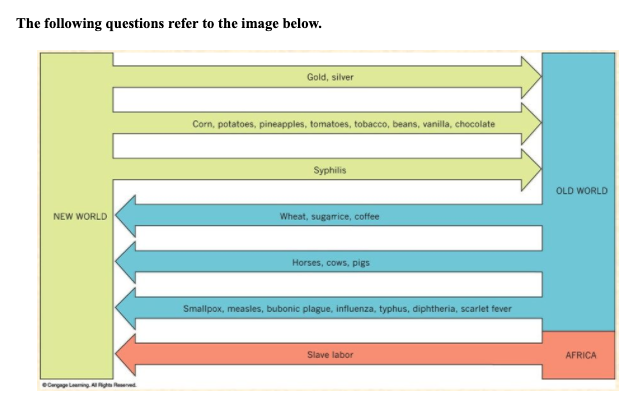
Which of the following was the most dramatic demographic effect of the Columbian Exchange on the New World?
A decline in population and livelihood for Native Americans, brought on by the introduction of African slave labor.
Longer life expectancy for Native Americans due to the introduction of the horse as an improved mode of transportation.
The destruction of up to 90% of the Native American population from diseases like smallpox.
A dramatic increase in European populations due to improved diets from the introduction of corn.
Horses, which came to the New World in the Columbian Exchange,
improved European farming productivity, which led to population growth.
made the buffalo less of a necessity for Native Americans.
allowed Spanish conquerors to easily prevail over the Native Americans they encountered.
were adopted by Plains Indians and transformed the way they hunted.
What was the major effect of the introduction of sugar to the New World?
it made Europeans turn away from trade with Africa,
it led to the integration of Native American economies into a global system.
it turned North America into a global leader in sugar production.
it led to the development of race-based labor systems.
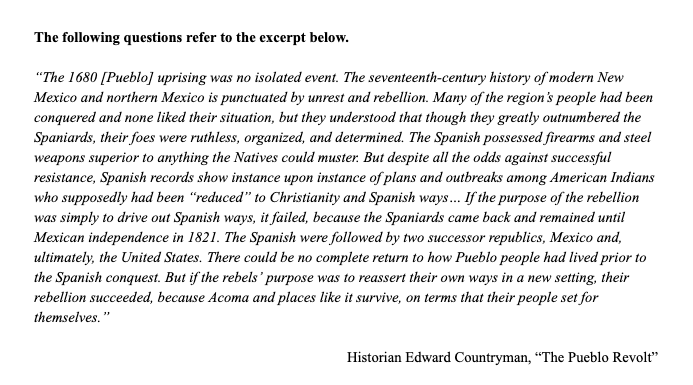
The passage supports which of the following historical trends?
The Spanish were forced by the Pueblo Revolt to accommodate some aspects of native culture.
British conflicts with natives declined as a result of the Pueblo Revolt.
Spanish colonizing efforts in the new world failed because the United States ultimately gained control of the southwest.
Economic growth in the southwest was stagnant because of native resistance.
As seen in the passage, which of the following was a similarity between Spanish and British colonizers?
Neither Spain nor Britain attempted to change the native populations they encountered.
Spain and Britain both largely incorporated native cultures into their lifestyles.
Spain and Britain often resorted to violence to control native populations.
Neither Spain nor Britain had any interest in converting native populations.
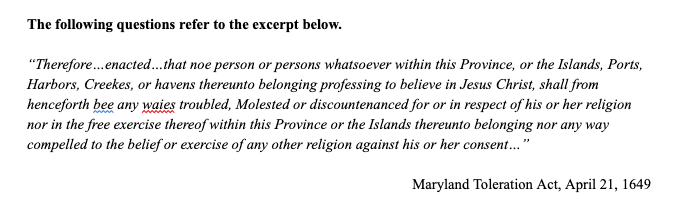
The legislation excerpted above reflects which of the following historical trends?
The New England colonies were founded as a largely homogenous society.
Religious toleration existed primarily in southern colonies.
Religious toleration existed in some, but not all, of the British colonies.
The middle colonies developed societies which were religiously homogenous.
Which of the following was a result of trends like those seen in the excerpt?
New ideas emerged that challenged the legality and morality of slavery
Decreasing Anglicization of the American colonies
The development of colonies with distinct religious and ethnic differences
British control of colonial governments increased during this period
All of the following statements are true of the period in which the legislation was enacted EXCEPT:
The colonies were operating relatively independently of the British government.
Protestant evangelism was a significant motivation for settlement of the British colonies.
Native American sovereignty was respected by the colonial governments and by the British government.
Increasing commerce from the colonies promoted a wide exchange of goods in the Atlantic community.
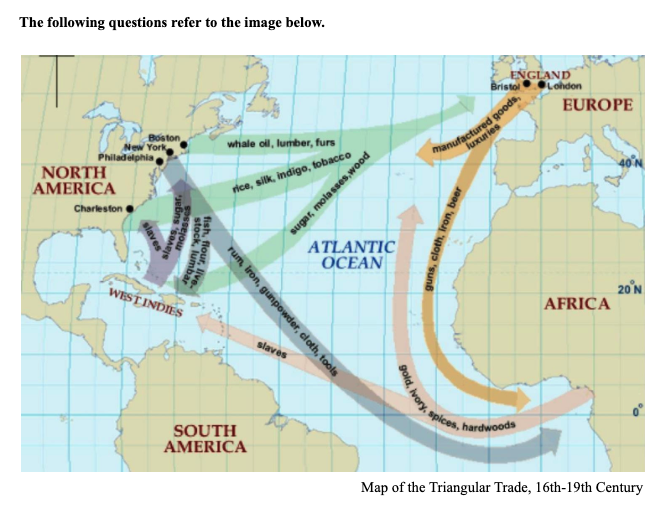
The map most directly illustrates that
Slaves were transported by European merchants from Africa to the New World.
European merchants exchanged raw materials for African slaves.
Slaves were sent from Africa to Europe in exchange for manufactured goods.
Europe traded manufactured goods in exchange for tobacco, cotton, sugar, and molasses.
Which of the following represents the Triangular Trade’s impact on the colonies?
Importation of slaves and manufactured goods to the New World.
Importation of lumber and furs to the New World.
Importation of cotton, tobacco, and sugar to the New World
Importation of rum and gunpowder to the New World.
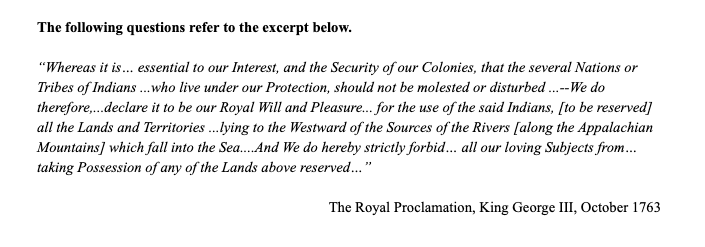
The Proclamation above sought to address British-Indian relations following the conclusion of
the Atlantic slave trade.
the French and Indian (Seven Years’) War.
the American Revolution.
the Pueblo Revolt.
The intent of the Proclamation above was to
reduce the impact of French settlers in New England.
expand British trade networks into French territories.
create a political alliance with Native American confederacies.
limit colonial encroachment on traditional tribal lands.
Which of the following best explains why British colonists would have been frustrated by the Proclamation above?
Increased attempts to regulate the colonial economy led many colonists to protest British rule.
Nationalist desires to compete with the French drove many colonists to attempt to expand Northward.
Population growth in the British colonies led many to seek land along the frontier between British territory and traditional tribal lands.
Repeated Native American raids of colonial outposts led to significant hostility among British colonists towards the Native Americans.
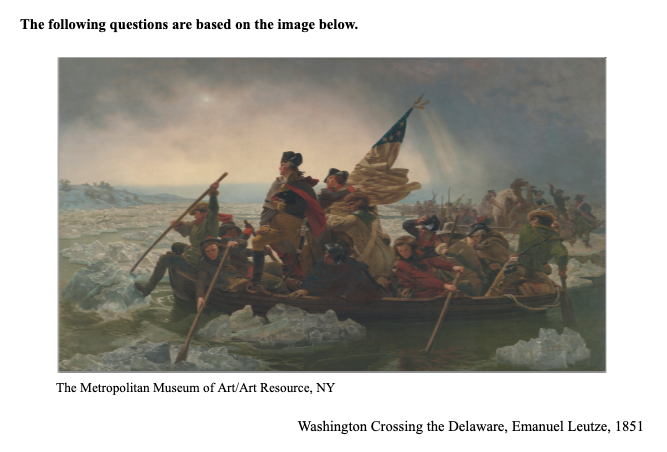
This painting commemorates a turning point in the Revolutionary War by emphasizing which of the following as a significant reason for the ultimate American victory?
The development of unity among nearly all American colonists.
Overwhelming support of European allies
Resilient and resourceful military and political leadership
Monetary advantages over the British, who had to maintain long and expensive supply lines.
The troops mustered by the American Continental Army were generally motivated by a belief in
the significance of the rights of the individual.
free trade as a means to economic success.
the demise of the aristocracy.
the British imperial system.
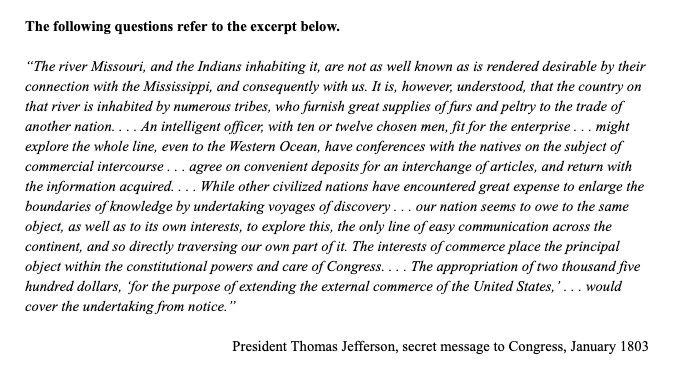
The fulfillment of Jefferson’s proposal in the excerpt would be used to support which of the following executive acts?
The securing of navigation rights on the Mississippi River
The purchase of the Louisiana territory from France
The use of federal funds for the building of the National Road
The acquisition of Florida from Spain
The immediate diplomatic goal Jefferson sought through his proposal in the excerpt was most likely
warning Americans about the dangers of permanent foreign alliances
extending United States influence over North America
encouraging support for United States annexation of Alaska
making a case for a federal navy to patrol domestic and international waters
The fulfillment of the proposal in the excerpt would most immediately affect American Indians by
providing the foundation for a new forced-labor system in which American Indians had to submit to the control of large landholders
plowing under much of the Great Plains for the expansion of farming and reducing the buffalo herds on which many American Indians in the West relied
prompting American Indian resistance to United States expansion and bringing about new federal government efforts focused on control
creating an interior empire in North America in which interaction with the United States government was primarily peaceful and mutually beneficial
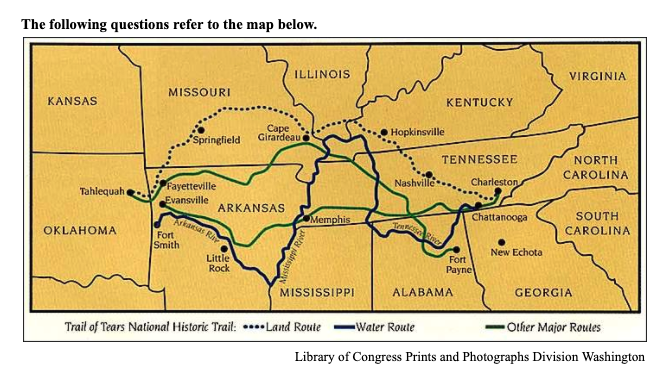
Which of the following best explains President Jackson’s reasoning for authorizing the Indian Removal Act of 1830?
He was convinced that the violent Five Civilized Tribes posed the greatest challenge to land claimed by Americans in southern states.
He wishes to punish the American Indians for their alliances to the British and French in previous wars.
He was eager to protect the native settlers by keeping white colonists from immigrating from the area.
He believed that white settlers had rights to the fertile farmland that the American Indians inhabited.
Which of the following statements best reflects the consequences of the Indian Removal Act of 1830?
Many American Indians perished due to the harsh winter and lack of food and supplies during their westward journey.
American Indians who willingly assimilated into American culture were allowed to stay in their original territory.
The American Indians were removed from fertile farmland and placed in a similar environment in western territory.
The American Indians were provided protection and supplies from the United States government to ease their transition.