Log in
Sign up for FREE
arrow_back
Library

APES Unit 3 Review Questions

star
star
star
star
star
Last updated about 4 years ago
19 questions
2
1
1
1
1
1
1
4
1
1
1
1
1
1
1
1
1
1
1
Data Analysis
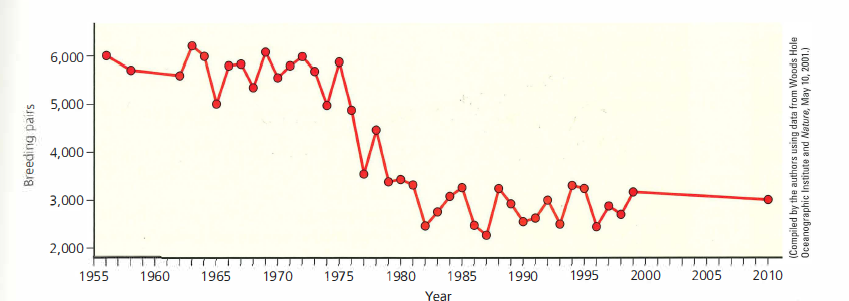
The graph below shows changes in the size of an emperor penguin population in terms of numbers of breeding pairs on the island of Terre Adelie in the Antarctic. Use the graph to answer the questions below.
Question 1
1.

a. Assuming that the penguin population fluctuates around the carrying capacity, what was the approxi­mate carrying capacity of the island for the pen­guin population from 1960 to 1975?
b. What was the approximate carrying capacity of the island for the penguin population from 1980 to 2010?

Question 2
2.

What was the percentage decline in the penguin pop­ulation from 1975 to 2010?

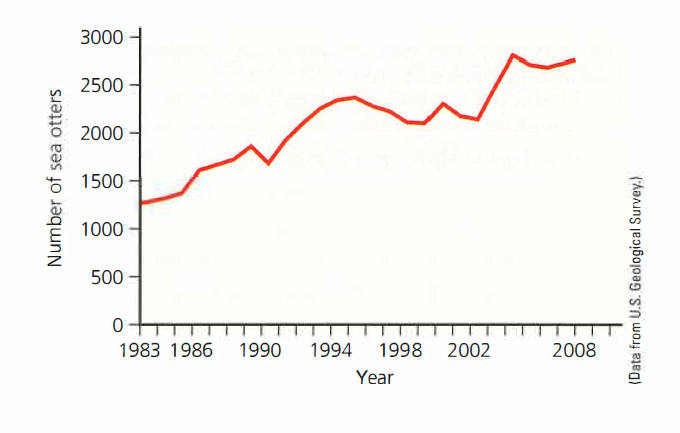
Review the graph below of an otter population off the coast of California.
Question 3
3.

What generalized trend can be made from 1983 to 2007 from this graph?

Question 4
4.

What is the percent change in the otter population from 1995 to 2000?

Question 5
5.

Which of the following has NOT contributed to the explosion of the white-tailed deer population?
Question 6
6.

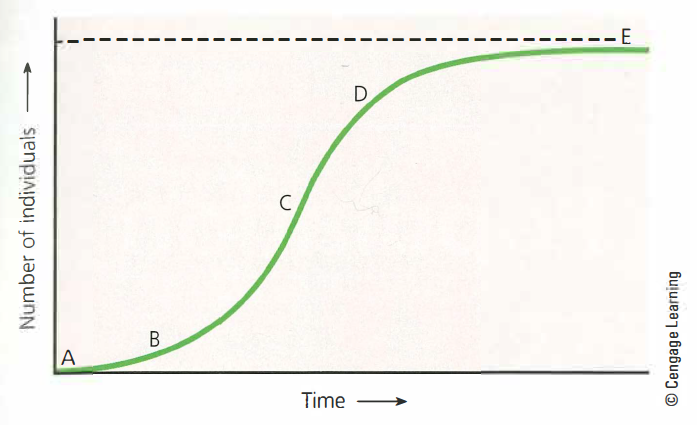
Which point on the curve above reflects the selection
most like that of an elephant, a K-selected species that
has reached its carrying capacity?

Question 7
7.

Which of the below is an example of density-dependent
population control?
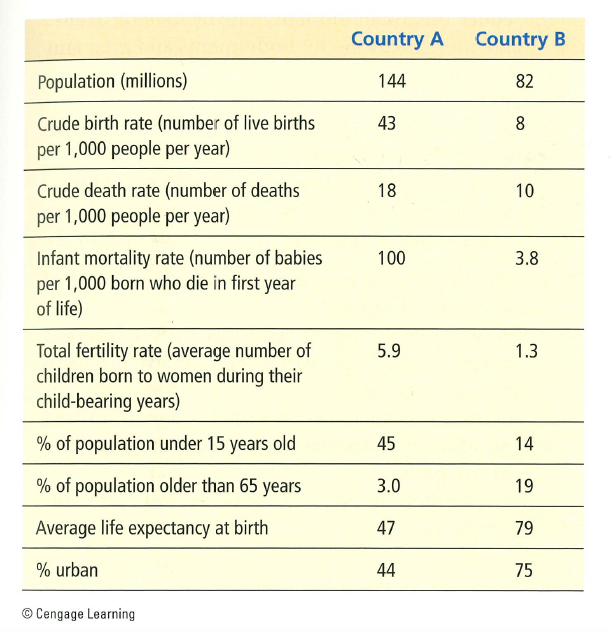
The chart below shows selected population data for two different countries, A and B. Study the chart and answer the questions that follow.
Question 8
8.

Calculate the rates of natural increase (due to births and deaths, not counting immigration) for the popu­lations of country A and country B. Based on these calculations and the data in the table, for each of the countries, suggest whether it is a more-developed country or a less-developed country and explain the reasons for your answers.

Question 9
9.

Describe where each of the two countries may be in the stages of demographic transition. Discuss factors that could hinder either country from progressing to later stages in the demographic transition.

Question 10
10.

Explain how the percentages of people under 15 years of age in each country could affect its per capita and total ecological footprints.

Question 11
11.

A medium population growth projection calls for a population of 9.3 billion people in 2050 up from the current population of 6.7 billion. What percent increase is this?

Question 12
12.

In 1798, Thomas Malthus hypothesized the collapse of the human population. What factor proved Malthus wrong and led to the continued increases in the human population?

Question 13
13.

The infant mortality rate is NOT

Question 14
14.

Why is replacement-level fertility slightly higher than two children per couple?

Question 15
15.

Taiwan, Cuba, and most of Europe have lower infant mortality rates than the U.S., in part because of

Question 16
16.

One of the most important factors in helping to stabi­lize a developing country's population and reducing environmental degradation is to

Question 17
17.

Which of the below is an example of a positive use of nature's natural capital?

Question 18
18.

Which of the below is the correct order of demographic transition states that a country experiences when industrializing?

Question 19
19.

Which of the below has been utilized in both India and China to attempt to reduce population growth rates?

The otter has reached its carrying capacity.
The otter is showing a slow rate of population increase.
The otter is an endangered species.
-0.13
0.0
Suburbanization eliminating many forests and cre­ating many edge habitats
Trapping of deer and moving them out of areas where they are not wanted
Many people planting their properties with edible flowers and shrubs
B
C
D
E
Red-tailed hawks feeding on rabbits
An avalanche clearing a hillside of all trees and
shrubs
Pollution from a city killing invertebrates in a local
stream
39
72
100
139
Increased genetic resistance of pest species
Reliance on renewable resources
Food production increased at an exponential rate
Modern health care doubling the birth rate worldwide
lower in the United States than in any other country.
in developing countries most commonly a result of diarrheal diseases caused by polluted water.
higher in countries where women are empowered by education and equality.
an indication of the availability of nutritious food and health in a country.
Some children die before reaching reproductive years.
Use of contraceptives is increasing in developed countries.
Death rates are high in developing countries.
Death rates exceed birth rates in stable countries.
increased education among teenage women.
more teenage pregnancies.
increased use of contraception and fewer births.
empower and educate women.
teach people the importance of recycling materials used in their everyday lives.
ensure that people have enough food to eat by establishing local plots of land for rent, thereby en­abling local communities to grow their own food.
Increased reliance on renewable energy resources
Introduction of species into new communities to control pests
Modification of the earth's geochemical cycles for energy uses
Nomadic➔ agrarian➔ preindustrial➔ industrial
Preindustrial ➔ transitional ➔ industrial ➔ postindustrial
Agrarian➔ preindustrial➔ transitional➔ industrial
Attempting to prevent the transition to an industrial state
Importing new technologies into the country