Log in
Sign up for FREE
arrow_back
Library

Guided Notes: Fossils

star
star
star
star
star
Last updated over 4 years ago
64 questions
Directions
https://ucmp.berkeley.edu/education/explorations/tours/fossil/5to8/Intro.html
3
https://ucmp.berkeley.edu/education/explorations/tours/fossil/5to8/Page1.html
1
1
1
https://ucmp.berkeley.edu/education/explorations/tours/fossil/5to8/Page2.html
2
4
https://ucmp.berkeley.edu/education/explorations/tours/fossil/5to8/Page2b.html
1
4
https://ucmp.berkeley.edu/education/explorations/tours/fossil/5to8/Page2c.html
1
1
1
https://ucmp.berkeley.edu/education/explorations/tours/fossil/5to8/Page3.html
4
4
3
1
1
1
1
https://ucmp.berkeley.edu/education/explorations/tours/fossil/5to8/Page4.html
1
1
https://ucmp.berkeley.edu/education/explorations/tours/fossil/5to8/Page5.html
1
https://ucmp.berkeley.edu/education/explorations/tours/fossil/5to8/Page6.html
1
1
1
1
1
https://ucmp.berkeley.edu/education/explorations/tours/fossil/5to8/Page6b.html
1
1
1
1
https://ucmp.berkeley.edu/education/explorations/tours/fossil/5to8/Page7.html
1
1
1
https://ucmp.berkeley.edu/education/explorations/tours/fossil/5to8/Page8.html
1
1
1
1
https://ucmp.berkeley.edu/education/explorations/tours/fossil/5to8/Page9.html
1
1
3
1
https://ucmp.berkeley.edu/education/explorations/tours/fossil/5to8/Page9a.html
3
https://ucmp.berkeley.edu/education/explorations/tours/fossil/5to8/Page10.html
1
1
1
1
https://ucmp.berkeley.edu/education/explorations/tours/fossil/5to8/Page11.html
1
1
1
1
https://ucmp.berkeley.edu/education/explorations/tours/fossil/5to8/Page12.html
https://ucmp.berkeley.edu/education/explorations/tours/fossil/5to8/Page12b.html
1
1
1
https://ucmp.berkeley.edu/education/explorations/tours/fossil/5to8/Page13.html
1
5
https://ucmp.berkeley.edu/education/explorations/tours/fossil/5to8/Page14.html
1
1
1
1
1
1
1
Link to video directions.

All answers to this section are found in the link below
https://ucmp.berkeley.edu/education/explorations/tours/fossil/5to8/Intro.html
The link at the top of each section is so you can skip the "pages" within the link to the part that has the answers for the questions to that section.

You will need to click next at times within that section, but they are in smller sections.
Question 1
1.
The fossil record holds important _______ about life in the past.
But not everything that once lived gets _______ as a fossil, nor do all fossils survive Earth’s _______.
Question 2
2.

All of the fossils that exist, whether dug up or still in the earth, provide what?

Question 3
3.

Definition of a Fossil Record

Question 4
4.

What is a Paleontologist?

Question 5
5.
Fossils can be _______ _______ of ancient organisms.
Question 6
6.
What are some examples of those parts that can be left behind as fossils? (List 4)
1) _______
2) _______
3) _______
4) _______
Question 7
7.
Fossils can also be _______ left by organisms.
Question 8
8.
What are some examples of those traces that can be left behind as fossils? (List 4)
1) _______
2) _______
3) _______
4) _______
Question 9
9.
It __________ possible for a fossil to be both a trace fossil and body fossil.
Question 10
10.

What is a body fossil?

Question 11
11.

What is a trace fossil?

Question 12
12.
Most fossils are formed when _______ and their _______ are _______ by _______.
Question 13
13.
Layers of sediment, such as _______ and _______, cover the remains of the _______ or its _______.
Question 14
14.
Eventually, the layers may _______ into _______ rock, _______ the remains inside.
Question 15
15.

Why is burial important speed important with fossils?

Question 16
16.

What is a scavenger?

Question 17
17.

What is a decomposer?

Question 18
18.

What are physical factors?

Question 19
19.

Question 20
20.
If an organism or its trace gets buried _______, it is less likely to be _______.
Question 21
21.
If a trace or body part/organism gets buried is it 100% guaranteed that it will fossilize? _______

Why or why not? _______
Question 22
22.

What are molds?

Question 23
23.

What are mineralizations?

Question 24
24.

What are impressions?

Question 25
25.

What are microfossils?

Question 26
26.
In each of these examples, the organism was buried in sediment. But does an organism have to be buried in sediment to become a fossil? _______

Why or why not. _______
Question 27
27.

Explain how an organism can be preserved in ice.

Question 28
28.

Explain how an organism can be preserved in amber.

Question 29
29.

What is amber?

Question 30
30.

Explain how an organism can be preserved in tar.

Question 31
31.

Question 32
32.

Explain your reasoning for the above answer.

Question 33
33.

What substance best helps soft structures remain preserved?

Question 34
34.

How does the Benthic Ocean environment affect fossilization?

Question 35
35.

How does the Lake environment affect fossilization?

Question 36
36.

How does the Rocky Intertidal environment affect fossilization?

Question 37
37.

How does the Rainforest environment affect fossilization?

Question 38
38.

Question 39
39.

Why is the above answer the correct answer?

Question 40
40.
Why is the fossil record not complete?
1) All _______
2) Only some _______
3) Of those that remain. _______
Question 41
41.

Question 42
42.
Remember _______
Insects _______
On the other hand, _______
Question 43
43.

How can fossils get crushed?

Question 44
44.

How can fossils get melted?

Question 45
45.

How can fossils get moved?

Question 46
46.

How can fossils get eroded?

Question 47
47.

Igneous rocks are...

Question 48
48.

Sedimentary rocks are...

Question 49
49.

Metamorphic rocks are...

Question 50
50.

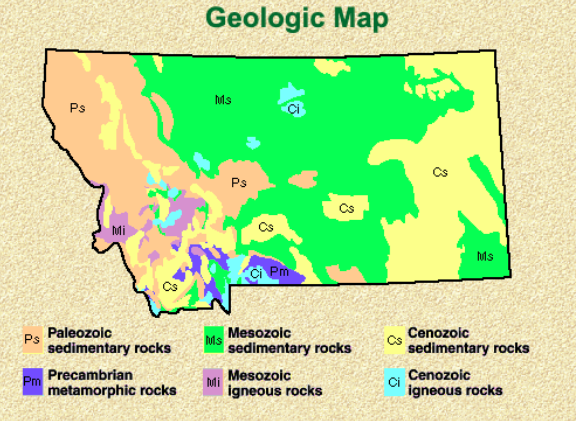
Take a look at this geologic map of Montana. The different colors represent the rocks we can see at the surface, both by age and by type.
1
1
Question 53
53.

What is the uplift process?

Question 54
54.

What is the erosion process?

Question 55
55.

Where do paleontologists look for fossils because the location has, like similar areas, are places where uplift and erosion occur.

Question 56
56.

Why don’t paleontologists always find fossils in the areas likely to contain fossils?

Question 57
57.
How do fossils represent only a partial picture of life in the past?
1) Organisms _______
2) Only _______
3) Of those that remain, _______
4) Some fossils _______
5) Of those fossils that do exist, _______
Question 58
58.

Question 59
59.

Question 60
60.

Question 61
61.

Question 62
62.

Question 63
63.

Question 64
64.

Which organism do you think is most likely to be preserved.
One that gets buried SLOWLY
One that gets buried QUICKLY
Which do you think is more likely to fossilize?
Hard Body Structures
Soft Body Structures
You just learned that not all organisms have an equal chance of fossilizing. What are the important factors to consider?
All of these.
Having hard body structures.
Dying in the right place.
Avoiding scavengers and decomposers.
Of all the organisms alive today, what percent do you think will eventually become fossils?
Fewer Than 10%
20% - 50%
More Than 50%
Which type of rock is most likely to contain fossils?
Igneous
Sedimentary
Metamorphic
Question 51
51.

Question 52
52.

Why was the above the correct answer?

Fossils are:
preserved bones, teeth or shells from long ago
preserved tracks, burrows or impressions from long ago
preserved candy wrappers, soft drink cans and baseball caps from long ago
both a and b are correct
Which would most likley to fossilize
a mammoth
a rock
sediment
a caterpillar
Why is a mammoth more likely to fossilize than a caterpillar?
soft tissues fossilize well
hard parts like bones and teeth are more likely to be preserved
undigested food in the stomach helps the fossilization proces
large organisms fossilize better
Rapid burial is important in the fossilization process because:
it protects a dead organism from physical and biological destruction
it causes erosion
it leaves an impression
it protects a dead organism from compression
Fossils are more likely to be found in...
all of these
igneous rock
sedimentary rock
metamorphic rock
Few organisms ever become fossils because:
they die in an environment where fossils rarely form
they are destroyed by physical and biological factors after death
they are made of soft body structures that do not fossilize well
all of the above
BONUS: (and be careful; this one is a bit tricky!) Of the tiny percentage of organisms that ever become fossils, most are never found because:
they are crushed, eroded or melted by geologic processes
they are eaten by scavengers
they remain hidden in the Earth where we can’t find them
both a and c are correct
both b and c are correct
Imagine that you are a paleontologist in search of Tyrannosaurus rex.
Where would you start looking
Paleozoic Sedimentary Rock
Mesozioic Sedimentary Rock
Cenozonic Sedimentary Rock
Precambrian Metamorphic Rock
Mesozioic Igneous Rock
Cenozoic Igneous Rock