1
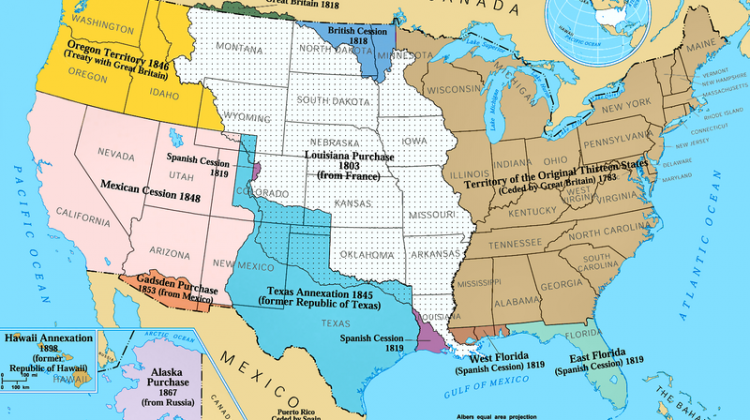
The Treaty of Guadalupe-Hidalgo ended the Mexican-American War (1846-1848). Mexico agreed to
Content Objective: I will be able to identify at least two causes of the Compromise of 1850.
Standard Objective: I will be able to identify explicitly stated relationships between groups and events, (e.g., cause-effect).
Content Objective: I will be able to identify at least two causes of the Compromise of 1850.
Standard Objective: I will be able to identify explicitly stated relationships between groups and events, (e.g., cause-effect).
Tue, 1/24 Warm Up: Please rate how well you understood last night's pre-work on a scale from 1 to 4. If you have any questions, drop them in the "Show Your Work" area.
Tue, 1/24 Warm Up: What do you recall about the Missouri Compromise?
Stuck? Click here for a visual reminder.
Tue, 1/24 Warm Up: One interesting historical fact I learned from the pre-work is…
Building Knowledge Together: First, let's make sure we're all on the same page regarding vocabulary. Here is a combination of old terms and new terms:
| Draggable item | arrow_right_alt | Corresponding Item |
|---|---|---|
Antebellum | arrow_right_alt | The idea that the United States is destined by God to expand and spread democracy and capitalism across the entire North American continent |
Consent of the Governed | arrow_right_alt | The mid-nineteenth century idea that the people of a given territory should decide whether or not to allow slavery |
Manifest Destiny | arrow_right_alt | A phrase from the Declaration of Independence, which means that a Republican form of government gets its power from the people |
36°30′ Line | arrow_right_alt | The time period before the Civil War |
Popular Sovereignty | arrow_right_alt | The northern limit for slavery to be legal in the territories of the west established by the Missouri Compromise when Maine (formerly a part of Massachusetts) was admitted as a free state in exchange for Missouri becoming a slave state (even though it was above this line) |
Guided Viewing: Based on what you know about the historical context of the United States in the Antebellum era, why do you think the United States picked a fight with the country of Mexico in the mid-1800s?
The Treaty of Guadalupe-Hidalgo ended the Mexican-American War (1846-1848). Mexico agreed to
Make a Prediction: Analyze the map above. What do you think will happen as a result of the Treaty of Guadalupe-Hidalgo?

Wed, 1/25 Warm Up: Please rate how well you understood last night's pre-work on a scale from 1 to 4. If you have any questions, drop them in the "Show Your Work" area.
Wed, 1/25 Warm Up: Have you ever followed a rule that you don't believe in? Explain why or why not.

The Underground Railroad was not actually underground. Rather, the name comes from the idea that it was not openly publicized. It was a

A series of symbols was developed as a
Typically, the abolitionists involved in the Underground Railroad were privy to the operation only to the extent that they were

Prior to the Underground Railroad, slaves would make their own attempts at freedom. Even after the network was developed, they were on their own until certain points north where it was safer for a station to exist. That being the case, the Fugitive Slave Act of 1793 was enacted. This act had slave bounty hunters coming out of the woodwork trying to cash in on the action.
Today, we are going to learn about spirituals, which are different from hymns and psalms because they were a way of
Can you decode the "Swing Low, Sweet Chariot" spiritual? Try it out!
| Draggable item | arrow_right_alt | Corresponding Item |
|---|---|---|
A band of angels coming after me | arrow_right_alt | Come into slaveholding states |
If you get there before I do, tell all my friends I’m coming too | arrow_right_alt | The Underground Railroad |
I’m sometimes up, I’m sometimes down | arrow_right_alt | Take me to freedom in the Northern States or Canada |
Comin' for to carry me home... | arrow_right_alt | I looked over the Mississippi or Ohio River, and what did I see? |
But still my soul feels heavenly bound | arrow_right_alt | Workers on the Underground Railroad coming to help me |
Swing low | arrow_right_alt | If I have escaped friends or family, please tell them my escape plan |
Sweet chariot, | arrow_right_alt | I have good days and bad days |
I looked over Jordan, and what did I see? | arrow_right_alt | But I know I will soon escape North on the Underground Railroad |
Exit Ticket: How did the enslaved and abolitionists work together to stand up for what they believed in despite the laws in the United States that upheld slavery? Support your answer with at least one specific historical example or fact.
Exit Ticket: Please evaluate how well you understood today’s lesson on a scale from 1 to 4: