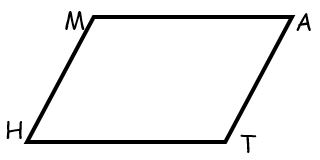
Use the parallelogram MATH for questions 6-9.
1
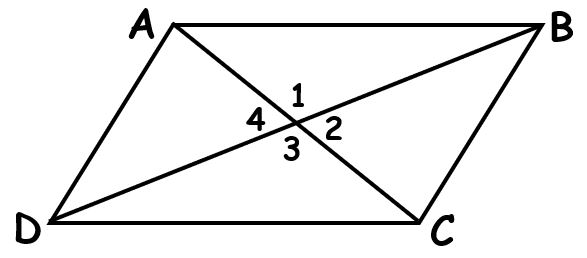
Which of the following angle pairs are congruent? Check all that apply.
Which of the following angle pairs are congruent? Check all that apply.
1
1
1
A quadrilateral with two pairs of parallel sides is a ______________________
The opposite sides of a parallelogram are ______________________
The opposite angles of a parallelogram are ______________________
The consecutive angles of a parallelogram are ______________________
The diagonals of a parallelogram _______________ each other.
Use the parallelogram MATH for questions 6-9.
Which of the following angle pairs are congruent? Check all that apply.
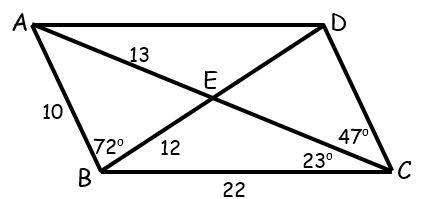
Use parallelogram ABCD below for questions 22-40.
Use parallelogram ABCD below for questions 41-49.
Opposite sides are parallel.
Two pairs of consecutive sides are congruent.
Diagonals are congruent.
All four sides are congruent.
Opposite sides are congruent.
Two pairs of consecutive angles are congruent.
Diagonals bisect each other.
Consecutive angles are supplementary.
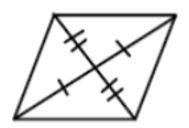
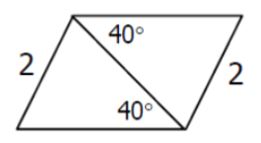
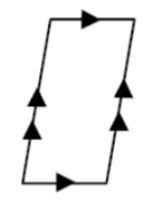
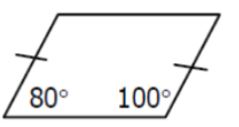
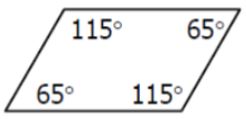
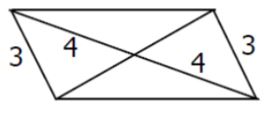
Which of the following angle pairs are supplementary? Check all that apply.
Which of the following sides are congruent? Check all that apply.
Which of the following sides are parallel? Check all that apply.
For #10-21, determine whether each statement is true or false about parallelogram ABCD below.
What is the length of CD?
What is the length of DA?
What is the length of AC?
What is the length of DB?
What is the length of CE?
What is the length of DE?
What is
What is
What is
What is
What is
What is
What is
What is
What is
What is
What is
What is
What is
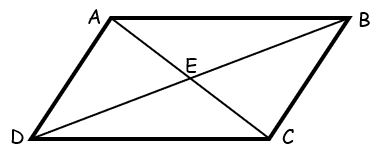
If AB = 12 and AE = 6, then DC = ______, and EC = _______. Write your answer as #, #
If AE = 9 and AD = 3, then AC = ______, and BC = _______. Write your answer as #, #
If BD = 14 and AB = 10, then BE = ______, and DC = _______. Write your answer as #, #
If
If AB = 2x + 1 and DC = 4x - 19, then find the value of x.
If BE = 6x + 1 and DE = 4x + 31, then find the value of x.
If AE = x + 1 and AC = 5x - 10, then find the value of x.
If AD = 7x - 9 and BC = 4x + 33, then find the value of x.
If AB = x + 3, BC = x - 4, and the perimter of ABCD is 6x - 20, then find the value of x.