Show your work or explain your answer where stated and there is space to do so. Use our angle pair vocabulary!
![]()
Identify pairs of angles formed by parallel lines and a transversal.

![]()
Parallel Lines: Two lines that never intersect
Transversal: Line that intersects two parallel lines
Alternate Interior Angles: Two angles on the opposite side of the transversal, inside the parallel lines
Corresponding Angles: Two congruent angles on the same side of the transversal
Alternate Exterior Angles: Two angles on the opposite side of the transversal, outside of the parallel lines
Consecutive Angles: supplementary angles inside of the parallel lines, on the same side as the transversal, also called same-side interior
Vertical Angles: Congruent angles across from each other, formed by two intersecting lines.
Straight Angle: a straight line, 180º
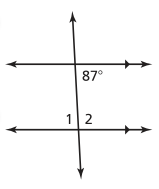
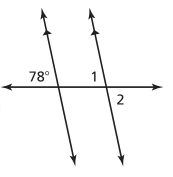
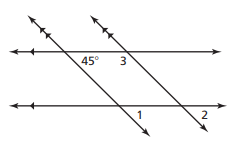
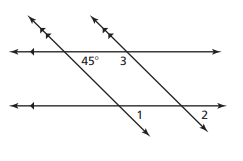
What is the measure of ∠1? Explain why using an angle pair.
State your answer, then the name of the angle pair. For example: 45, corresponding angles
What is the measure of ∠2? Explain why using angles pairs.
What is the measure of ∠1? Explain why using angles pairs.
What is the measure of ∠2? Explain why using angles pairs.
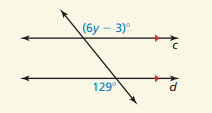
Find y. Show your work or explain your answer.
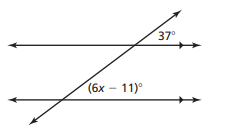
Find x. Show your work or explain your answer.
m∠1=
m∠3=
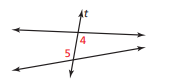
Describe the error.
Angles 4 and 5 are congruent because they are alternate interior angles.
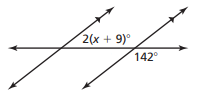
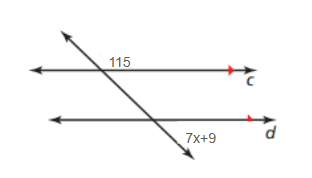
Solve for x.
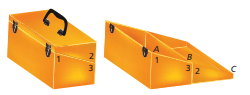
The following tool box has sides that are parallel.
m∠1 = 65º. What are the measures of angles 2 and 3? State your answer as Angle 2 = , Angle 3 = .
EXTENSION:
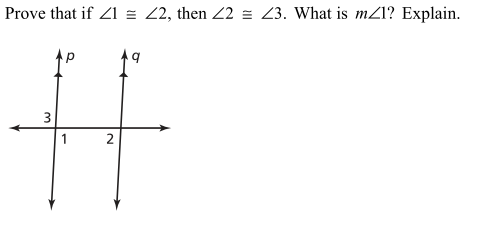
Write a prove using a statement and reason table!
EXTENSION:
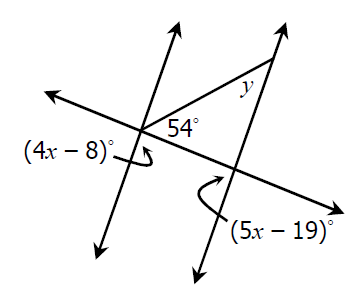
Two parallel lines are shown. Find x and y. Show your work or explain your answer.
EXTENSION:
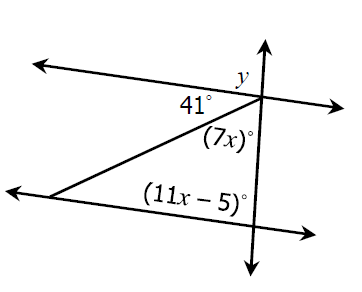
Two parallel lines are shown. Find x and y. Show your work or explain your answer.
Rate your understanding on using angle pairs and parallel lines to solve for missing angles.
Rate your understanding of using what you know about parallel lines to write a proof.