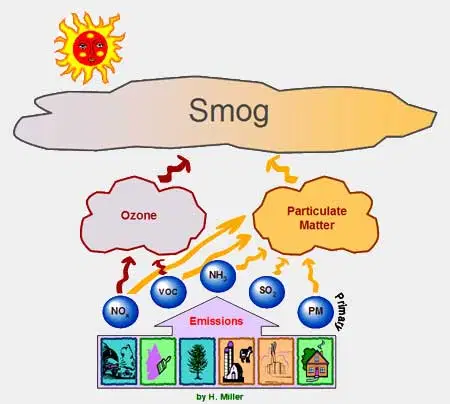
Where do volatile organic compounds (VOCs) come from?
Where do volatile organic compounds (VOCs) come from?
What are the ingredients for photochemical smog?
How can ozone be both good and bad?
What is happening to the “good” ozone layer?
How much damage can 1 Chlorine atom do?
Explain #4
How does depletion of “good” ozone affect human health and the environment?
What is being done about ozone depletion?
What causes “bad” ozone?
What are some sources of “bad” ozone?
How does “bad” ozone affect human health and environment?
What is being done about “bad” ozone?
What can we do/actions we can take to reduce our risks?
What is the current air quality index (AQI) in Houston, TX?
Scroll down to the Air Quality Index Color Chart – Write down a one-word descriptor of each color code.
List three health problems associated with “bad” ozone.
Instructions: Change the settings in the city and notice the effects that those changes have on the amount of “smog” the city produces and the air quality.
Take notes about what the various condition changes do to the AQI.
Which set of conditions produce the best possible scenario for the city?
Which set of conditions produce the worst scenario for the people, animals, and plants of the City?
How can we reduce smog? (Think about the end of the video)
Where do volatile organic compounds (VOCs) come from?