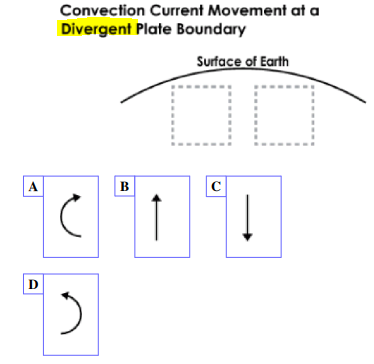
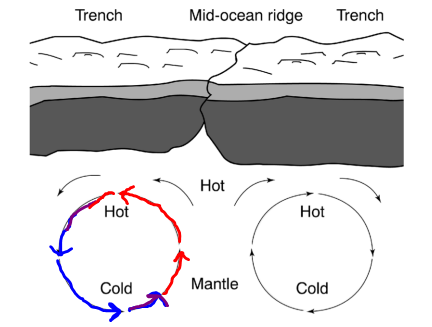
Which motion of the arrows would go in the boxes to show how the convection currents in the mantle would move at a divergent plate boundary?
Required
1 point
1
Question 2
2.
The country of Iceland sits on a boundary between two diverging tectonic plates. A geologic map of Iceland shows three regions of volcanic rock, which are different ages. The pattern of volcanic rock shows that Iceland is diverging or spreading apart.
Select the box or boxes that represent the YOUNGEST rock region.
Required
1 point
1
Question 3
3.
One type of plate boundary is Convergent.
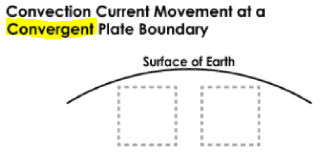
Which motion of the arrows would go in the boxes to show how the convection currents in the mantle would move at a convergent plate boundary?
Required
1 point
1
Question 4
4.
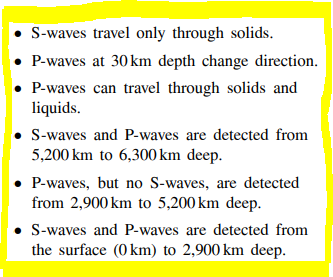
The composition of Earth from its surface to its center is 6,300 kilometers (km) down can be studied using seismic waves. There are two basic types of seismic waves, S-waves and P-waves. Students studying Earth's interior are given the following information about P and S waves and how they travel through Earth.
Select 4 statements that can be concluded from the information above:
(DRAW a picture if you need to!)
Required
1 point
1
Question 5
5.
Which feature does NOT result from seismic activity?
Required
1 point
1
Question 6
6.
The map shows the boundaries of tectonic plates in the South Pacific. Several cities on the map are labeled. A company wants to build tall skyscraper buildings in all of these cities.
Choose 3 cities where Earthquake-resistant technology would be most important in building these skyscrapers. (select the black dots with white outline.)
Required
1 point
1
Question 7
7.
Which statement about seismic waces is accurate?
Required
1 point
1
Question 8
8.
Convection currents in the mantle are driven by changes in the temperature and density of the material.
Mark the boxes that show the motion of matter as it's density and temperature changes.
as Matter moves UP toward the Upper Mantle
as Matter moves DOWN toward the lower mantle
Density Increases (more dense)
Density Decreases (less dense)
Temperature increases
Temperature descreases
Required
1 point
1
Question 9
9.
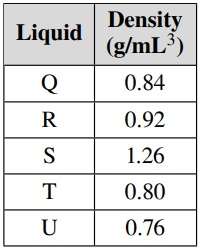
A group of students builds a model showing the process of planetary differentiation (how planets dispearse their composition), using liquids of different densities measured in grams per milliliter cubed. The table shows the liquid and their densities.
Select the 2 boxes that would demonstrate where liquid S would be located.
Required
1 point
1
Question 10
10.
The diagrams show two rock units being affected in different ways by tectonic stress. The arrows in each diagram represent the general direction of the stress.
Which diagram shows rocks responding to tectoinc stress in a way that would lead to the formation of new crust?
Required
1 point
1
Question 11
11.
Glacial and volcanic processes have helped shape the landscape in Yosemite Valley.
Mark the boxes to classify each Yosemite Valley feature as the result of either glacial or volcanic processes
Glacial Processes
Volcanic processes
Basalt flows
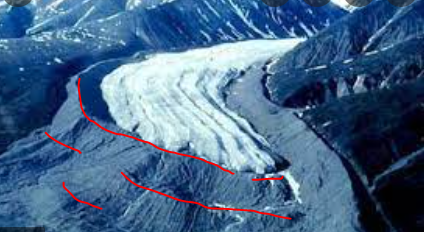
Bedrock striations
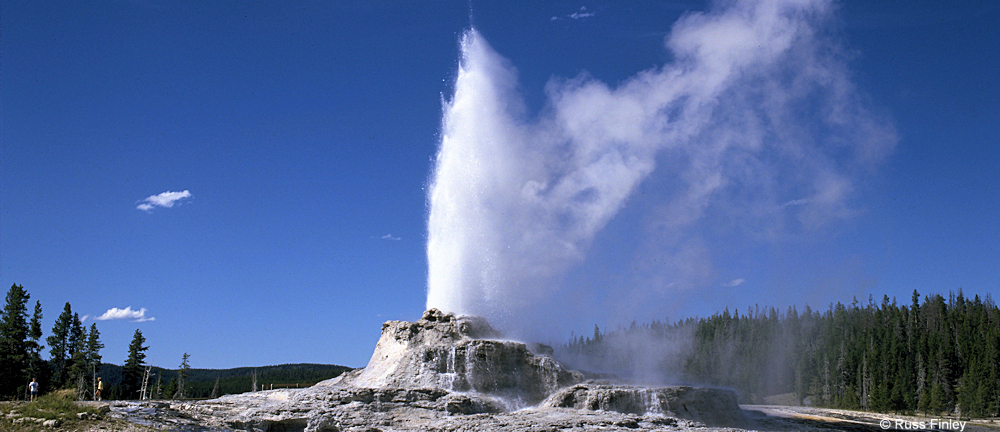
Thermal geysers (erupting hot water out of earth)
Terminal moraines
U-shaped valley
Required
1 point
1
Question 12
12.
The Hawaiian islands were formed over a "hot spot" as shown in the diagram.
Which island was formed first? (select the box of the name of the island)
Required
1 point
1
Question 13
13.
Select 3 pieces of evidence from the diagram that support your choice for which island was formed 1st.
Required
1 point
1
Question 14
14.
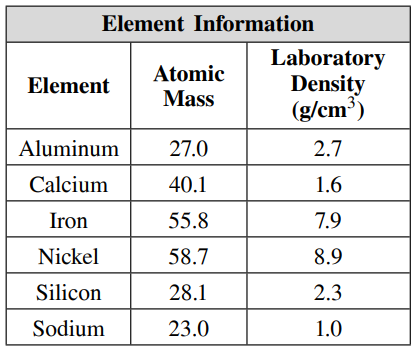
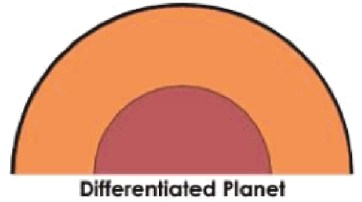
In a very young planet, also called a protoplanet, elements are distributed evenly throughout. As teh protoplanet ages, the elements separate, leading to formation of layers with different element concentrations. Some of these elements are listed in the table belwo, along with their atomic mass and laboratory Density.
Choose where each element will be in the layers (mantle & core) after the planet differentiates into layers.
Required
1 point
1
Question 15
15.
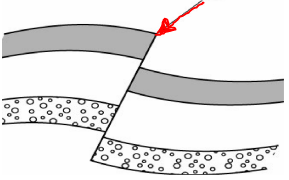
The diagram shows a geologic cross-section. Which of these does the arrow indicate/show?
Required
1 point
1
Question 16
16.
At which location would earthquakes be least likely to occur? (Click the # that is circled)
Required
1 point
1
Question 17
17.
Based on the diagram above, ________________________ are occuring in the ___________ . This process occurs when ________ magma rises to the surface because it is _______________ , allowing it to move. It will replace the _________ magma that was farther away from the heat source. Heat released from the Earth's _________ will drive the convection currents throughout the mantle and crust. The cold magma will then sink to the bottom of the mantle towards the core, due to____________ , because it is _______________ .
Other Answer Choices:
core
mantle
crust
convection currents
circle currents
less dense
hot
cold
gravity
more dense
radiation currents
conduction currents
Required
1 point
1
Question 18
18.
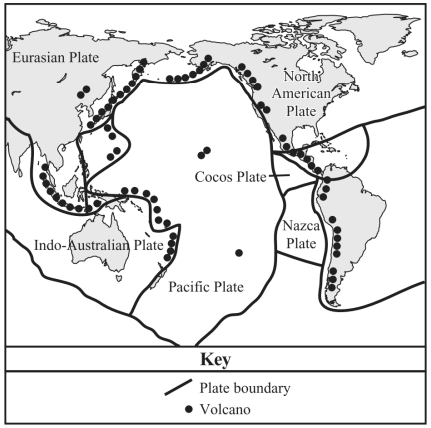
On the map below, dark circles show the position of volcanoes in the "Ring of Fire" in and around the Pacific Ocean. Dark lines indicate/show tectonic plate boundaries of Earth's crust.
Where are volcanoes most likely to form in the Ring of Fire?
Required
1 point
1
Question 19
19.
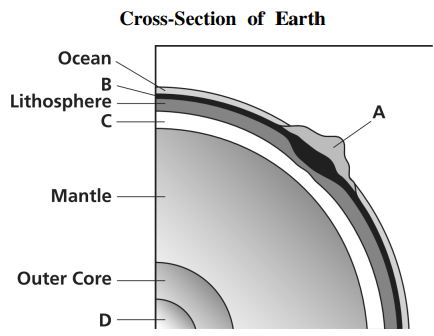
Which letter represents the location of the asthenosphere?
Required
1 point
1
Question 20
20.
The Hawaiian islands are located near the center of the pacific plate. The islands were formed as the Pacific plate moved over a hot spot located beneath the oceanic crust. This processes occurs at a slow rate. The island named Hawaii in the Southest corner is approximately 400,000 years old, the youngest of the island chain.
Select the dotted box of the OLDEST island in the diagram if the hotspot is located under Hawaii.