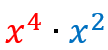
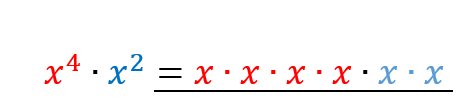
The next topic we are learning involves exponents! Let's see how much you remember...
1 point
1
Question 1
1.
1 point
1
Question 2
2.
1 point
1
Question 3
3.
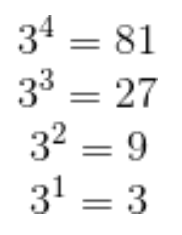
Analyze the powers with a base of 3. As the exponent decreases by 1, the numbers on the right are being divided by _______
1 point
1
Question 4
4.
According to this pattern, what do you think 3^0 equals?
3^4 = 81
3^3 = 27
3^2 = 9
3^1 = 3
3^0 = _______
1 point
1
Question 5
5.
According to this pattern, what do you think 5^0 equals?
5^4 = 625
5^3 = 125
5^2 = 25
5^1 = 5
5^0 = _______
1 point
1
Question 6
6.
65^0 =
1 point
1
Question 7
7.
Any number to the zero power will always equal _______ .
1 point
1
Question 8
8.
Let's keep this pattern going. Now that we know 4^0 = 1 what do you think 4^-1 = ?
4^4 = 256
4^3 = 64
4^2 = 16
4^1 = 4
4^0 = 1
4^-1 = _______
1 point
1
Question 9
9.
What do you think 5^-1 equals?
5^4 = 625
5^3 = 125
5^2 = 25
5^1 = 5
5^0 = 1
5^-1 =
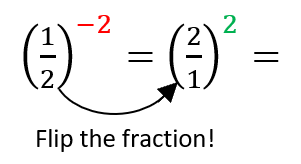
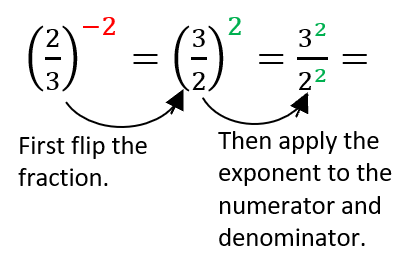
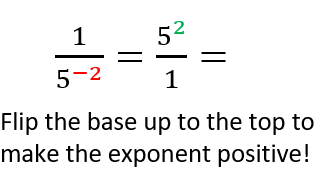
Negative exponents tell you to flip the base. You can never have a negative exponent in your answer. If you do, flip it to the denominator to make it positive!
Type in all answers as whole numbers or fractions. No decimals!
1 point
1
Question 10
10.
2^0=
1 point
1
Question 11
11.
12^-1=
Here's an example similar to #12:
1 point
1
Question 12
12.
3^-2=
Simplify completely. Your answer should not have exponents.
1 point
1
Question 13
13.
4^-2=
Simplify completely. Your answer should not have exponents.
1 point
1
Question 14
14.
(-7)^0=
1 point
1
Question 15
15.
0^6=
1 point
1
Question 16
16.
*Hint: flip the fraction to make the exponent positive. Then evaluate.
1 point
1
Question 17
17.
1 point
1
Question 18
18.
1 point
1
Question 19
19.
Hint:
Fraction answers only, no decimals!
1 point
1
Question 20
20.
1 point
1
Question 21
21.
1 point
1
Question 22
22.
1 point
1
Question 23
23.
Hint:
1 point
1
Question 24
24.
1 point
1
Question 25
25.
1 point
1
Question 26
26.
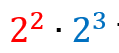
Let's expand and look for a shortcut:
How many 2's are underlined? _______
1 point
1
Question 27
27.
Let's expand and look for a shortcut:
How many x's are underlined? _______
1 point
1
Question 28
28.
Therefore, we can say,
1 point
1
Question 29
29.
1 point
1
Question 30
30.
Hint: The second y has an invisible exponent of 1
1 point
1
Question 31
31.
1 point
1
Question 32
32.
What's the rule?
Example similar to #33:
Notice how we still multiply the coefficients (3 x 2) but add the exponents.
1 point
1
Question 33
33.
Now you try!
1 point
1
Question 34
34.
Let's expand and look for a shortcut:
How many 2's are underlined? _______
1 point
1
Question 35
35.
Let's expand and look for a shortcut:
How many x's are underlined? _______
1 point
1
Question 36
36.
Therefore, we can say:
1 point
1
Question 37
37.
1 point
1
Question 38
38.
1 point
1
Question 39
39.
Hint: z has an invisible exponent of 1
1 point
1
Question 40
40.
What's the rule?
Here's an example similar to #41:
1 point
1
Question 41
41.
Now you try!
1 point
1
Question 42
42.
Therefore, according to the last example we can say:
So when we divide by the same base we _______ the exponents.
1 point
1
Question 43
43.
1 point
1
Question 44
44.
1 point
1
Question 45
45.
What's the rule?
Example similar to #46:
1 point
1
Question 46
46.
Now you try!
Example similar to #47:
Notice how we still divide the coefficients (15 / 5) but subtract the exponents.
1 point
1
Question 47
47.
Now you try!
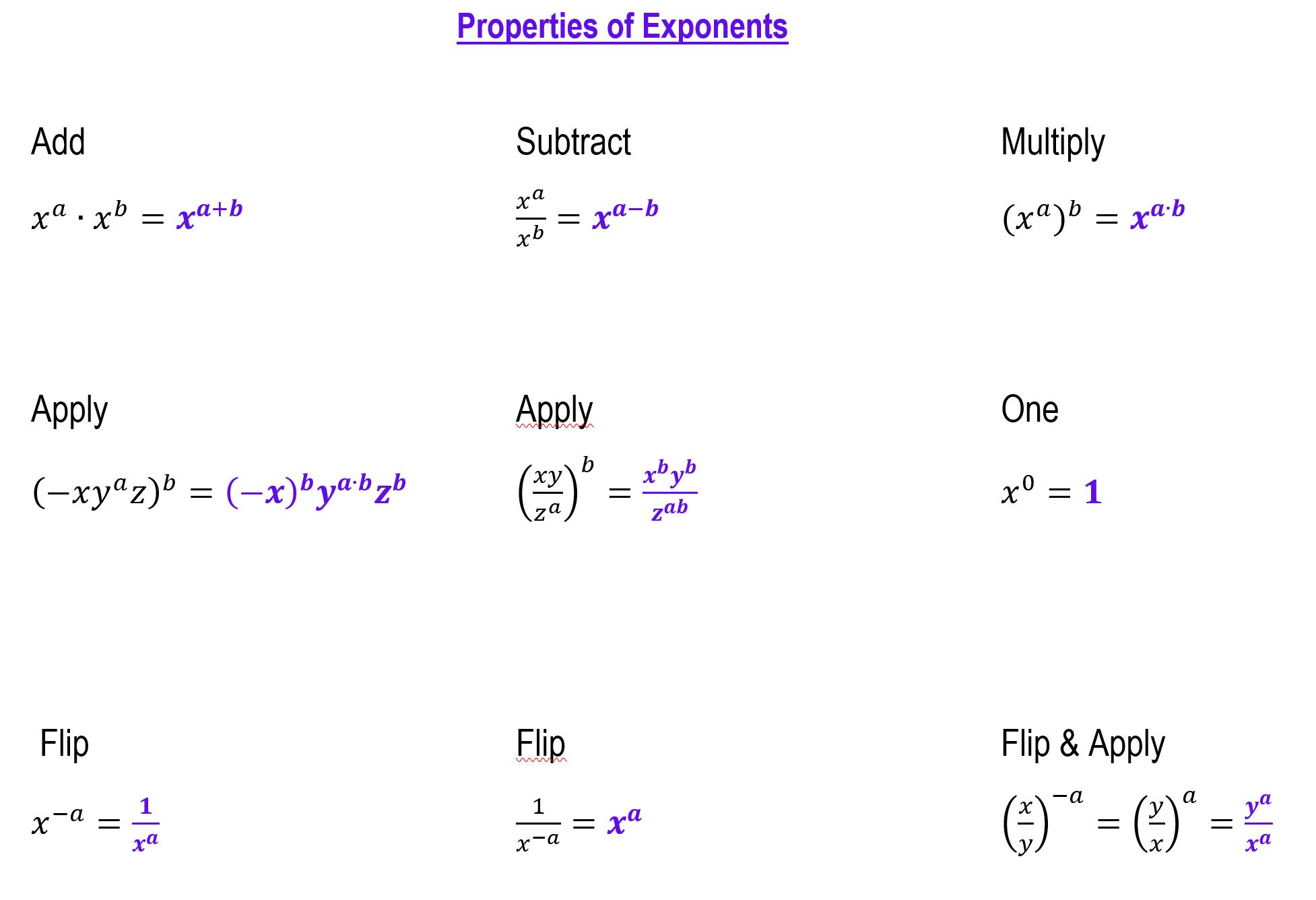
Below are all the exponent rules you re-learned today.