Look at the diagram below.
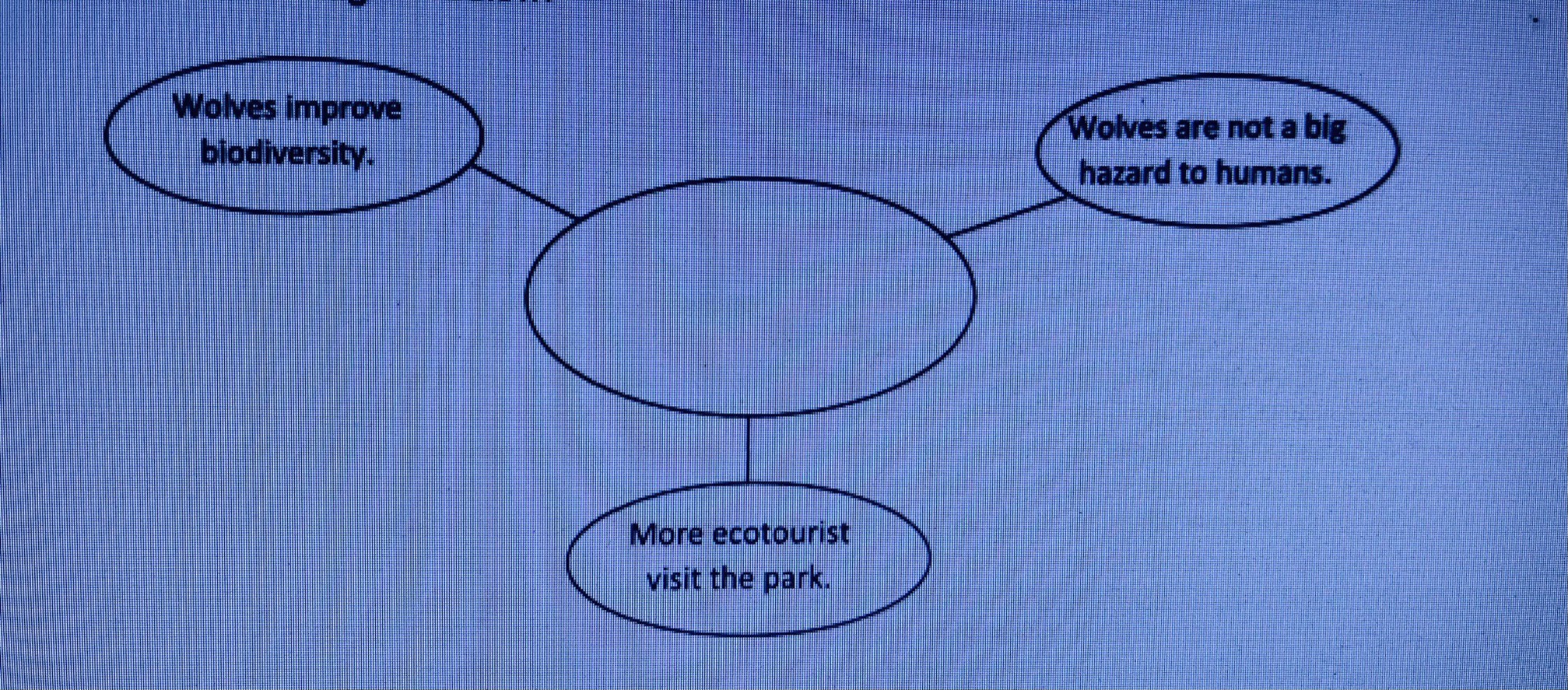
Which of these completes the diagram?
Look at the diagram below.
Which of these completes the diagram?
RI.3.1 Analyze Text Structure
RI.3.4 Vocabulary
RI.3.9 Compare and Contrast Texts
RF.3.3c VCe Syllable Pattern Multisyllabic
L.3.2d Plural Possessive Nouns
L.3.5 Figurative Language
W.3.2 Informative Writing
Which word is an antonym of solitary in paragraph 3?
Look at the diagram below.
Which of these completes the diagram?
The map below paragraph 1 is included to show the reader...
CAUSE: ?
EFFECT: The population of elk increased in Yellowstone National Park.
Which sentence is the cause for the given effect?
In paragraph 12, what did the author most likely mean when she said that the "big bad wolf is a myth?"
In paragraph 1, the word eliminate means...
Which of the following sentences is an opinion stated in the story?
What is the meaning of the word reintroduced as it is used in paragraph 12?
According to the selection, the reason why the cattle are so slim is because...
The author wrote this selection most likely to...
Vocabulary
Directions: For numbers 11-15, choose the word or word group that has about the same meaning as the underlined word.
The snake lived in a forest habitat.
Word Study
Directions: For numbers 16-20, choose the word that has the same long vowel sound as the boldfaced word.
dislike
Reading Comprehension
Directions: Read the selections. Then answer each question.
1) Do zoos add to a community? There are those who would say no. But, in fact, zoos are helpful for animals, especially those that are endangered, or in danger of disappearing forever. Zoos can help protect them and keep them safe.
2) Early zoos were often nothing more than cement cages with bars. But today, more and more zoos are working to create areas that look very much like an animal's habitat in nature.
3) Workers at zoos want to help animals. If an animal becomes hurt or sick, zoos have special doctors to help them get better. Zoos make it possible for animals to raise their young in a safe place. This helps animals that are endangered as they struggle to survive.
1) For years, most people did not really stop to think about the ways zoos affect animals. It's true that zoos give people a place to learn about animals. But more and more people are questioning the idea of putting animals in zoos.
2) No matter how hard zoos work to make a zoo habitat similar to a natural habitat, they cannot succeed completely. This is because, in many cases, the needs of animals cannot be met. For example, elephants and giraffes in the wild travel and run great distances. They cannot do that in a zoo.
3) One reason people say zoos are needed is because they can help animals that are in danger of disappearing. But some animals simply do not do well in a zoo. Putting those animals in zoos is not fair.
4) Even though zoos want to help animals, there are too many problems. It is time for zoos to close.
Based on the selections, explain two different opinions that people have about zoos. Write your response using complete sentences and correct capitalization and punctuation.
Writing - Informational
There are many ways a zoo can care for animals. Write a brief how-to article that explains what you think zoo workers should do to provide the best care for animals. Remember the characteristics of informational articles as you write.
Hint-
1) Engaging introduction
2) Include a list of steps explaining what zoo workers should do to care for animals.
3) Conclusion
Directions: Read the selection and answer the question.
A Theater in the Community
You take your seat in a huge hall. Your heart is racing. The lights lower, the whispers stop, and the show begins. You will not see a movie, though. You are at a community theater, the most exciting show in town! You can watch live actors perform on stage at a community theater. Most of the time, the actors are people from your town. You might see your teacher dressed up as a wolf. Your librarian could be a princess. Normal people can be stars. That is one of the best parts of community theaters. Theater is better than movies. That is because a play happens right in front of your eyes. Interesting sets and costumes help you imagine new worlds. Plays can make you laugh or cry. Plays with songs can get your feet tapping. Some stories are based on fact. Other stories are made up. Either way, it is a lot of fun. There are many benefits of community theater. People of all ages can get involved. Of course, a lot of people get nervous on stage. That’s called “stage fright.” With practice, this nervousness goes away. There are plenty of ways to help at a theater, even if you don’t want to act. People are needed to paint the set. Sometimes theaters need people to play music. Even watching the show is important. After all, someone has to clap at the end!
What is the author’s opinion about people being involved in community theater, even if they don’t want to act?
The solitary shark lived in the aquarium.
The number of mice multiplied.
The farmer eliminated all the weeds in the pumpkin patch.
Which phrase is a synonym for reintroduced in the sentence below?
The gray wolf was reintroduced to the ecosystem.
mistake
tadpole
amuse
The word with the same long vowel sound as inhale is -
Which sentence from the first selection explains a claim or main argument from "Yes to Zoos!"?
Which statement from "No to Zoos!" contains a fact about the topic?
The two selections agree about the idea that -
Which sentence supports the author’s claim that anyone can get involved in community theater?
Which statement from the selection is a fact that supports the author’s claim that community theater is a good place to see a play?
Which claim is meant to persuade the reader that community theater is enjoyable?
Which sentence from the selection presents an opinion about the benefits of community theater?