Franz Liszt: Piano Terminator
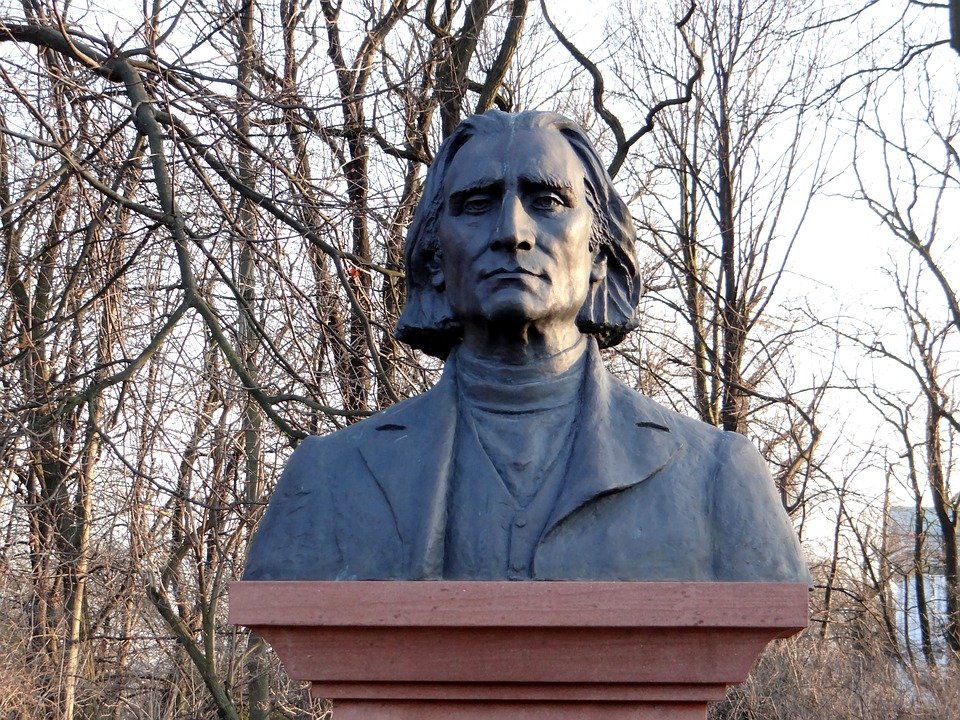
Franz Liszt was born in 1811 in Hungary. At the age of 11 he moved to Vienna. There he met Schubert and Beethoven while studying music. While he was in his teens and twenties, he lived in Paris. While there, Liszt heard the great violin virtuoso, Paganini, and declared that he wanted to be as great a virtuoso on the piano as Paganini was on the violin. He had been performing on concert stages already, but at age 19 he withdrew from the concert stage for a few years and practiced from 8 to 12 hours a day. When he came out of seclusion, Franz Liszt became one of the greatest pianists of his time. He toured Europe for eight years, playing most of his own piano music and receiving tremendous acclaim.
Liszt was known as a great performer who could go through as many as two or three pianos in a concert. The pianos of that time were not nearly as sturdy as the pianos that we have today, and Liszt was a very physically strong player. Often, by the end of one relatively long piece of music they would have to replace the piano that he had been playing with a new one so that he could continue his concert. This knack that Liszt had for destroying pianos gave him a reputation that would have earned him a name in our day as a piano “terminator.” When Liszt was 36, he decided to no longer travel and perform as a soloist. Instead, he wanted to stay in one place and become a conductor. During this time he composed and conducted many of his own orchestral pieces as well as works of his contemporaries such as Berlioz, Schumann, and Wagner. He was also an active music critic and wrote several books. In his last years, Liszt wrote music that was unique and curious. It showed hints of what might be coming in twentieth-century music. However, these works went very much unappreciated, and Franz Liszt died in 1886. Of him the Grand Duke of Weimar said, “Liszt was what a prince ought to be.”