The primary objective of this experiment is to determine the relationship between the pressure and volume. The gas we use will be air, and it will be confined in a syringe.
For the experiment, the syringe is connected to a Gas Pressure Sensor. When the volume of the syringe is changed by moving the piston, a change occurs in the pressure exerted by the confined gas. This pressure change will be monitored using a Gas Pressure Sensor. It is assumed that temperature will be constant throughout the experiment. Pressure and volume data pairs will be collected during this experiment and then analyzed. From the data and graph, you should be able to determine what kind of mathematical relationship exists between the pressure and volume of the confined gas.
For this experiment, the number of air molecules inside the syringe should remain constant since it is sealed.
OBJECTIVES In this experiment, you will
Use a Gas Pressure Sensor and a gas syringe to measure the pressure of an air sample at several different volumes.
Determine the relationship between pressure and volume of the gas.
Describe the relationship between gas pressure and volume in a mathematical equation.
Use the results to predict the pressure at other volumes.
MATERIALS 20 mL gas syringe, LabQuest, Vernier Gas Pressure Sensor, Chromebook w/Vernier Logger Pro
PROCEDURE- Boyle’s Law You may need to install Graphical Analysis https://chrome.google.com/webstore/detail/vernier-graphical-analysi/dncgedbnidfkppmdgfgidcepclnokpkb
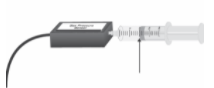
1. Connect the LabQuest Mini to the Gas Pressure Sensor and to the Chromebook.
2. Open Vernier App Collect with Sensor → Bottom corner click on MODE. Change to EVENT BASED → with ENTRY, change the Event name to VOLUME with the appropriate unit.
With the 20 mL syringe disconnected from the Gas Pressure Sensor, move the piston until the front edge of the inside black ring (indicated by the arrow in Figure 1) is positioned at the 10.0 mL mark.
Attach the syringe to the white stem on the Gas Pressure Sensor box with a gentle half-turn.
3. Collecting the pressure vs. volume data. For each volume measurement you will need to add 0.8mL to your reading to account for the volume of air trapped in the sensor. 📷
a. Start data collection COLLECT
b. Move the piston to position the front edge of the inside black ring at the 5.0 mL line on the syringe. Hold the piston firmly in this position until the pressure value stabilizes.
c. When the pressure reading has stabilized, click KEEP. Type 5.8 in theVOLUME box. Select KEEP POINT to store this data. Note: You can redo a point by pressing the ESC key (after clicking KEEP, but before entering a value).
d. Continue the procedure for a total of 7 volumes between 5-20 mL.
e. Click STOP when you have finished collecting data.
4. Copy your data in the table. Save your data (UNTITLED→ SAVE AS) to your drive since you will need the graph for the analysis.