EH: 2.2 (2/28)
star
star
star
star
star
Last updated about 3 years ago
6 Nsɛmmisa

0
0

0
0
0
4
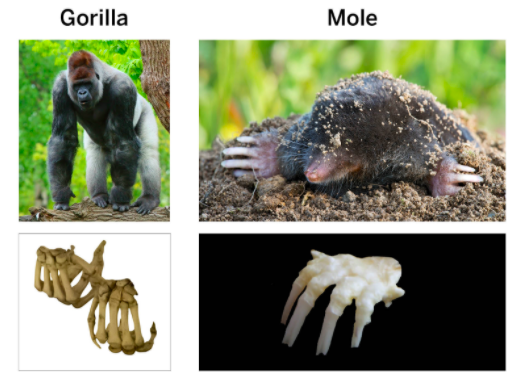
Why do you think the western gorilla’s hands are shaped the way they are? What does the western gorilla use its hands to do?
Why do you think the European mole’s hands are shaped the way they are? What does the European mole use its hands to do?
Chapter 1:
Speciation Evolution is not just a thing of the past—it’s happening all the time. That means new species are still evolving today. There are many ways in which species can evolve, but one type of evolution occurs when one species is divided into more than one population living in different environments. If these populations live in different environments for many, many generations, they may evolve so many differences that they are no longer the same species. What used to be populations of the same species become populations of different species.
The process of one species evolving into two or more different species is called speciation. Speciation often starts when populations are separated by a barrier, such as a body of water or a mountain range. After they are separated, the populations don’t encounter one another regularly anymore. They become separate populations, and over time they may evolve into different species. To learn more about some populations that were divided into very different environments and became different species, choose one of the chapters that follow.
Chapter 2: Galápagos Tortoises
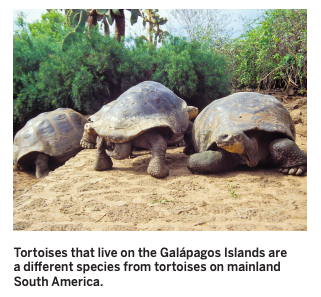
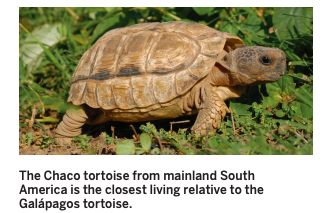
Tortoises have lived in South America for many millions of years. About 3 million years ago, some tortoises living in South America floated about 1,000 kilometers (more than 600 miles) across the Pacific Ocean from the mainland of South America to the Galápagos Islands. Unlike turtles, tortoises can’t swim—so once they arrived on the islands, the tortoises never left! The population of tortoises that floated to the islands became permanently separated from the population of tortoises on the mainland.
The islands had different environments than the mainland environment, so different traits were adaptive—helpful for survival—for the island tortoises than for the mainland tortoises. Some of the islands had desert environments, where food was scarce. Over many generations, the population of tortoises on the Galápagos Islands evolved specialized shells, as well as changes to some other body structures. Meanwhile, the environment on the South American mainland didn’t change much over time, so the structures of the tortoise population there remained relatively stable. They stayed about the same as the structures of their common ancestors. Today, the structures of Galápagos tortoises are so different from the structures of mainland tortoises that they would not reproduce with each other even if they were brought back together. These two populations that once came from a shared common ancestor population are now different species.
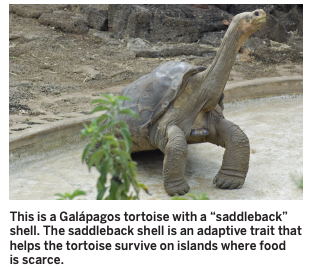
Natural selection acted on the populations of tortoises in mainland South America and in the Galápagos. All tortoises have a random chance of being born with a mutation that can change the shape of their shells. Millions of years ago, some Galápagos tortoises were born with this mutation and had shells that curved upward at the neck. The curved shape made more space for the tortoises’ necks and allowed them to reach up high. This mutation was an adaptive trait on the Galápagos Islands with desert environments where food was scarce: it helped tortoises with the curved shell structure survive by reaching leaves higher up and getting more food. As the mutation for the curved shell was passed down by tortoises that had been born with it, curved shells became more common in the Galápagos tortoise population over many generations.
Changes that result in one species becoming two do not happen with just one generation. The Galápagos tortoises did not become a new species as soon as they arrived at the islands; it took a long time. Speciation takes place slowly as mutations build on one another, adding up to big changes in structure.
How did the tortoise population get separated from the rest of the population?
CFS:
student describes speciation and separation in changing species population.
uses the best source of evidence to support their response.
How did the Galapagos Tortoise evolve to have such different shells?
CFS:
student describes speciation and separation in changing species population.
uses the best source of evidence to support their response.
Why did the other population in the article stay mostly the same (stable)?
CFS:
student describes the relationship between anatomical similarities and differences in animal species
student describes the environmental changes that cause traits to become adaptive over time
One of the populations that was separated had structures that changed over time. Describe the changes that happened and why they happened?
CFS:
student describes the environmental changes that cause traits to become adaptive over time in population 1
student describes the relationship between anatomical similarities and differences in animal species in poulation 1
student describes the environmental changes that cause traits to become adaptive over time in population 2
student describes the relationship between anatomical similarities and differences in animal species in poulation 2