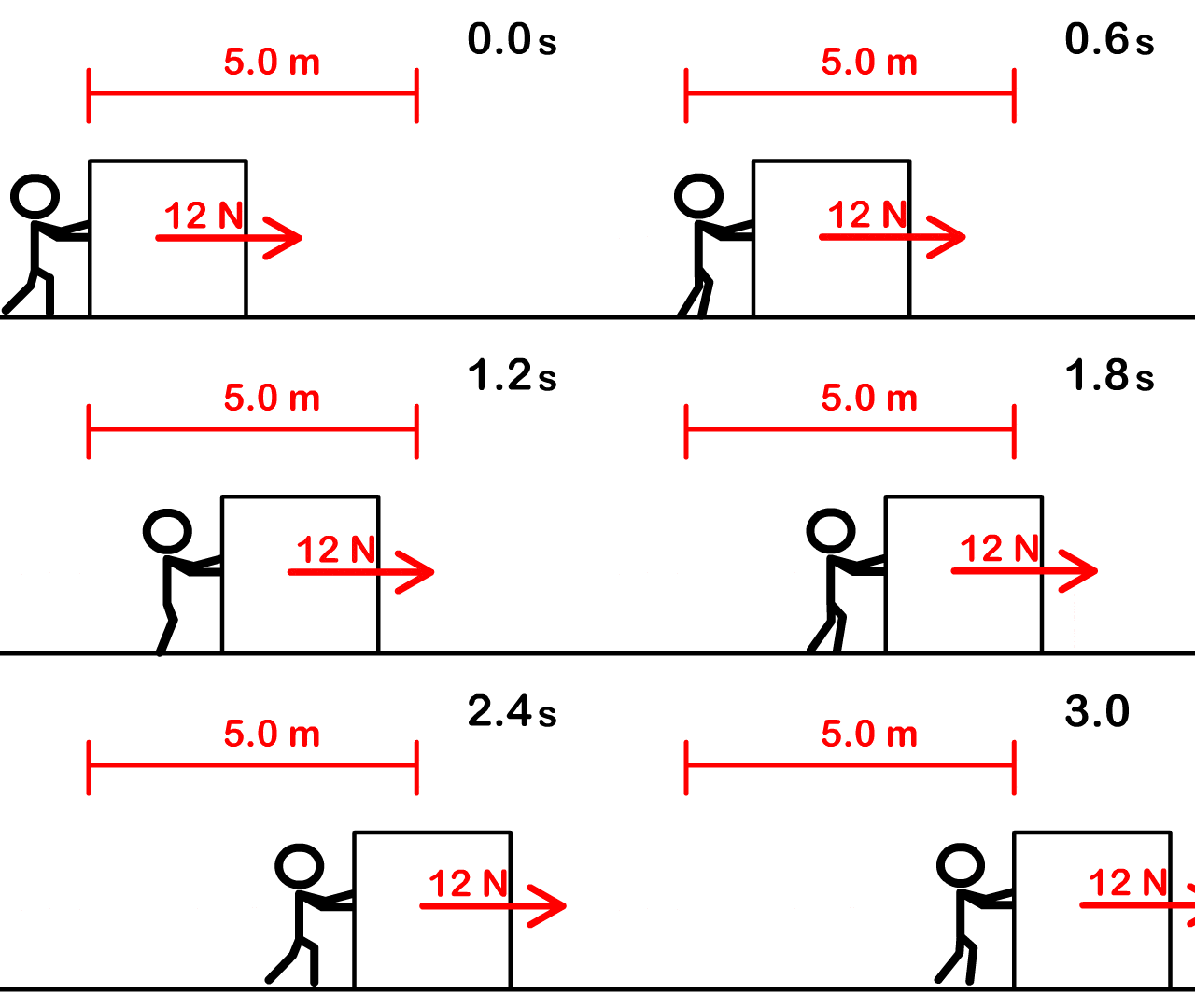
Describe how you know that work was done in this GIF.
Describe how you know that work was done in this GIF.
Describe how you know that work was done in this GIF.
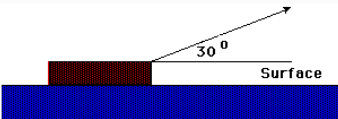
A force of 30 N acts on the block at the angle shown. The block moves a horizontal distance of 37 cm. How much work is done by the applied force? (Show your work for feedback!)
What is the 'theta angle' AND how do you know?
Calculate the work done by a 22-N force (directed at a 40° angle to the vertical) to move a 5-kilogram box a horizontal distance of 500 cm across a rough floor at a constant speed of 0.7 m/s. (LOST? Confused?: Go back to the slideshow, and read the very last slide and the speaker notes at the bottom.) (Make sure you show your work for feedback!)
In your own words, describe what potential energy is. (Be ready to defend your answer.)
If you double the height above the zero position, then you the PEgrav.
There is a ball that is 30m above the zero line that has a mass of 55kg. The ball current PEgrav =
If you double the amount of compression of a spring relative to its equilibrium position, then you the PEspring.
"An object possesses elastic potential energy if it is at a position on an elastic medium other than the equilibrium position."
Interpret this sentence and give 2 real-life examples of its meaning.
When you quadruple the speed of the object, you its KE by a factor of .
When you reduce the speed of the object by a factor of 3, you its KE by a factor of .
Write a statement that best summarizes the relationship between the initial release height and the speed at the bottom of the hill in the lab activity.
Determine the kinetic energy of a 740-kg roller coaster car that is moving with a speed of 19.1 m/s.
Olver Weightver, the former platform diver for Harrison, had a kinetic energy of 21,000 J just prior to hitting the Pool. If Olver's mass is 140 kg, then what is his speed?
Give one example of mechanical energy, and then justify why your example definitly has mechanical energy.
KE to PE or PE to KE? How do you know?
A shopping cart full of groceries is sitting at the top of a 3.0-m hill. The cart begins to roll until it hits a stump at the bottom of the hill. Upon impact, a 0.5-kg can of peaches flies horizontally out of the shopping cart and hits a parked car with an average force of 100 N. How deep a dent is made in the car (i.e., over what distance does the 100 N force act upon the can of peaches before bringing it to a stop)?
A 1200-kg car traveling with a speed of 25 m/s skids to a stop. The car experiences a 1000 N force of friction. Determine the stopping distance of the car.