APES FRQ Practice - Forestry and Aquaculture

Last updated over 3 years ago
18 questions
Note from the author:
Directions: The suggested time for answering this question is about 22 minutes. Where calculations are required, clearly show how you arrived at your answer. Where explanation or discussion is required, support your answers with relevant information and/or specific examples.
FRQ #1 - Forestry
Forests are often considered a commons or a shared resource. They can often experience the tragedy of the commons.
1

Explain the tragedy of the commons.

1

Describe one potential approach to reducing the occurrence of the tragedy of the commons in forests.

1

Identify a negative effect of increasing pest populations in forests or agriculture areas.

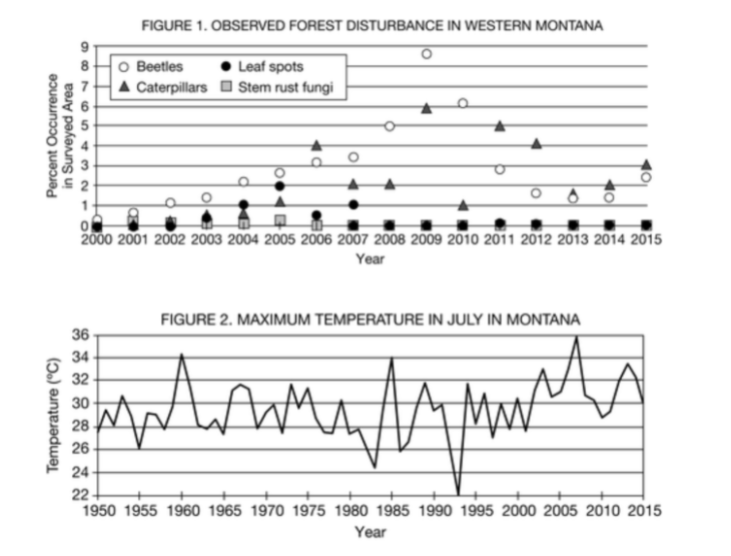
Figure 1 shows the occurrence of several different forest pests in western Montana identified by aerial surveys from 2001 to 2015. Figure 2 shows the average temperature in July in Montana from 1950 to 2015.

1

Identify the year when leaf spots were found in the highest percent of the surveyed area.

1

Describe the trend for the occurrence of caterpillars in forests in western Montana from 2010 to 2013.

1

Explain what the data in both graphs imply about the relationship between temperature and beetle survival.

Methods to protect forests from pathogens and insects include using integrated pest management (IPM).
1

Identify one method of IPM that is used to control pests.

1

Integrated pest management can be used in sustainable forest management to control pests, rather than removing affected trees. Justify the use of IPM as an alternative to removing affected trees by explaining a potential advantage of IPM in forest other than pest control.

In addition to affecting forests, pests can affect agricultural areas.
1

Make a claim that proposes a solution other than IPM to the problems of pests in agriculture.

1

Describe a possible disadvantage of an unintended consequence of the solution proposed in part I.

FRQ #2 - Aquaculture

1

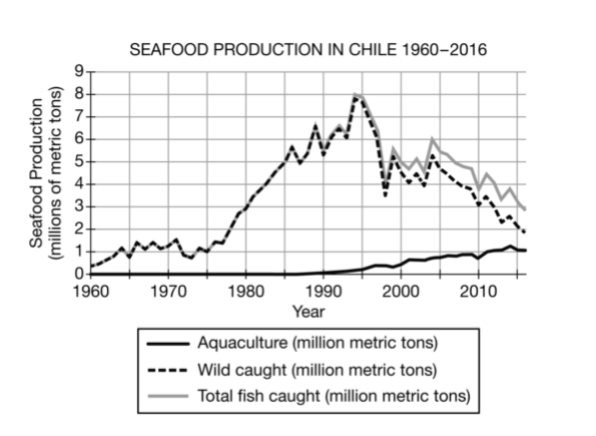
Based on the graph, describe the trend in production from aquaculture in Chile between 1995 and 2010.

1

Based on the graph, identify the range of years in which approximately all seafood produced in Chile was wild caught.

1

Explain one possible reason for the change in wild-caught fish production in Chile from 2005 to 2016.

1

Primary consumers, like clams and scallops, and secondary consumers, like salmon and shrimp, are both harvested in the wild and raised in aquaculture.
A shopper in the seafood section of their market believes that purchasing farmed shrimp is a better choice for the environment than purchasing farmed scallops. Make a claim using evidence that supports or refutes this assertion.

1

Another shopper believes that purchasing farmed salmon is a better choice for the environment than purchasing wild-caught salmon. Make a claim by citing an environmental problem associated with one of the options that supports or refutes this assertion.

1

Propose a solution to the environmental problem you cited in part (e).

1

For the solution you proposed in part (f), describe one disadvantage or unintended consequence that could result.

1

Most wild fish populations belong to the public and not to individuals or individual countries. Explain how this public ownership can lead to an environmental problem.