Look at the diagram below.
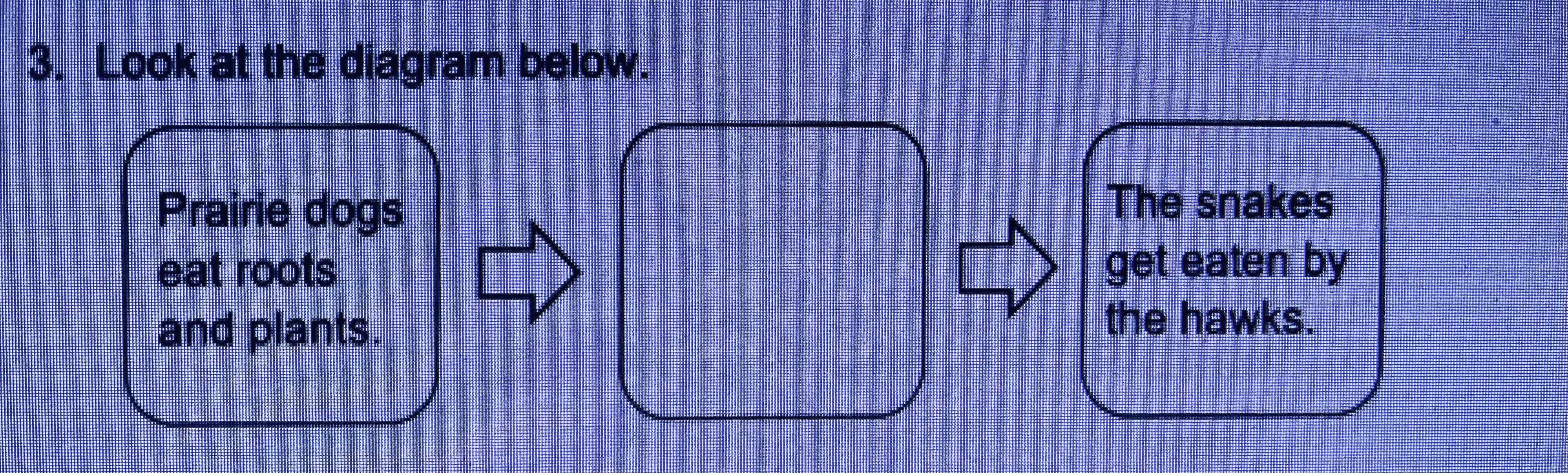
Which of the following choices completes the diagram?
Look at the diagram below.
Which of the following choices completes the diagram?
RI.3.1 Visualize Details; Author’s Purpose
RF.3.3c Contractions
L.3.1d Main Verbs and Helping Verbs
L.6 Vocabulary
W.3.2 Informative Writing
Which sentence best states the central idea of the selection?
In paragraph 5, the word interdependence means -
Look at the diagram below.
Which of the following choices completes the diagram?
According to the selection, long ago swimming birds were...
Which sentence from the selection expresses an opinion?
Which word is an antonym of camouflage in paragraph 13?
The author wrote this selection most likely to...
In paragraph 7, the author compares a quilt's unique piece to...
What is the meaning of the word adaptations as it is used in paragraph 13?
According to the selection, what are some things that environmentalists do to save the plant's and animal's habitat?
Vocabulary
Directions: For numbers 11-15, choose the word or word group that has about the same meaning as the underlined word or phrase.
Many animals survive through interdependence.
Word Study
Directions: For numbers 16-20, choose the word that correctly shortens each boldfaced phrase into a contraction.
do not
Reading Comprehension
Directions: Read the selection. Then answer each question.
1) There are many kinds of fruits and seeds-apples, berries, and acorns, to name a few. These fruits and seeds are tasty treats for all different kinds of animals. An animal sees the bright colors and eats the fruit, which contains seeds. But some fruits and seeds are not meant to be eaten by animals. Instead, the fruit becomes attached to an animal and catches a ride.
2) It is very difficult for two plants to grow in the same spot. They have to constantly fight for the same water, nutrients, and sunlight. Plants need their seeds to be spread around so that new plants can grow in different places.
3) But plants can't do this by themselves. They depend on other things to help them. Some plants depend on the wind to blow their seeds to new places. Some plants depend on animals to move their seeds to new places. When an animal eats a fruit such as an apple, it eats the seeds, too. The animal moves somewhere else as it continues to search for food. The seeds move through the animal and drop to the ground. Then the seeds can grow in a new place.
4) Plants like Enchanter's Nightshade have a different kind of fruit. Their fruits are very small and furry, like a tear-shaped fluff ball. But the furry "hairs" on these fruits have tiny hooks. These hooks help the fruit attach to anything that passes by, such as a deer grazing on the grass or a rabbit hopping through the a field. The animal probably won't even know it-the fruit has gotten a free ride!
5) Soon, the deer or rabbit will move to a new place and the Enchanter's Nightshade fruit will fall off. The seeds inside the fruit can then grow into new plants. Plants spread their seeds in different ways, but the goal is always the same-to allow new plants to grow in many places.
Explain how the author's use of descriptive details and imagery add to this selection. Use text evidence from the selection in your explanation. Write your response below. Be sure to use complete sentences with correct capitalization and punctuation.
Writing - Informational
Animals and plants rely on each other for many different reasons. Write a brief how-to article for a plant that explains how the plant might help an animal.
Be sure to include an introduction, a list of steps explaining how a plant might help an animal, and a conclusion.
Directions: Read the selection and answer the question.
Our Solar System
On a clear summer night, you can look up and see a blanket of stars covering the sky. If you are lucky, you will also be able to see a planet or two. It may seem like the stars are just out of reach, but they are very far away. The closest star to us is the sun, which is the center of our solar system. The solar system is made up of the sun, eight planets, other objects going around it, and a whole lot of nothing in between. Let’s take a brief journey through our little corner of the universe. The sun is the largest object in our solar system. It is so big, it could contain more than a million Earths. Each planet moves around the sun. The smallest planet, Mercury, is at the front of the line. It only takes 88 days for Mercury to travel around the sun. Venus is farther from the sun than Mercury, but it is the hottest planet. It is sometimes called “Earth’s sister” because it is close in size and shape to Earth. Earth, our home, is the only planet known to have life. The next planet, Mars, is known as the “Red Planet” because of its color. Jupiter is the largest planet. It has a red spot that is roughly the size of Earth. Next comes Saturn. You might know about Saturn’s rings, but did you know they are made out of floating rocks and ice? Uranus is the only planet that spins end over end, like a rolling soccer ball. Neptune is the farthest planet from the sun. It is dark and cold, and strong winds are always blowing. It takes Neptune 165 Earth years to go around the sun just once.
The selection states that our solar system has eight planets. How does that relate to the author’s purpose for writing the selection?
Forest animals and plants are part of a food chain.
Spotted skin can camouflage a frog from its predators.
Animal adaptations take place over time.
Which phrase is a synonym for biodiversity in the sentence below?
There is a great amount of biodiversity in the ocean.
you are
can not
that is
The contraction we're combines and shortens -
Which sentence or sentences from the selection best shows the author's purpose?
Which sentence in paragraphs 2 and 3 does the author use to show why it is important that seeds do not land near each other?
In paragraph 4, the author uses the simile "like a tear-shaped fluff ball" to -
The author includes the detail, “…it is so big, it could contain more than a million Earths” to make a comparison. This helps the reader to —
What detail from the selection does the author use to describe all the planets in the solar system?
Which sentence from the selection contains a detail about a planet that supports the author’s message that each planet is unique?
The author most likely wrote the selection to —