Introduction to the Discriminant

Last updated over 3 years ago
15 questions
In our previous lesson you learned that the Quadratic Formula can be used to solve quadratic equations that CAN'T be solved by factoring (has two or three terms) or by square roots (has an ax^2 term and a c term).
The Quadratic Formula can ALWAYS be used on any quadratic equation!
Review the quadratic formula below:

Required
1

The part of the quadratic formula that is under the square root (radical) symbol is:
Type your answer in below using the MATH KEYBOARD.

Required
1

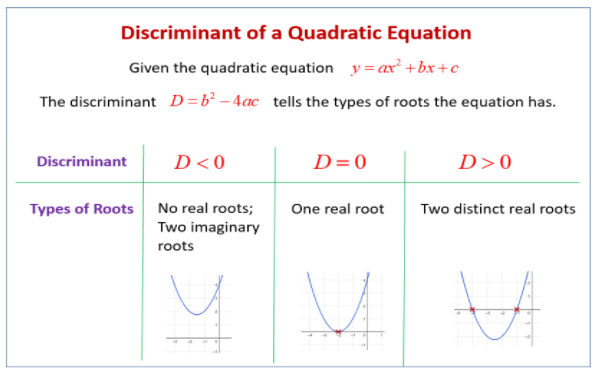
The part of the quadratic equation that is under the square root symbol (radical) is called the Discriminant.
Select the quadratic formula below:

When you calculate the discriminant it gives you information on:
  1. What the graph will look like.
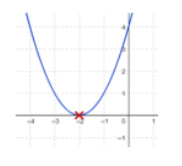
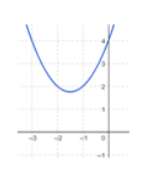
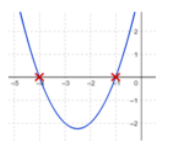
  2. The number of Real or Imaginary Solutions (or roots)
Carefully look over the following information about three possible scenarios for the solutions of a quadratic equation:
Required
1

What does the discriminant tell you?

Required
1

Match the different possiblities for the value of the discriminant (D) with the type of roots (solution) the equation will have.

Draggable itemCorresponding Item
No real roots; Two imaginary roots.
D>0
Two distinct real roots.
D=0
One real root
Required
1

Drag the items under the correct category:

  • One real root or solution.
  • No real roots or solutions.
  • Two imaginary roots.
  • Two distinct real roots.
You will now practice calculating the value of the discriminant for different quadratic equations.
REMEMBER:
when solving a quadratic equation you ALWAYS need to make sure it is set equal to 0 first
AND
the equation needs to be in standard form:


NOW you know the values for a, b and c.
NOW you can set up the discriminant to find the value.

Try the equations below:
Required
1

Remember:


Calculate the discriminant, show your work in your Notes 5.2 packet page 4, #11.
Enter your answer below:

Required
1

Based on your answer for #6 above, what do you know about the solutions (or roots) for the quadratic equation?

Required
1

Remember:


Calculate the discriminant, show your work in your Notes 5.2 packet page 4, #12.
Enter your answer below:

Required
1

Based on your answer for #6 above, what do you know about the solutions (or roots) for the quadratic equation?

Required
1

Remember:


Calculate the discriminant, show your work in your Notes 5.2 packet page 4, #13.
Enter your answer below:

Required
1

Based on your answer for #6 above, what do you know about the solutions (or roots) for the quadratic equation?

Required
1

Remember:


Calculate the discriminant, show your work in your Notes 5.2 packet page 4, #14.
Enter your answer below:

Required
1

Based on your answer for #6 above, what do you know about the solutions (or roots) for the quadratic equation?

Required
1

Remember:


Calculate the discriminant, show your work in your Notes 5.2 packet page 4, #15.
Enter your answer below:

Required
1

Based on your answer for #6 above, what do you know about the solutions (or roots) for the quadratic equation?