Use the Mohs Hardness Scale to answer the following questions 21-24
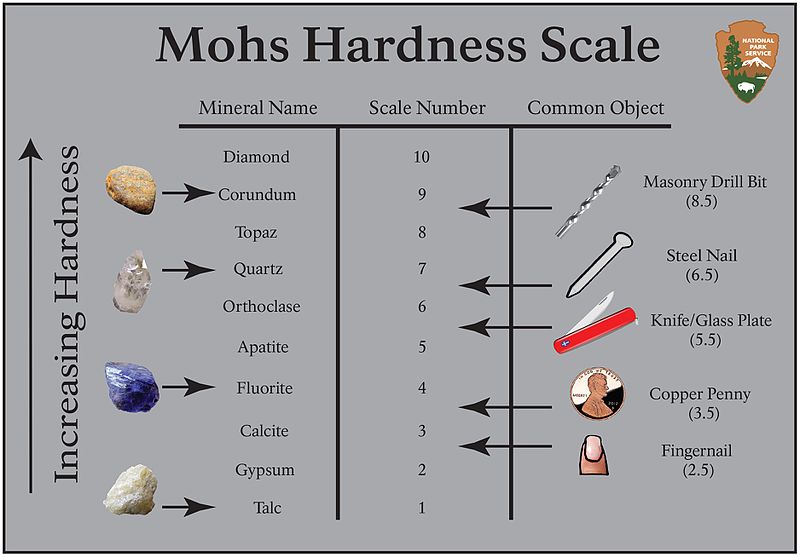
Which mineral is number 6 on the hardness scale?
An igneous rock commonly used as building material is
Which igneous rock has large crystals surrounded by smaller crystals?
A sedimentary rock made up of rock fragments with rounded edges is called
An example of a mineral made up of a pure element is
Which term is used to describe how light is reflected from a mineral’s surface?
The three major fossil fuels are coal, oil, and
What is the hardest known mineral?
Heat and pressure deep beneath Earth’s surface can change any rock into
Halite is a mineral formed by
The process by which sediment settles out of the water or wind carrying it is
How do coarse-grained igneous rocks form?
As layer upon layer of sediments are deposited, the process of
presses them together.
The sedimentary rock called
The texture of slate is said to be
seen only with a microscope.
The splitting of a mineral along flat surfaces is a property called
The small particles of rock or the remains of living things that make up sedimentary rocks are called cement.
In the United States, the fossil fuel that is present in the largest amount is natural gas.
Particles of minerals called grains give a rock its texture.
A mineral with a hardness of 6 will scratch a mineral with a hardness of more than 6.
Burning fossil fuels provides more energy per kilogram than burning other fuels.
To study a rock sample, geologists observe the rock’s mineral composition, color, and texture.
The three major groups of sedimentary rocks are clastic rocks, organic rocks, and chemical rocks.
The deeper a rock is buried in the crust, the greater the pressure on that rock
The collision of continental plates can push up a mountain range, after which weathering and erosion begin.
As rock moves through the rock cycle, material is not lost or gained.
Use the Mohs Hardness Scale to answer the following questions 21-24
Which mineral is number 6 on the hardness scale?
Which mineral would scratch calcite but not scratch apatite?
Which minerals would all scratch apatite?
What is the numbered scale for the Mohs Hardness Scale?
What are three common uses of coal?
Tell me why fossil fuels are non renewable resources.
Tell me the 5 characteristics a substance must have to be a mineral.
Name the 5 steps in the sequence or processes that form sedimentary rocks. Start with Weathering .
Use this diagram for questions 34 and 35.
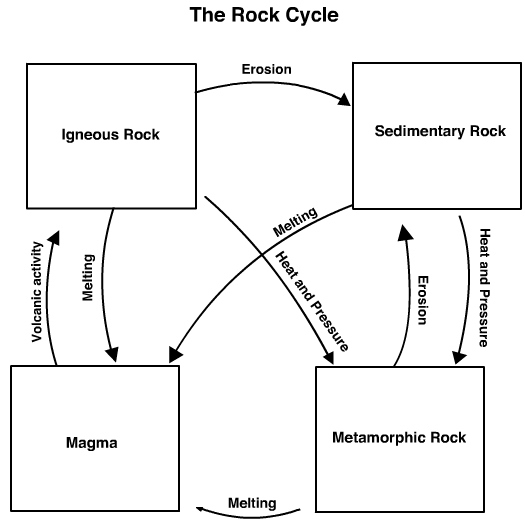
Describe a pathway through the rock cycle in which magma becomes sedimentary rock.
Using the rock cycle diagram above, tell me what step in the rock cycle creates the sediment from which sedimentary rock is formed?