Evolutionary History 2.3 (3/1) Exit Ticket

Last updated over 2 years ago
3 questions
Read the passage below, and answer the questions that follow.
While you might be familiar (a little too familiar, you might say), with bedbugs, they didn’t always used to be the terrifying critters we know today.
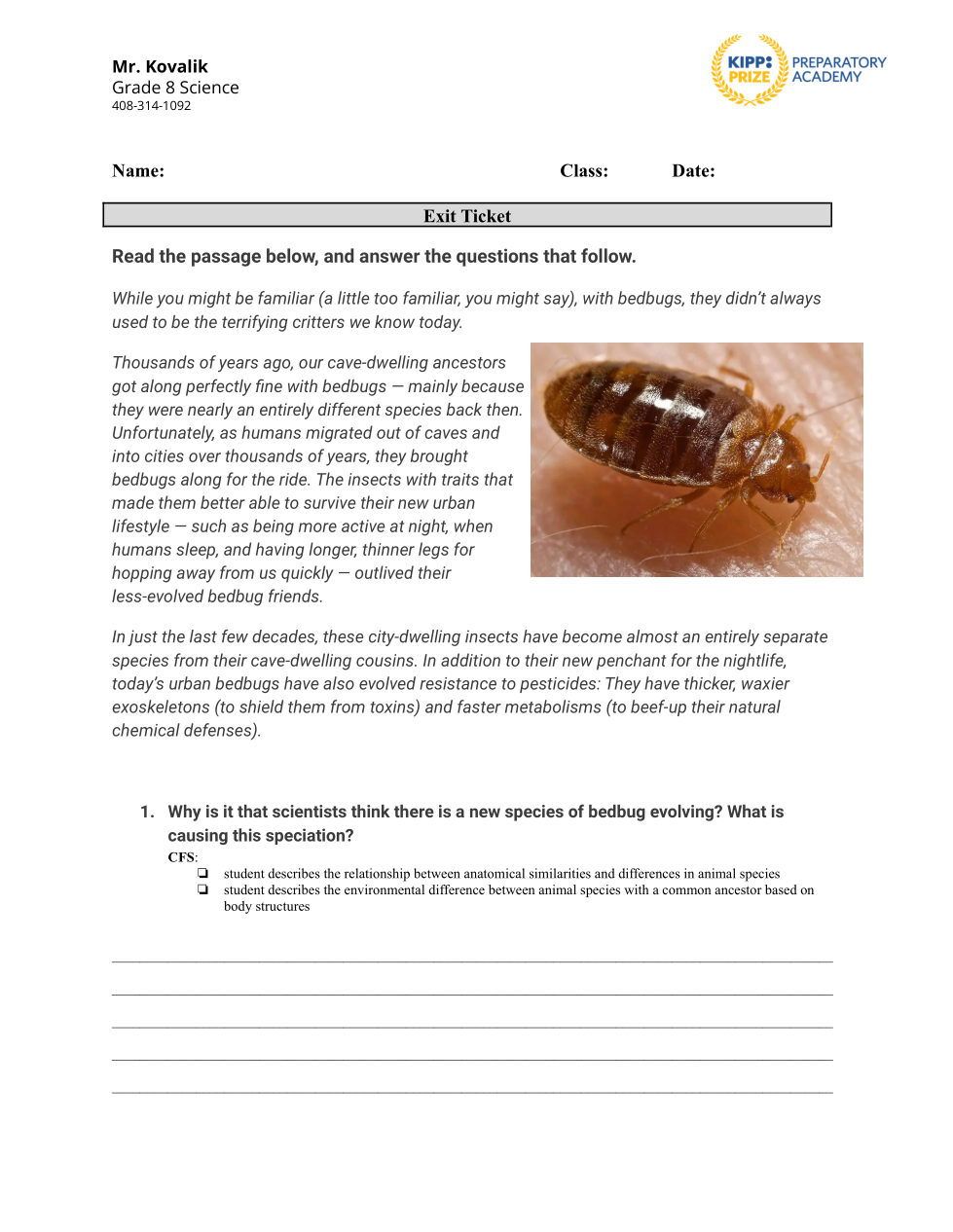
Thousands of years ago, our cave-dwelling ancestors got along perfectly fine with bedbugs — mainly because they were nearly an entirely different species back then. Unfortunately, as humans migrated out of caves and into cities over thousands of years, they brought bedbugs along for the ride. The insects with traits that made them better able to survive their new urban lifestyle — such as being more active at night, when humans sleep, and having longer, thinner legs for hopping away from us quickly — outlived their less-evolved bedbug friends.

In just the last few decades, these city-dwelling insects have become almost an entirely separate species from their cave-dwelling cousins. In addition to their new penchant for the nightlife, today’s urban bedbugs have also evolved resistance to pesticides: They have thicker, waxier exoskeletons (to shield them from toxins) and faster metabolisms (to beef-up their natural chemical defenses).
0

Why is it that scientists think there is a new species of bedbug evolving? What is causing this speciation To become more common?
CFS:
  • student describes the relationship between anatomical similarities and differences in animal species
  • student describes the environmental difference between animal species with a common ancestor based on body structures

0

What traits do these new bedbugs often have that their cave-dwelling cousins do not have?
CFS:
  • student describes the relationship between anatomical similarities and differences in animal species
  • student describes the environmental difference between animal species with a common ancestor based on body structures

3

What bedbug trait became more common in the population? Why did this trait become more common over time and seen in more individuals?
CFS:
  • accurately describes the relationship between environmental changes and population variations
  • describes the cause and effect relationship between environmental factors and species traits