Log in
Sign up for FREE
arrow_back
Library

C1 Advanced Reading and Use of English

star
star
star
star
star
Last updated over 3 years ago
29 questions
1. Read the instructions carefully.
2. Submit the exam when it is ready
3. Bear in mind the time limit

1
1
1
1
1
1
1
1
1
Question 9
9.
Write the answers in the boxes
9 _______
10 _______
11 _______
12 _______
13 _______
14 _______
15 _______
16 _______
1
Question 10
10.
Write your answers in the boxes

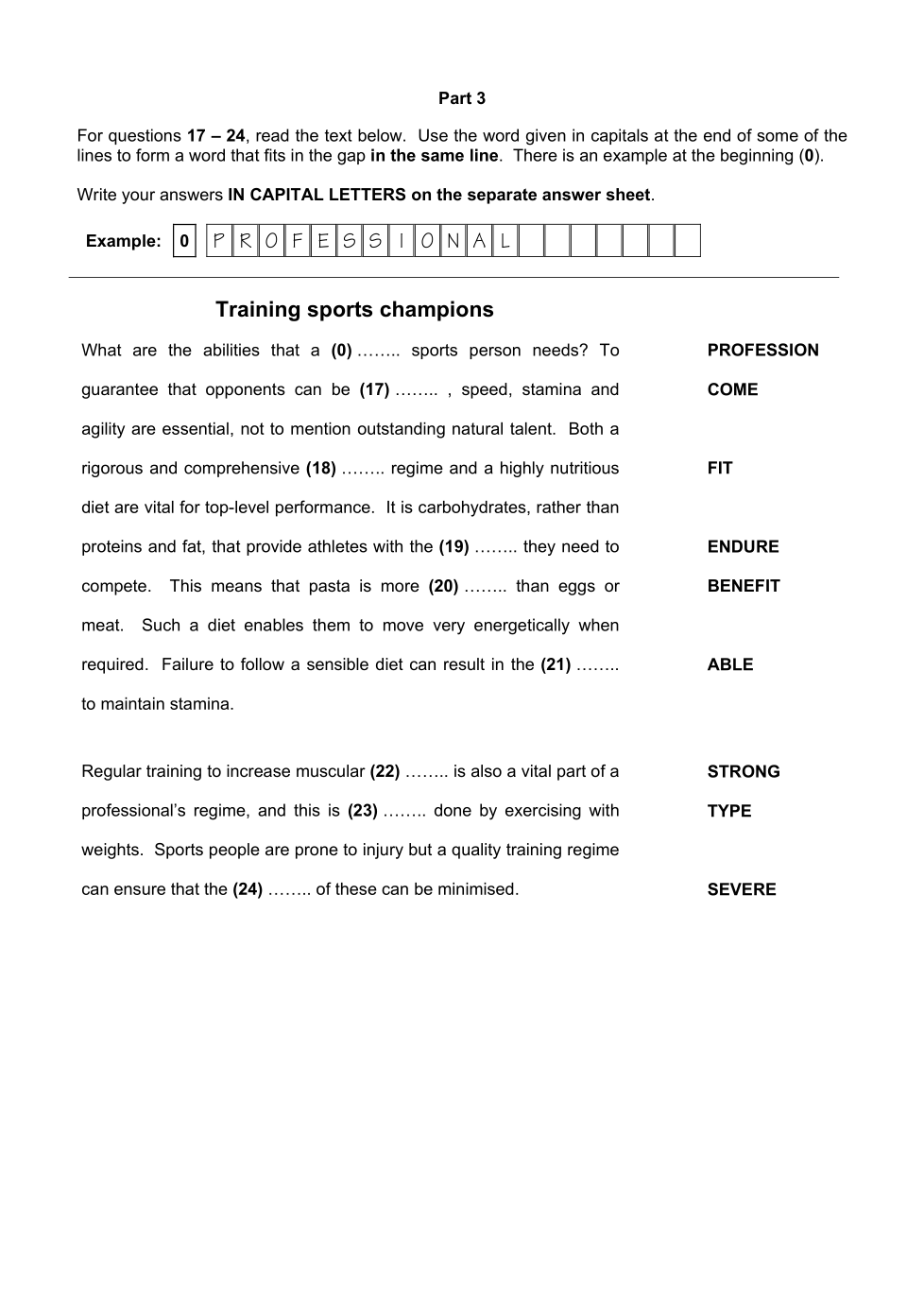
17 _______
18 _______
19 _______
20 _______
21 _______
22 _______
23 _______
24 _______
1
Question 11
11.
Complete the sentences.

25 My brother _______ much now as he did when he was younger.

26. The old bus station is _______ with a new one.

27. The number of students now at university is _______ been, apparently.

1
Question 12
12.
Complete the sentences.

28. I think the Fishen's new album is _______ their previous one.

29. Anna got the job _______ of experience in public relations.

30. Max received a _______ at night without any lights from the police officer.
1
1
1
1
1
1
1
1
1
1
1
1
1
1
1
1
1
Question 29
29.
Write A, B, C or D in the boxes.
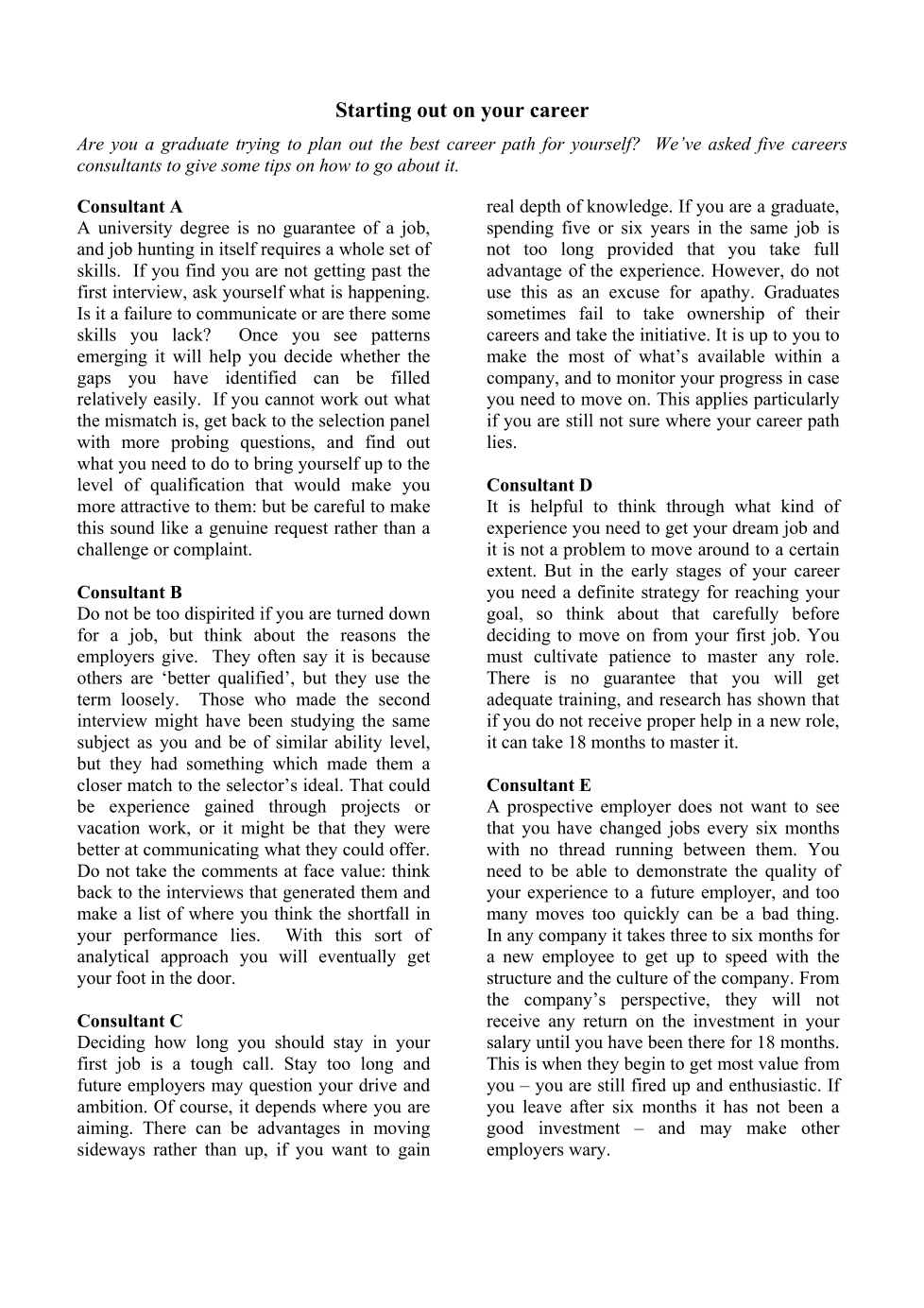
Which consultant makes the following statements?

47 Keep your final objective in mind when you are planning to change jobs. _______

48 It takes time to become familiar with the characteristics of a company you have joined. _______

49 You should demonstrate determination to improve your job prospects. _______

50 Make sure your approach for information is positive in tone. _______

51 It is not certain that you will be given very much support in your job initially. _______

52 Stay optimistic in spite of setbacks. _______

53 Promotion isn’t the only way to increase your expertise. _______

54 Ask for information about your shortcomings. _______

55 Some information you are given may not give a complete picture. _______

56 It will be some time before you start giving your employers their money’s worth. _______
Question 1
1.

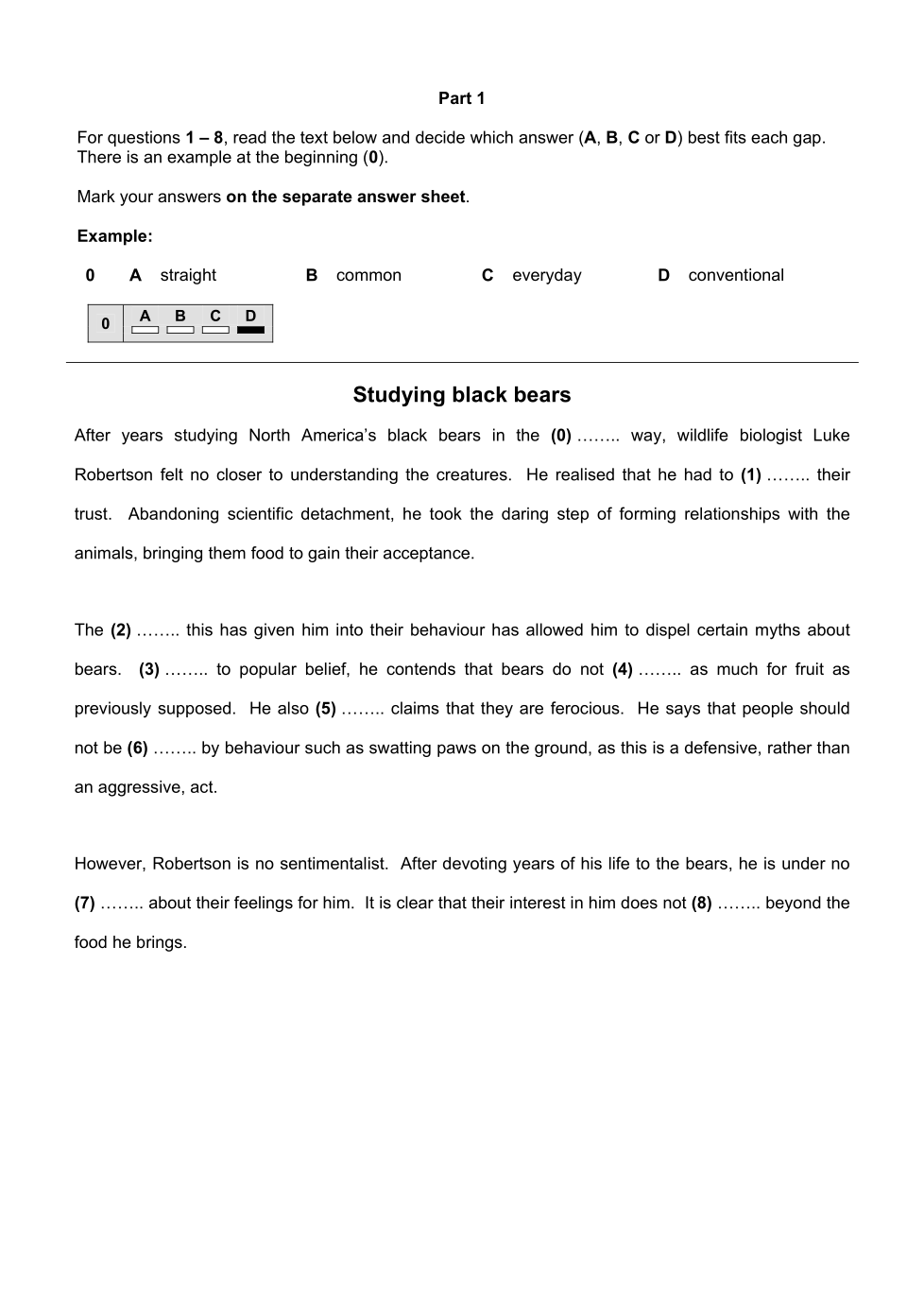
Choose the answer for number 1

Question 2
2.

Choose the answer for number 2

Question 3
3.

Choose the answer for number 3

Question 4
4.

Choose the answer for number 4

Question 5
5.

Choose the answer for number 5

Question 6
6.

Choose the answer for number 6

Question 7
7.

Choose the answer for number 7

Question 8
8.

Choose the answer for number 8

Question 13
13.

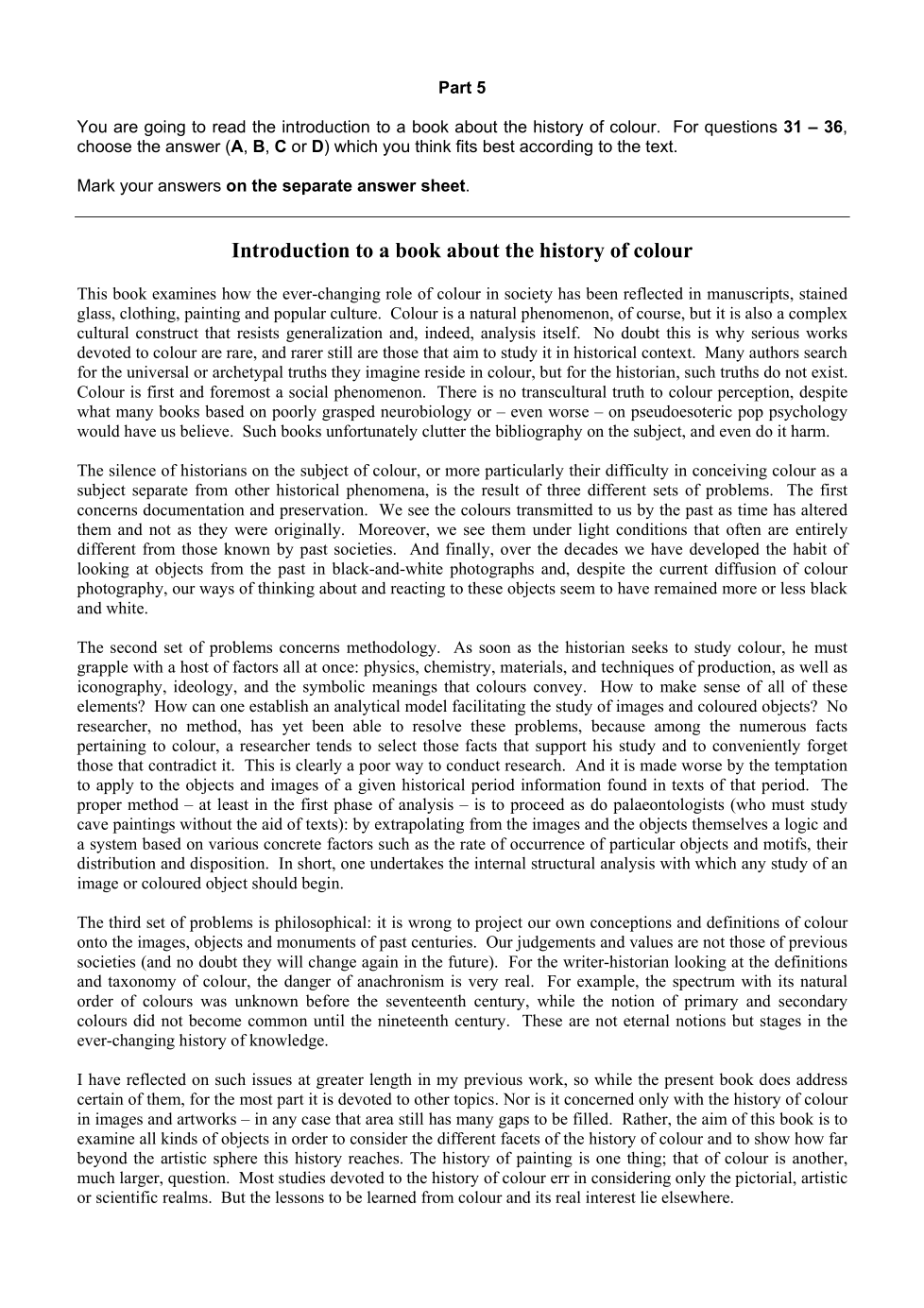
What problem regarding colour does the writer explain in the first paragraph?

Question 14
14.

What is the first reason the writer gives for the lack of academic work on the history of colour?

Question 15
15.

The writer suggests that the priority when conducting historical research on colour is to

Question 16
16.

In the fourth paragraph, the writer says that the historian writing about colour should be careful

Question 17
17.

In the fifth paragraph, the writer says there needs to be further research done on

Question 18
18.

An idea recurring in the text is that people who have studied colour have

Question 19
19.

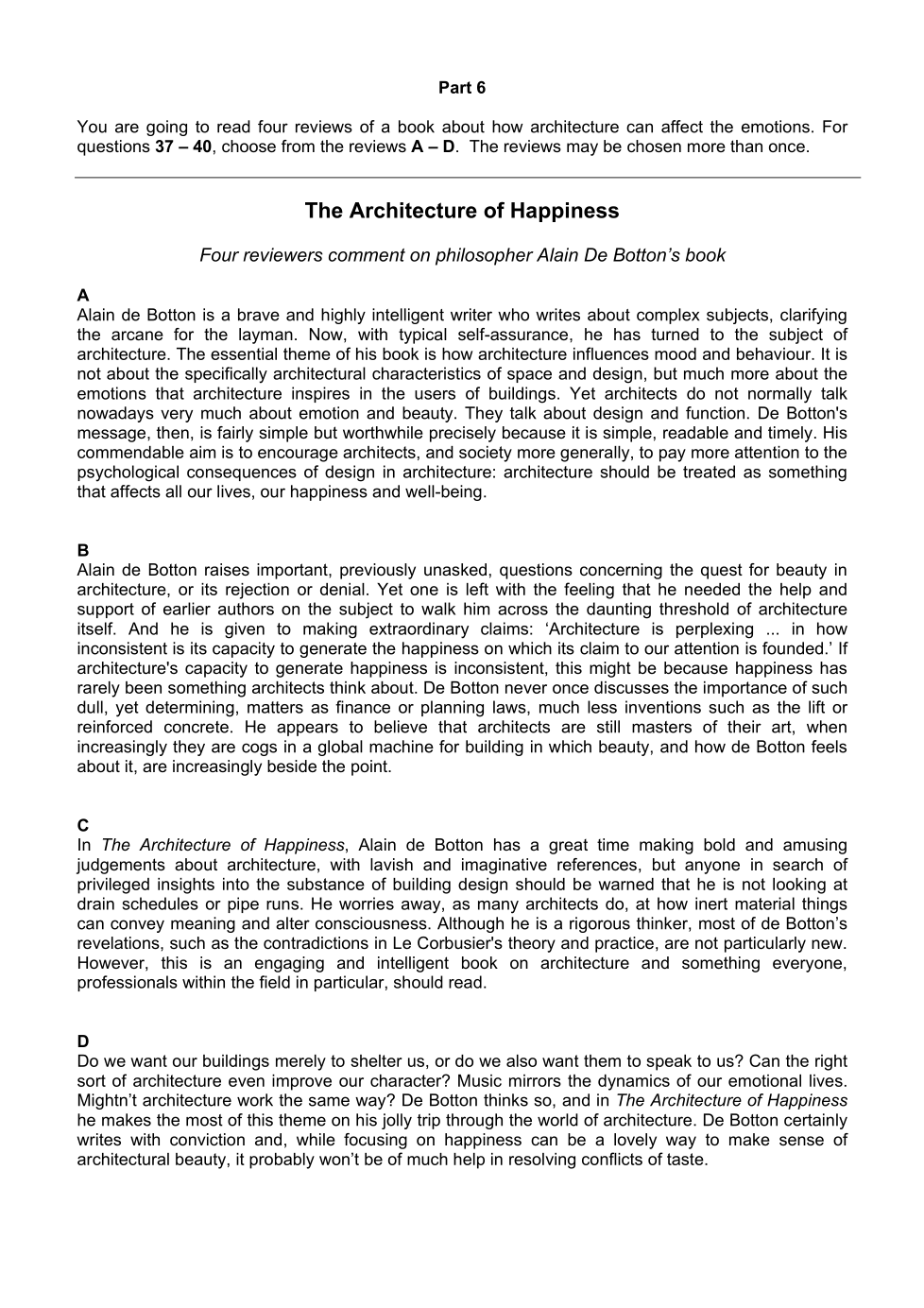
Which reviewer has a different opinion from the others on the confidence with which de Botton discusses
architecture?
Question 20
20.

Which reviewer shares reviewer A’s opinion whether architects should take note of de Botton’s ideas?

Question 21
21.

Which reviewer expresses a similar view to reviewer B regarding the extent to which architects share
de Botton’s concerns?

Question 22
22.

Which reviewer has a different view to reviewer C on the originality of some of de Botton’s ideas?

Question 23
23.

Question 24
24.

Question 25
25.

Question 26
26.

Question 27
27.

Question 28
28.

Choose the answer for 41
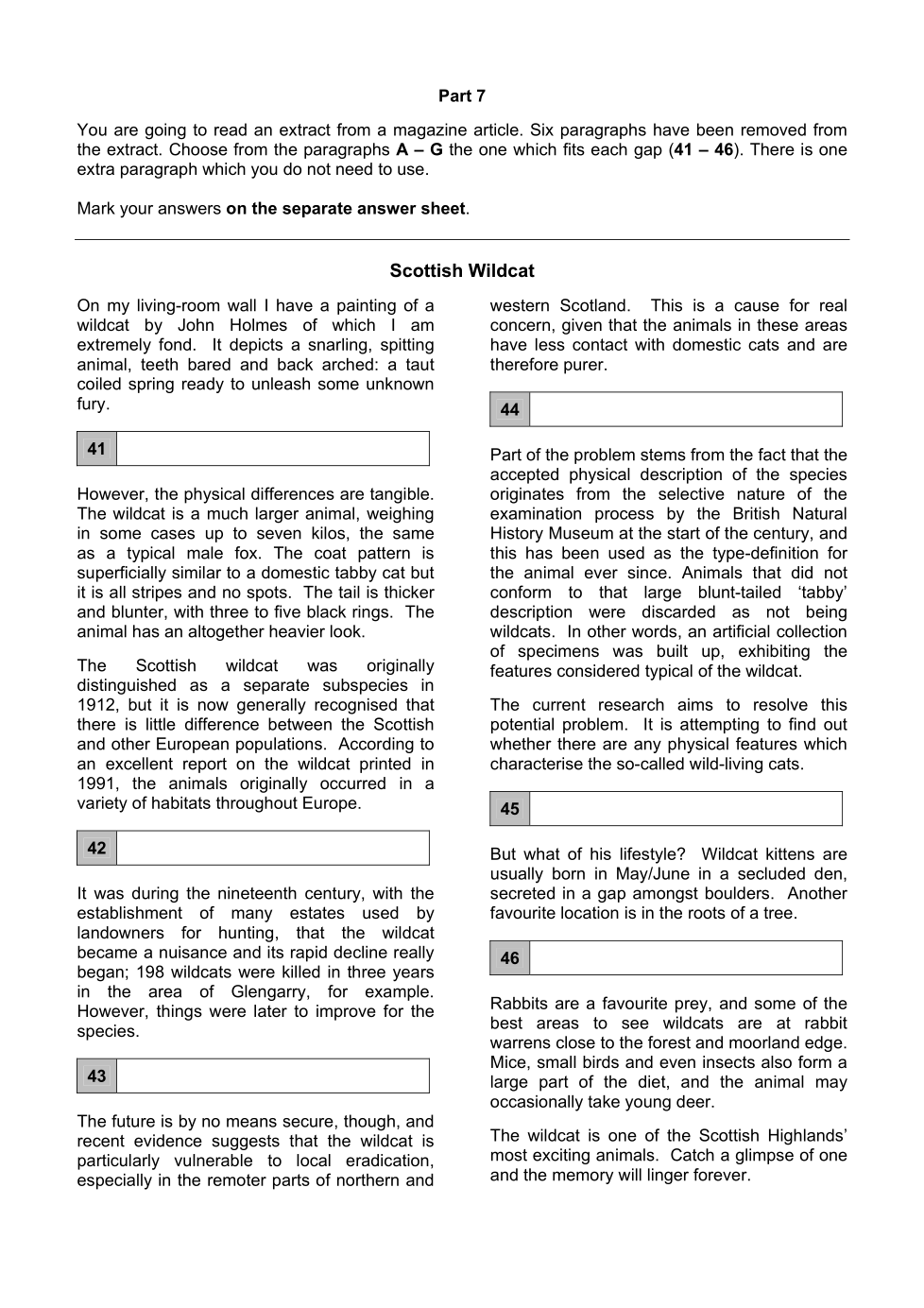
The recruitment of men to the armed forces during the conflict in Europe from 1914 to 1918 meant there was very little persecution, since gamekeepers went off to fight. As the number of gamekeepers decreased, the wildcat began to increase its range, recolonising many of its former haunts. Extinction was narrowly averted.
The wildcat waits for a while in rapt concentration, ears twitching and eyes watching, seeing everything and hearing everything, trying to detect the tell-tale movement of a vole or a mouse. But there is nothing, and in another leap he disappears into the gloom.
The results, which are expected shortly,
will be fascinating. But anyone who has seen a wildcat will be in little doubt that there is indeed a unique and distinctive animal living in the Scottish Highlands, whatever his background.
They probably used deciduous and coniferous woodland for shelter, particularly in winter, and hunted over more open areas such as forest edge,
open woodland, thickets and scrub,
grassy areas and marsh. The wildcat
was probably driven into more mountainous areas by a combination of
deforestation and persecution.
As the animals emerge, their curiosity
is aroused by every movement and rustle in the vegetation. Later they will accompany their mother on hunting trips, learning quickly, and soon
become adept hunters themselves.
This is what makes many people think
that the wildcat is a species in its own
right. Research currently being undertaken by Scottish Natural
Heritage is investigating whether the wildcat really is distinct from its homeliving cousin, or whether it is nothing more than a wild-living form of the domestic cat.
It is a typical image most folk have of
the beast, but it is very much a false
one, for the wildcat is little more than a
bigger version of the domestic cat, and
probably shows his anger as often.
Choose the answer for 42
The recruitment of men to the armed forces during the conflict in Europe from 1914 to 1918 meant there was very little persecution, since gamekeepers went off to fight. As the number of gamekeepers decreased, the wildcat began to increase its range, recolonising many of its former haunts. Extinction was narrowly averted.
The wildcat waits for a while in rapt concentration, ears twitching and eyes watching, seeing everything and hearing everything, trying to detect the tell-tale movement of a vole or a mouse. But there is nothing, and in another leap he disappears into the gloom.
The results, which are expected shortly,
will be fascinating. But anyone who has seen a wildcat will be in little doubt that there is indeed a unique and distinctive animal living in the Scottish Highlands, whatever his background.
They probably used deciduous and coniferous woodland for shelter, particularly in winter, and hunted over more open areas such as forest edge,
open woodland, thickets and scrub,
grassy areas and marsh. The wildcat
was probably driven into more mountainous areas by a combination of
deforestation and persecution.
As the animals emerge, their curiosity
is aroused by every movement and rustle in the vegetation. Later they will accompany their mother on hunting trips, learning quickly, and soon
become adept hunters themselves.
This is what makes many people think
that the wildcat is a species in its own
right. Research currently being undertaken by Scottish Natural
Heritage is investigating whether the wildcat really is distinct from its homeliving cousin, or whether it is nothing more than a wild-living form of the domestic cat.
It is a typical image most folk have of
the beast, but it is very much a false
one, for the wildcat is little more than a
bigger version of the domestic cat, and
probably shows his anger as often.
Choose the answer for 43
The recruitment of men to the armed forces during the conflict in Europe from 1914 to 1918 meant there was very little persecution, since gamekeepers went off to fight. As the number of gamekeepers decreased, the wildcat began to increase its range, recolonising many of its former haunts. Extinction was narrowly averted.
The wildcat waits for a while in rapt concentration, ears twitching and eyes watching, seeing everything and hearing everything, trying to detect the tell-tale movement of a vole or a mouse. But there is nothing, and in another leap he disappears into the gloom.
The results, which are expected shortly,
will be fascinating. But anyone who has seen a wildcat will be in little doubt that there is indeed a unique and distinctive animal living in the Scottish Highlands, whatever his background.
They probably used deciduous and coniferous woodland for shelter, particularly in winter, and hunted over more open areas such as forest edge,
open woodland, thickets and scrub,
grassy areas and marsh. The wildcat
was probably driven into more mountainous areas by a combination of
deforestation and persecution.
As the animals emerge, their curiosity
is aroused by every movement and rustle in the vegetation. Later they will accompany their mother on hunting trips, learning quickly, and soon
become adept hunters themselves.
This is what makes many people think
that the wildcat is a species in its own
right. Research currently being undertaken by Scottish Natural
Heritage is investigating whether the wildcat really is distinct from its homeliving cousin, or whether it is nothing more than a wild-living form of the domestic cat.
It is a typical image most folk have of
the beast, but it is very much a false
one, for the wildcat is little more than a
bigger version of the domestic cat, and
probably shows his anger as often.
Choose the answer for 44
The recruitment of men to the armed forces during the conflict in Europe from 1914 to 1918 meant there was very little persecution, since gamekeepers went off to fight. As the number of gamekeepers decreased, the wildcat began to increase its range, recolonising many of its former haunts. Extinction was narrowly averted.
The wildcat waits for a while in rapt concentration, ears twitching and eyes watching, seeing everything and hearing everything, trying to detect the tell-tale movement of a vole or a mouse. But there is nothing, and in another leap he disappears into the gloom.
The results, which are expected shortly,
will be fascinating. But anyone who has seen a wildcat will be in little doubt that there is indeed a unique and distinctive animal living in the Scottish Highlands, whatever his background.
They probably used deciduous and coniferous woodland for shelter, particularly in winter, and hunted over more open areas such as forest edge,
open woodland, thickets and scrub,
grassy areas and marsh. The wildcat
was probably driven into more mountainous areas by a combination of
deforestation and persecution.
As the animals emerge, their curiosity
is aroused by every movement and rustle in the vegetation. Later they will accompany their mother on hunting trips, learning quickly, and soon
become adept hunters themselves.
This is what makes many people think
that the wildcat is a species in its own
right. Research currently being undertaken by Scottish Natural
Heritage is investigating whether the wildcat really is distinct from its homeliving cousin, or whether it is nothing more than a wild-living form of the domestic cat.
It is a typical image most folk have of
the beast, but it is very much a false
one, for the wildcat is little more than a
bigger version of the domestic cat, and
probably shows his anger as often.
Choose the answer for 45
The recruitment of men to the armed forces during the conflict in Europe from 1914 to 1918 meant there was very little persecution, since gamekeepers went off to fight. As the number of gamekeepers decreased, the wildcat began to increase its range, recolonising many of its former haunts. Extinction was narrowly averted.
The wildcat waits for a while in rapt concentration, ears twitching and eyes watching, seeing everything and hearing everything, trying to detect the tell-tale movement of a vole or a mouse. But there is nothing, and in another leap he disappears into the gloom.
The results, which are expected shortly,
will be fascinating. But anyone who has seen a wildcat will be in little doubt that there is indeed a unique and distinctive animal living in the Scottish Highlands, whatever his background.
They probably used deciduous and coniferous woodland for shelter, particularly in winter, and hunted over more open areas such as forest edge,
open woodland, thickets and scrub,
grassy areas and marsh. The wildcat
was probably driven into more mountainous areas by a combination of
deforestation and persecution.
As the animals emerge, their curiosity
is aroused by every movement and rustle in the vegetation. Later they will accompany their mother on hunting trips, learning quickly, and soon
become adept hunters themselves.
This is what makes many people think
that the wildcat is a species in its own
right. Research currently being undertaken by Scottish Natural
Heritage is investigating whether the wildcat really is distinct from its homeliving cousin, or whether it is nothing more than a wild-living form of the domestic cat.
It is a typical image most folk have of
the beast, but it is very much a false
one, for the wildcat is little more than a
bigger version of the domestic cat, and
probably shows his anger as often.
Choose the answer for 46
The recruitment of men to the armed forces during the conflict in Europe from 1914 to 1918 meant there was very little persecution, since gamekeepers went off to fight. As the number of gamekeepers decreased, the wildcat began to increase its range, recolonising many of its former haunts. Extinction was narrowly averted.
The wildcat waits for a while in rapt concentration, ears twitching and eyes watching, seeing everything and hearing everything, trying to detect the tell-tale movement of a vole or a mouse. But there is nothing, and in another leap he disappears into the gloom.
The results, which are expected shortly,
will be fascinating. But anyone who has seen a wildcat will be in little doubt that there is indeed a unique and distinctive animal living in the Scottish Highlands, whatever his background.
They probably used deciduous and coniferous woodland for shelter, particularly in winter, and hunted over more open areas such as forest edge,
open woodland, thickets and scrub,
grassy areas and marsh. The wildcat
was probably driven into more mountainous areas by a combination of
deforestation and persecution.
As the animals emerge, their curiosity
is aroused by every movement and rustle in the vegetation. Later they will accompany their mother on hunting trips, learning quickly, and soon
become adept hunters themselves.
This is what makes many people think
that the wildcat is a species in its own
right. Research currently being undertaken by Scottish Natural
Heritage is investigating whether the wildcat really is distinct from its homeliving cousin, or whether it is nothing more than a wild-living form of the domestic cat.
It is a typical image most folk have of
the beast, but it is very much a false
one, for the wildcat is little more than a
bigger version of the domestic cat, and
probably shows his anger as often.