In a normal fault, the part of the fault that lies below the other part is called the
1 point
1
Question 2
2.
Stress that pushes a mass of rock in two opposite directions is called
1 point
1
Question 3
3.
Which type of stress force produces reverse faults?
1 point
1
Question 4
4.
Which of the following can cause damage days or months after a large earthquake?
1 point
1
Question 5
5.
The point beneath Earth’s surface where rock breaks under stress and triggers an earthquake is called the
1 point
1
Question 6
6.
In a strike-slip fault, the rocks on either side of the fault slip past each other sideways with little
1 point
1
Question 7
7.
A fold in rock that bends upward into an arch is called a(n)
1 point
1
Question 8
8.
The type of seismic waves that arrive at the surface first and move by compressing and expanding the ground like an accordion are called
1 point
1
Question 9
9.
The rating system that estimates the total energy released by an earthquake is called the
1 point
1
Question 10
10.
A large area of flat land elevated high above sea level is called a
1 point
1
Question 11
11.
The Ring of Fire, where many earthquakes occur, is located around the rim of which ocean?
1 point
1
Question 12
12.
Which type of seismic wave causes the most destruction to property?
1 point
1
Question 13
13.
Which type of seismic wave can move through solid layers of the earth but not through the liquid outer core?
1 point
1
Question 14
14.
The scale, which is numbered 1-10, that measures the strength or magnitude of an earthquake.
1 point
1
Question 15
15.
A seismograph uses a _______ to record the drum's vibrations.
1 point
1
Question 16
16.
The stress force that pulls on the crust where two plates are moving apart is called
_______ .
1 point
1
Question 17
17.
The seismic waves that travel along Earth’s surface and produce the most severe ground
movements are called_______ .
1 point
1
Question 18
18.
The block of rock that lies above a fault is called the_______ .
1 point
1
Question 19
19.
Shearing creates _______faults, like the San Andreas fault in California.
1 point
1
Question 20
20.
_______ seismic stations are required to determine the epicenter of an earthquake?
1 point
1
Question 21
21.
An upward fold in a rock is called a plateau.
1 point
1
Question 22
22.
With the range of data available, geologists cannot predict exactly where and when earthquakes will occur.
1 point
1
Question 23
23.
The squeezing together of rocks by stress is called shearing.
1 point
1
Question 24
24.
In a strike-slip fault, the rocks on either side of the fault slip past each other sideways.
1 point
1
Question 25
25.
When an earthquake occurs, S waves are the first seismic waves to arrive at a given location.
2 points
2
Question 26
26.
Distinguish between the focus and the epicenter of an earthquake.
3 points
3
Question 27
27.
Explain in your own words what happens during an earthquake? (Include the words plate boundaries, fault, seismic waves, and scale on which it’s measured).
2 points
2
Question 28
28.
Use the illustration to answer questions 28-30.
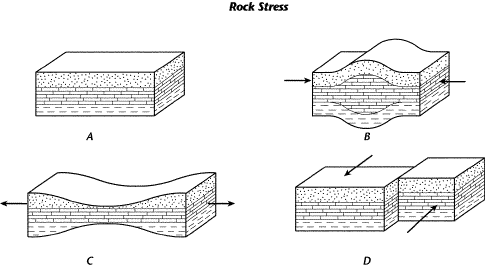
Describe the rock layers shown in Diagram A and any forces acting on the rock.
2 points
2
Question 29
29.
Using the above diagram, contrast the plate movements that cause the stresses in Diagrams B and C.
2 points
2
Question 30
30.
Using the above diagram, will a normal fault result from the stresses being applied to the rock unit in Diagram D? Explain.
2 points
2
Question 31
31.
Explain how geologists use seismic waves to locate an earthquake's epicenter.
2 points
2
Question 32
32.
Describe how a seismograph works.
2 points
2
Question 33
33.
Describe the Modified Mercalli Scale. Explain why it is useful.