Log in
Sign up for FREE
arrow_back
Library

Religion Test 2023

star
star
star
star
star
Last updated over 1 year ago
35 questions
1
1
1
Required
1
1
1
1
1
Required
4
1
Required
1
Required
1
Required
1
Required
1
Required
1
Required
1
Required
2
Required
1
Required
1
Required
1
Required
1
Required
1
Required
1
Required
1
Required
1
Required
1
Required
3
Required
1
Required
1
Required
1
Required
1
Required
1
Required
1
Required
1
Required
1
Question 1
1.

Question 2
2.

Question 3
3.

Question 4
4.

Question 5
5.

Question 6
6.

Question 7
7.

Question 8
8.

Question 9
9.

1) Choose 2 monothesitic religions
2) Make a comparison statement about any of the two monotheistic religions.

Question 10
10.

Question 11
11.

Question 12
12.

Question 13
13.

Question 14
14.

In one complete sentence .... and making sure to EXPLAIN EVERY RELIGIOUS BELIEF ...


What is the difference between Yom kippur, Lent and Ramadan?

Question 15
15.

Question 16
16.

Question 17
17.

We know, for example, that there was a street of booksellers with more than 100 shops, each one with paper and books for sale. This is a time when in Europe a monastery would be lucky if it had five or ten books.” While the monks of the West were hoarding their wisdom on scraps of expensive parchment, paper enabled Islamic civilization to spread its newfound knowledge far and wide, creating a single community linking three continents.

Using information from the text and in your own words answer the following question in 1- 2 COMPLETE SENTENCES

Question: How did the availability of books in the Abbasid Caliphate compare to the availability of books in Western Europe from the 700s to the 1300s? How do you think this different affected the two regions?

Question 18
18.

Question 19
19.

Question 20
20.

Question 21
21.

Question 22
22.

Question 23
23.

Question 24
24.

Question 25
25.

Question 26
26.

Write an example of meritocracy in your life or something that you have seen happen ( at least one complete sentence)

Question 27
27.

Confucius believed that there were five fundamental relationships in society:
  1. Ruler to Subject
  2. Father to Son
  3. Husband to Wife
  4. Older Brother to Younger Brother
  5. Friend to Friend
According to Confucius what was supposed to happen in the 5 key relationships? Why or what was the purpose? ( be as detailed as possible )

Question 28
28.

Question 29
29.

Question 30
30.

Question 31
31.

Question 32
32.

Question 33
33.

Question 34
34.

Question 35
35.

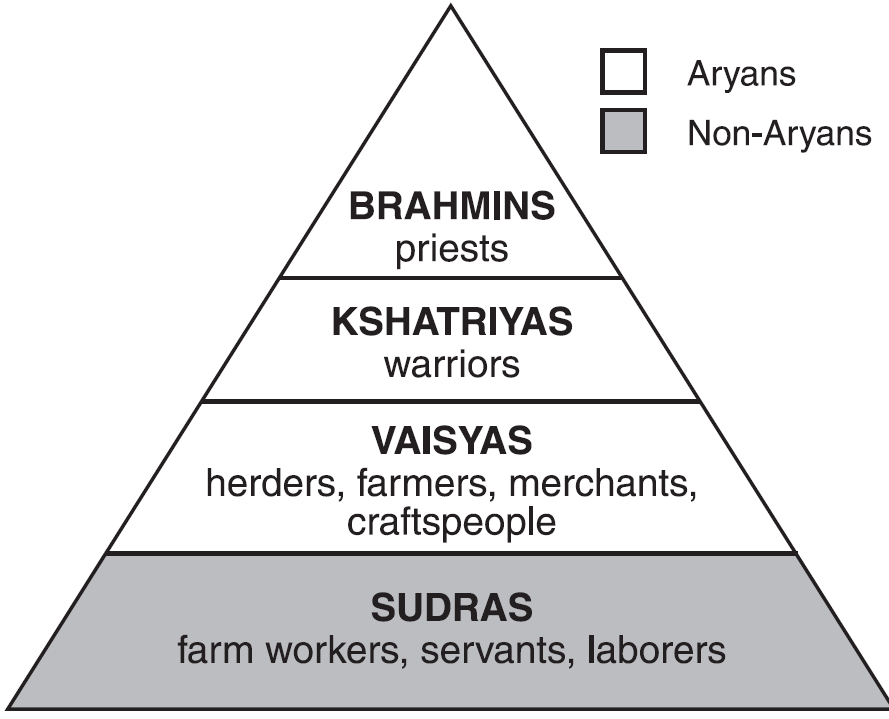
Using the information in the image below and the following 2 part question...

Sudras are different than the rest of the caste because .... as such this leads to the Sudras being...
They can never reach Moksha ... discriminated against despite it being ilegal
They will reach Moksha... discriminated against despite it being ilegal
They will reach Heaven ... celeberated as great workers in the world
They will reach Nirvana... discriminated against despite it being ilegal
The Ten Commandments are to Judaism and Christianity as the Five Pillars are to

Islam
Buddhism
Hinduism
Shinto
Which two major beliefs are similar between Hindus and Buddhist?
Moksha .... Nirvana
Reincarnation .... Atman
Reincarnation .... Karma
Moksha .... No deities
God made a __________ with Abraham.... This story is found in which sacred text?
Circus .... Torah, Bible and Q'aran
Covenant ... Torah, Bible and Veda
Covenant .... Torah, Bible and Q'aran
Transfusion .... Torah, Bible and Q'aran
The Buddha from China in comparison to the Buddha in India is a representation of ....
Racial Disparities
Food Exchange
Cancel Culture
Cultural Diffusion
Which heading best completes the partial outline below?
I. ______________________________
A. Development of medical encyclopedias
B. Development of algebra and astronomical tables
C. Production of cotton textiles and woolen carpets
D. Production of literature, calligraphy, and geometric art
Inventions During the Neolithic Revolution
Contributions of the Islamic Civilization
Achievements of Feudal Societies
Issues of the Protestant Reformation
Which religion/ philosophy did not begin in the continent of Asia ?
Taoism/ Daoism
None of the Above
Islam
Legalism
Hinduism
Judaism
Christianity
Confucianism
Buddhism
The belief systems of daoism and animism stress ...
harmony with nature to live in peace
acceptance of monotheism to achieve salvation
proper behavior to maintain social order
obedience to caste rules to achieve moksha
Which of the following is a denomination of Judaism?
Pentecostal
Reform
Protestant
Covenant
Which of the following is not part of ten commandments?
Thou shalt have no other gods before me
Thou shalt not bear false witness against thy neighbour
Though shall not say anything to hurt others
Honour thy father and thy mother
Who took over Judah in 63 BCE ?
Assyrians
Babylonians
Roman Empire
Persians
What holiday do Jewish people fast for ? How many days?
Ramadan, 30 days
Lent, 40 days
Rosh hashanah, 3 days
Yom Kippur , 1 day
Christianity and Islam are similar in that both
have roots in Judaism
are polytheistic religions
have practiced a strict code of nonviolence
have the same religious holidays
Jewish religious and cultural identity has been greatly influenced by
Ramadan and the concept of reincarnation
the Torah and the Diaspora
the New Testament and the Four Noble Truths
the Koran and the code of bushido
  • Fasting during Ramadan
  • Praying five times each day
  • Giving charity to the poor

Followers of which religion engage in these practices?
Christianity
Buddhism
Islam
Judaism
Which text is essential to the practice of Islam?
Qur’an (Koran)
Analects
Torah
New Testament
1. In the name of Allah, Most
Gracious, Most Merciful.
2. Praise be to Allah,
The Cherisher and Sustainer of the Worlds;
3. Most Gracious, Most Merciful;
4. Master of the Day of Judgement.
5. Thee do we worship,
And Thine aid we seek.
6. Show us the straight way,
7. The way of those on whom
Thou hast bestowed Thy Grace,
Those whose (portion)
Is not wrath,
And who go not astray.
— 'Abdullah Yusuf 'AIT, ed.,
The Meaning of The Holy Quran,
Amana Publications, 1999

Which concept is best reflected in this passage?
baptism
karma
animism

monotheism
. . Muslims, Christians, and Jews lived together in peace. Because several Christian and Jewish prophets, including Adam, Abraham, and Moses,are named in the Qur'an and because the Jewish Torah and Christian gospels are recognized as revelations from Allah, the Muslim rulers called Christians and Jews "people of the Book" and permitted them much religious and personal freedom. Jews, especially, enjoyed many liberties, and many Jews distinguished themselves in science, the arts, and government. Convivencia, a Spanish word meaning "living together," helped make tenth-century al-Andalus the most civilized country in Europe. . . .
–Lawrence Houghteling, "Al-Andalus: Islamic Spain," Calliope, Nov.-Dec. 1995

What is the main idea of this passage?
Religious tolerance in Muslim Spain encouraged the growth of a rich and diverse culture.
Spain was troubled by deep-rooted religious conflicts.
The Torah and the Bible were rejected in Muslim Spain.
Arabs, Jews, and Christians shared houses and places of worship in Muslim Spain.
1. The Nature of Suffering (Dukkha): "This is the noble truth of suffering: birth is suffering, aging is suffering, illness is suffering, death is suffering; sorrow, lamentation, pain, grief and despair are suffering; union with what is displeasing is suffering; separation from what is pleasing is suffering; not to get what one wants is suffering; in brief, the five aggregates subject to clinging are suffering." 2. Suffering's Origin (Samudaya): "This is the noble truth of the origin of suffering: it is this craving which leads to renewed existence, accompanied by delight and lust, seeking delight here and there, that is, craving for sensual pleasures, craving for existence, craving for extermination." 3. Suffering's Cessation (Nirodha): "This is the noble truth of the cessation of suffering: it is the remainderless fading away and cessation of that same craving, the giving up and relinquishing of it, freedom from it, nonreliance on it." 4. The Way (Mārga) Leading to the Cessation of Suffering: "This is the noble truth of the way leading to the cessation of suffering: it is the Noble Eightfold Path; that is, right view, right intention, right speech, right action, right livelihood, right effort, right mindfulness, right concentration.

The text above express the view and believes of a ...
Christian
Jew
Buddhist
Hinduist
“For God so loved the world, that he gave his only begotten Son, that whosoever believeth in him should not perish, but have everlasting life. " John 3:16

The above text can be found in the ...
Q'aran
Bible
Rig Veda
Torah
"The usefulness of a pot comes from its emptiness.” “Empty yourself of everything, let your mind become still.”

The above text is most closely related to which philosophy or religion ?
Daoism/ Taoism
Judaism
Buddhism
Christianity
Which belief is most closely associated with the philosophy of confucianism?
filial piety
prayer
reincarnation
nirvana
What does the christianity cross represent?
Easter
Christmas
Jesus death on the cross for the salvation of people
Abraham's Convenant
Where was Christianity founded ?
Israel
Saudi Arabia
Italy
Egypt
Who is the founder of Buddhism ?
Lana del Ray
Lao Tsu
Jesus Christ
Saddartha Gautama
Why is Buddhism believed to be a philosophy rather than a religion ?
There are no Gods worshipped
Buddhism worships Jesus
No religions are real
There are no sacred text
Which religious holidays do we have a day off from school ?
Hannakuh, Christmas, Eid al Fatir
Christmas, Yom Kippur, Eid Al- Fatir
Yom Kippur, Christmas and Lent
Yom Kippur, Christmas, and Thanksgiving
Click on all of the Religions/ Philosophy which do not eat pork
Christianity
Judaism
Islam
Buddhism
What are the two ways in which the Zakah can be completed
Giving money to the Bowery Mission and the Catholic Church
Giving money to the church and a Buddhist Temple
BY donating to the poor and building yourself a new mansion
By donating to the poor and volunteering your time if you do not have the financial resources
For which one of the religions below do you have to believe that their is only one God ( check all that apply)
Judaism
Christianity
Buddhism
Hinduism
Daoism
Islam