Unit 3 Quiz: Westward Expansion & the Age of Jackson
star
star
star
star
star
Last updated almost 2 years ago
12 questions
Note from the author:
1
1
1
IIWD.01
1
1
IIRC.02
1
IITE.01
1
IIWD.01
0
Directions: Please answer the following questions based on your understanding of the course readings and lessons we have done in U.S. History.
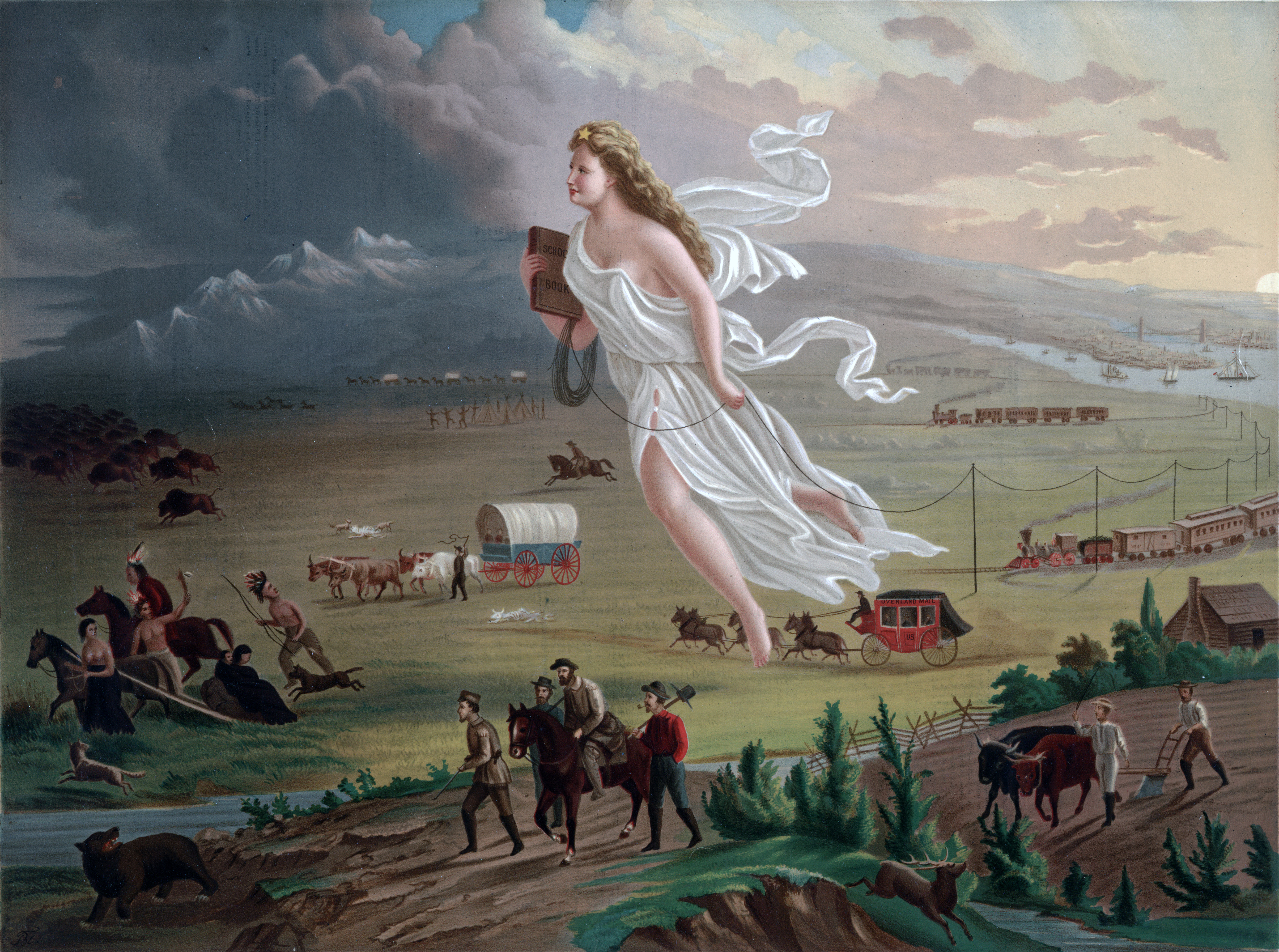
Questions 1-2 refer to John Gast’s American Progress painting.
1
IICI.01
1
IIUR.01
Questions 3-6 refer to key vocabulary and ideas from class discussions.
Question 3
3.
Question 4
4.
Question 5
5.
Question 6
6.
Excerpt Audio Recording:
1
IIWD.01
1
IIWD.01
Question 9
9.
Question 10
10.
Question 11
11.
Question 12
12.
First Mastery assessment of the semester in the books! How are you feeling?
Let us know in the "Show Your Work" function.
Question 1
1.
Question 2
2.
What is a key difference between the presidencies of Andrew Jackson and Donald Trump?
Both men came from wealthy backgrounds that made it easier for them to seek political office through the help of influential friends in power.
While Trump knew how to use the media to his advantage, the use of media to communicate did not yet exist in the Jackson era.
While Trump served in the Vietnam War, Jackson dodged the draft and claimed that he had “bone spurs” to avoid serving in the armed forces.
Although Jackson expanded the vote to include all white men, Trump actively tried to keep certain voters out of politics who were less likely to vote for him.
In an effort to accommodate their culture to white American society, the Cherokees took all of these steps EXCEPT
develop a Cherokee writing system.
support antislavery reform.
promote education and schools.
develop a written legal code and constitution.
Indian boarding schools like the Carlisle Industrial School attempted to forcibly ___________________ Native American children to adopt white culture by giving them new names, clothes, and hairstyles.
assimilate
appoint
secede
occupy
Which Native American group took in runaway enslaved Blacks and fought U.S. troops for seven years in an effort to hold onto their homelands?
The Chickasaws
The Creek
The Cherokee Nation
The Seminoles
Question 7
7.
Question 8
8.
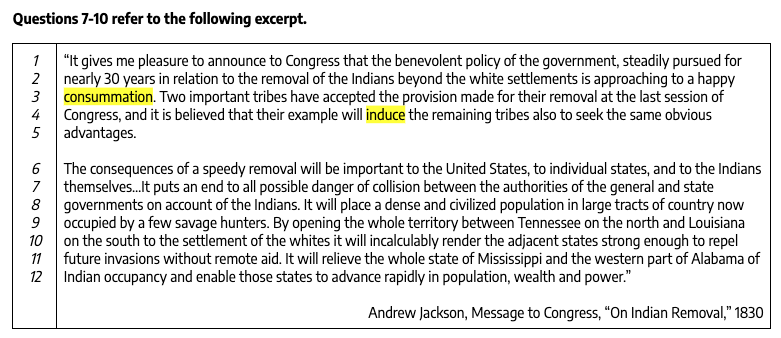
In the excerpt, Jackson suggests that
white settlers had rights to the fertile farmland that the American Indians inhabited.
he will protect the native settlers by keeping white colonists from immigrating from the area.
he wishes to punish the American Indians for their alliances to the British and French in previous wars.
the two tribes he mentioned pose the greatest challenge to land claimed by Americans in southern states.
Which choice provides the best evidence for the answer to the previous question?
Line 3-5 (“Two important...obvious advantages”)
Line 6-7 (“The consequences…Indians themselves”)
Line 7-8 (“It puts...the Indians”)
Line 8-9 (“It will...savage hunters”)
Extra Credit: There was a row between the oarsmen about who would row first in the competition.
What does the first "row" mean?
Argument
Racket
Line
Paddle
The painting exemplifies the term Manifest Destiny, which refers to
the tragic fate of the Plains Indians.
an urging for the United States to build from within their borders.
a mindset that fueled territorial expansion across North America.
a prediction of war between North and South.
How would the movement celebrated in the painting affect the United States economy?
Rising conflicts with Native Americans would become costly and cause the U.S. economy to plummet.
The U.S. was able to become self-sufficient, which led to a decrease in desire for international trade.
Access to vast land and new resources led to rapid economic development and industrialization.
The new focus on agricultural development would define America’s economic activity for a century.
The word “consummation” in line 3 most nearly means