Log in
Sign up for FREE
arrow_back
Library

SGGK TEST (Part 1)

star
star
star
star
star
Last updated over 3 years ago
63 questions
Honor Code
Required
0
History of the English Language
1
1
1
1
Chivalry and Courtly Romance
1
1
1
1
1
1
1
5
1
Symbolism
1
1
1
1
1
Application - Cold Passage Analysis
Sir Gawain and the Green Knight
1
1
1
1
1
1
1
1
1
1
1
1
3
1
1
1
1
3
1
1
1
1
1
1
1
1
1
1
1
Question 1
1.

Check the box below to acknowledge the honor code:

Question 2
2.

Question 3
3.

Question 4
4.

Question 5
5.

Question 6
6.

Question 7
7.

Question 8
8.

Question 9
9.

Question 10
10.

Question 11
11.

Question 12
12.

Question 13
13.

Draggable itemarrow_right_altCorresponding Item
arrow_right_alt
arrow_right_alt
arrow_right_alt
arrow_right_alt
arrow_right_alt
arrow_right_alt
arrow_right_alt
arrow_right_alt
arrow_right_alt
arrow_right_alt
Question 14
14.

Question 15
15.

Question 16
16.

Question 17
17.

Question 18
18.

Question 19
19.

1
1
1
1
1
1
1
1
Question 28
28.

Question 29
29.

Question 30
30.

Question 31
31.

Question 32
32.

Question 33
33.

Question 34
34.

Question 35
35.

Question 36
36.

Question 37
37.

Question 38
38.

Question 39
39.

Question 40
40.

Draggable itemarrow_right_altCorresponding Item
arrow_right_alt
arrow_right_alt
arrow_right_alt
arrow_right_alt
arrow_right_alt
Question 41
41.

Question 42
42.

Question 43
43.

Question 44
44.

Question 45
45.

Question 46
46.

Question 47
47.

Question 48
48.

Question 49
49.

Question 50
50.

Question 51
51.

Question 52
52.

Question 53
53.

Question 54
54.

Question 55
55.

Question 56
56.

1
1
1
1
1
1
1
In its earliest stages, many dialects of the language that will eventually become English was spoken by...
the French, English, and Vikings
the Irish, English, Welsh, and Scottish
the Celts, the French, and the Romans
the Celts, Saxons, Anglos, and Jutes
Who invaded England in 800 A.D. and what type of words did they bring with them?
The Vikings, Germanic
The Normans, Old French
The Romans, Latin
The Celts, Celtic
Who led the Norman Conquest of England?
William the Conqueror in 1066
Geoffrey Chaucer in 1256
Richard the Lionheart in 1175
Ragnar the Terrible in 1330
By the mid1300s, the common tongue of both the peasants and royalty of England had become
Anglo Saxon
Norman French
Middle English
Ecclesiastical Latin
Which of the following is NOT a chivalric ideal?
superficial and physical beauty
courtesy and brotherly love
self-sacrifice and loyalty
bravery and gallantry
True or False: To be a knight, you had to maintain the perfection of the chivalric ideal and you could do no wrong or you would lose your status as a knight.
True
False
True or False: One of the chivalric ideals is faithfulness - both to God and to your King.
True
False
Courtly Love, True or False:

Courtly love is a love from “afar” and it is usually very superficial.
True
False
Courtly Love, True or False:

Courtly love is a love that is attainable, where the goal is to marry a fine Lady or Queen.
True
False
Courtly Love, True or False:

Courtly Love creates a situation where the knight seeks to impress the lady from afar by doing brave deeds and being the perfect gentleman (showing great chivalry).
True
False
Which of the following is NOT true about Medieval Romances
mainly focused on stories about chivalric knights on adventures
they are catagorized into "Matters" of Britain, France, and Rome by their subject matter
a type of verse narrative typically formatted like a long poem
usually contained a courtly romance plot or a quest to save "damsels in distress"
None of the above (all are true about Medieval Romances)
Match names to concepts and characters from Arthurian Legends.
Mordred
King of Camelot
Excaliber
Queen of Camelot
Arthur Pendragon
Arthur's sister, Gawain's mother
Sir Gawain
King Arthur's illegitimate son
Guinevere
Arthur's nephew and knight
Camelot
Completed the quest for the holy grail
Sir Galahad
Greatest knight; affair with Guinevere
Lancelot
Arthur's legendary sword
The Round Table
Arthur's castle
Morgan Le Fay
Knights of _________ .

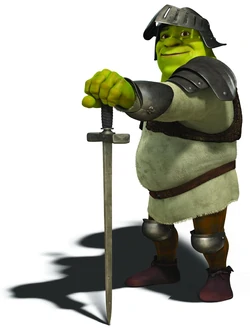
Because of its humorous take on the "damsel in distress," the knight's quest, courtly romance, and elements of fantasy such as dragons, magic, and fairy tale creatures, the movie Shrek could be considered a contemporary satire of Medieval Romance.
True
False
In literature, nature usually symbolically represents...
a challenge to overcome and tame
death, ruin, and decay
darkness/mystery AND light/truth
hell/judgement AND heaven/rewards
In literature, the color green usually symbolically represents all of the following EXCEPT
spring/new life/freshness
corruption/decay
nature/the natural world
inexperience/immaturity
True or False: During the Medieval period, symbols carried a more literal meaning, taking on a deeper belief in its magical, mystical, or spiritual power in the real world.
True
False
True or False: During the Medieval period, shields carried very intricate designs - patterns, symbols, drawings - which conveyed a deeper meaning about the knight behind the shield.
True
False
Which of the following Medieval artworks displays Medieval Symbolism for Courtly Love?

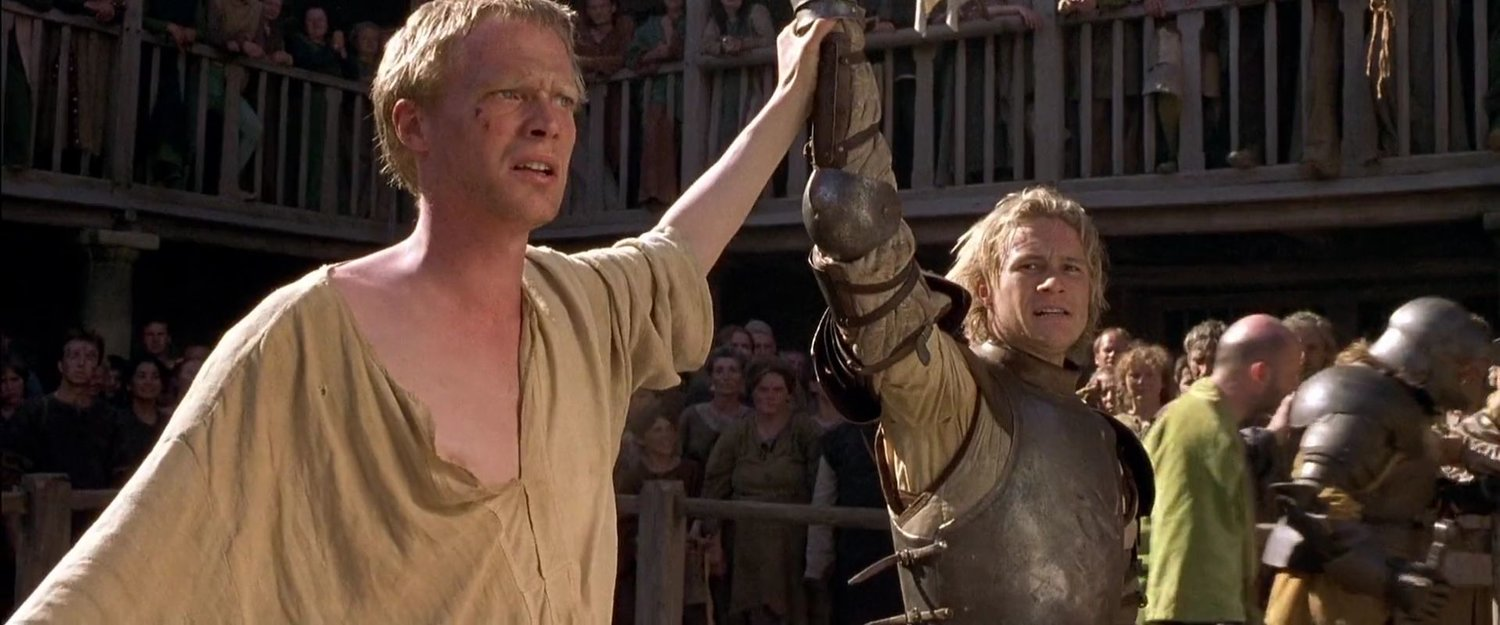
Excerpt: "A Knight's Introduction," speech from the 2001 movie, A Knight's Tale

Background: In this movie, a peasant man has disguised himself as a knight in order to participate in chivalric tournaments and pursue the woman of his dreams in a courtly fashion. In this scene, his bard gives a speech to a tournament audience to introduce him as a true "knight," the made-up "Sir Ulrich".

_______________________________________________

"My lords! My ladies. And everyone else here not sitting on a cushion! Today, you find yourselves equals! For you are all equally blessed. For I have the pride, the privilege, nay, the pleasure of introducing to you a knight sired by knights. A knight who can trace his lineage back beyond Charlemagne.

I first met him atop a mountain near Jerusalem, praying to God, asking His forgiveness for the Saracan* blood spilt by his sword.

Next, he amazed me further still in Italy when he saved a fatherless beauty from the would-be ravishings of her dreadful Turkish uncle.

In Greece, he spent a year in silence... just to better understand the sound... of a whisper.

And so, without further gilding the lily and with no more ado, I give to you, the Seeker of Serenity, the Protector of Italian Virginity, the Enforcer of our Lord God, the one, the only, SIR ULRICH VON LICHTENSTEIN!!"

_____________________________________________
*Saracen = Muslim soldies who fought against the Christian Crusa
Question 20
20.

Question 21
21.

Question 22
22.

Poem: "The Knightly Guerdon" (see above)

_______________________________________________

The Knightly Guerdon
Untrue to my Ulric I never could be,
I vow by the saints and the blessed Marie,
Since the desolate hour when we stood by the shore,
And your dark galley waited to carry you o'er:
My faith then I plighted, my love I confess'd,
As I gave you the BATTLE-AXE marked with your crest!

When the bold barons met in my father's old hall,
Was not Edith the flower of the banquet and ball?
In the festival hour, on the lips of your bride,
Was there ever a smile save with THEE at my side?
Alone in my turret I loved to sit best,
To blazon your BANNER and broider your crest.

The knights were assembled, the tourney was gay!
Sir Ulric rode first in the warrior-mle.
In the dire battle-hour, when the tourney was done,
And you gave to another the wreath you had won!
Though I never reproached thee, cold, cold was my breast,
As I thought of that BATTLE-AXE, ah! and that crest!

But away with remembrance, no more will I pine
That others usurped for a time what was mine!
There's a FESTIVAL HOUR for my Ulric and me:
Once more, as of old, shall he bend at my knee;
Once more by the side of the knight I love best
Shall I blazon his BANNER and broider his crest.
Question 23
23.

Question 24
24.

Question 25
25.

Question 26
26.

Question 27
27.

Sir Gawain and the Green Knight was authored by...
Sir Thomas Mallory - a knight who had been imprisoned after rebelling against his own king, reflecting on what it really means to be a knight.
Friar Tuck - a man who had taken monastic orders and was attempting to edit in more Christian themes into the Old English-pagan stories of magic and mystery.
Unknown - the poet's name is lost to us know but they are referred to as the "Pearl Poet" after another attributed poem of theirs.
Anonymous - the poet wished to remain anonymous because they were only transcribing a famous story of the time and they didn't actually create it.
When and where was Sir Gawain and the Green Knight written?
5th century London (a.k.a. the Roman city Londinium)
10th century England
14th century Northern England/Wales
16th century London
Sir Gawain and the Green Knight is written in...
Old English
Middle English
Anglo-Saxon
Norman French
Sir Gawain and the Green Knight would be considered a...
epic poem
mystery play
lyrical ballad
medieval romance
Sir Gawain and the Green Knight revolves around what holiday season?
Christmas and New Years Day
The Winter Solstice and Saturnalia
Lupercalia and the Harvest Moon
Easter and the Spring Equinox
How are King Arthur and his court portrayed in this story?
They are scholarly and intellectual. It is clear Camelot values education.
They are humble, modest, subdued. It is clear that Camelot is a very serious place focused on personal growth, virtue, and humility.
They are a wild and unmannered bunch. It is clear that Camelot is a vulgar place where chaos reigns unchecked.
They are well dressed and festive. It is clear that Camelot is a joyful place full of rich knights and ladies.
How is the Green Knight portrayed in this story?
He is simply dressed as a commoner, but moves gracefully and delicately. Similarly, he seems almost sneaky, hiding something, and never showing his true face or intention.
He is heavily armored in strange wooden armor. Similarly, he is very wooden personality and says little, if nothing at all.
He is richly dressed in green, but wears no armor and only carries an axe. Similarly, he boasts, laughs, and challenges boldy with an implied, rather than direct threat.
He is decked in heavy metal armor that looks light on him. Similarly, he uses very heavy langauge that rolls off his tongue naturally and powerfully.
What does the Green Knight carry as his banner symbol when entering into Arthur's court?
a shield painted with green and gold designs
a green holly branch
a pine wreath
an olive branch and a hunting bow
What is the name of Gawain's horse?
Bertilak
Pendragon
Grigolet
Shadowfax
The Green Knight's Christmas Game is a common trope of this story type, called a(n)....
Swap Game
Gift Exchange
Exchange Game
Courtly Contest
How does the Green Knight address Arthur and the members of his court, including Gawain throughout this story?
reverent and respectfully
skeptical and judgementally
challenging and condescendingly
joyful and honestly
Which of the following is NOT on Gawain's shield?
an image of the Virgin Mary
a pentangle
King Arthur's crest
a Seal of Soloman star
None of the above (all are on the shield)
Match the "Five 5s" of Gawain's shield with his knightly virtues.
5 Fingers
Faithfulness
5 Senses
Strength / Swordsmanship
5 Wounds of Christ
Chastity / Purity
5 Joys of Mary
Courage, Loyalty, Brotherly/Courtly Love, Chastity, Honor
5 Chivalric Ideals
Self-Sacrificing / Selflessness
Which of the following did Gawain NOT fight during his journey to find the Green Knight?
Dragons
Ogres
Wolves
Giants
Wizards
None of the above (Gawain fought all of these)
Who lives in the castle that Sir Gawain comes across in his travels?
a series of wicked ghosts and spirits of the past who haunt this castle
a courtly lord, his beautiful young queen, and an old woman who is always with the queen
a monstrous beast who is truly a beautiful prince who has been enchanted by a witch
an old wizard named Merlin who gives Sir Gawain crucial information and tells him where he can find the Green Knight.
In Part 3, Gawain takes part in a(n)...
Hunting Contest
Exchange Game
Courtly Romance / Test of Chastity
All of the above
None of the above
In Part 3, the agreement between Gawain and his host is that ...
the loser will bless the winner and pray for them for guidance and godspeed
they will exchange their winnings with each other at the end of each day
they will swap shields and secret identities at the end of the week if they are both found worthy
they will go to confession together and tell each other the truth of what happened during the week
Gawain wins and accepts all of the following during Part 3 (check all that apply)
6 kisses
his host's identity
a fox pelt
a magical green girdle
a ring
a boar's head
the lady's hand in marriage
a trophy of bone and wood
a horse
the holy grail
a magical axe
venison (deer meat)
What is the revealed name of Sir Gawain's host?
Igraine of Elaine
Uther Pendragon
Sir Bertilak
Sir Galahad
The Green Chapel was a traditional church-style chapel.
True
False
When Gawain arrives at the Green Chapel he hears a sound of an axe being sharpened.
True
False
The Green Knight swings the axe three times total, nicking Gawain's neck on the third swing.
True
False
The Green Knight reveals who is the mastermind behind the game(s) and challanges?
Sir Bertilak to challenge Arthur for Camelot
Mordred to attempt to take the throne
Arthur himself to test his knight
Morgan Le Fay to prove her son's chivalry
Which is NOT a direct source of Gawain's moral dilemma in the poem?
the courtly romantic expectations for honoring a lady
human fear of the supernatural and unknown
the chivalric code of honor
Christian values and virtues
What does the color green NOT symbolize in SGGK?
Nature
Life
Magic
None of the above (green symbolizes all of these)
Fear
Both Arthur and the lord's castle are despicted as white to symbolize...
how both places represent enlightenment, faithfulness, and a "fresh start/blank slate"
how both kingdoms are inexperienced, new, and immature
how both places are immoral and sinful
how both kingdoms are in a state of decay, ruin, and old age; "going white"
In SGGK Part 3, the hunted fox carries a deeper symbolic message of...
agility
slyness
courage
speed
Which of the following statements best describes Gawain's transformation (heroic journey):
his "leveling up" from squire to knight as a result of this challenge and earning his seat at the round table.
his ability to survive the axe swings and come back in one piece
his acceptance of defeat and cowardice as part of who is is
his knowledge that though he sinned, he is still a worthy knight welcome in Camelot
The contrast between the Green Knight and Sir Gawain could represent which of the following contrasts:
the green knight vs. the green knight
paganism vs. Christianity
order vs. Christianity
nature vs. paganism
Excerpt: Sir Gawain and the Green Knight, Part 4 (lines 2485-2521)

".... [Gawain] wore that gleaming belt slanted 2485
Across his tunic, tied beneath
His arm, as a sign and token of the sin
He'd committed, and his sorrow and shame. And so,
He arrived at court, safe and sound.
And the king, when he heard, called to his knights, 2490
Laughing, delighted, that Gawain was home.
And he kissed his knight, and the queen kissed him,
And a host of noble soldies greeted him,
Asked his adventures; and he told them marvelous
Things, never concealing his hardships, 2495
Told them of the chapel, described the green knight,
Talked of the lady, and at last of the belt.
He showed them the faint scar on his neck,
Sign of treachery, given as a loving
Warning. 2500
He groaned, admitting it,
Suffering torment;
Blood flooded the skin
In his face, as he mourned it.

"My Lord," said Gawain, lifting the belt, 2505
"This band and the nick on my neck are one
And the same, the blame and the loss I suffered
For the cowardice, the greed, that came to my soul.
This sign of bad faith is the mark of my sin:
I'll wear it on my waist as long as I live, 2510
For a man may hide an injury to his soul,
But he'll never be rid of it, it's fastened forever."
The king consoled him, and all the court,
And they laughed and resolved, then and there,
That lords and ladies of Arthur's Table 2515
Would each of them wear a slanted belt
Around their waists, woven of green,
To keep company with their well-loved Gawain.
And that belt was the glory of Arthur's Round Table;
Its knights wore it forever more,
As the best books of romances tell." 2521
Question 57
57.

Question 58
58.

Question 59
59.

Question 60
60.

Question 61
61.

Question 62
62.

Question 63
63.

In this speech, the bard cites all of the following EXCEPT which chivalric ideal?
Faith
Courage
(defender of) Chastity
Strength
Honesty
Which of the following qualities in his speech is NOT necessarily a chivalric or courtly ideal?
praying to God for forgiveness
spilling the blood of the enemy
protecting the virginity of the Italian woman
studying the sound of a whisper
What is the purpose of this speech?
To defend "Sir Ulrich's" chivalric knighthood
To prove his worth as a bard in inventing such a tale
To explain how Sir Ulrich came to compete in the tournament
To praise Sir Ulrich's courtly romantic virtues as a lover
In stanza 1, the lady reflects that:
She has remained faithful to her Ulric since the day she confessed her love and gifted him a battle axe with his crest on it.
She has missed her love since he left across the sea, carrying her father's battle axe.
She has remained true to her faith and continues to pray to the saints and Mary on Ulric's behalf.
She undermined her faith the day she professed her love to Ulric and gave him the axe.
In stanza 2, the lady is reflecting on...
how lonely she is
her love's chivalric honor
their courtly romance
how she does not smile when her lover is near
In stanza 3, the lady comments that "cold, cold was my breast" because...
Ulric lost the tournament
Ulric honored another lady at the tournament
she had forgotten her love for Ulric till that moment
she is so lonely
In stanza 4, the lady...
decides to move on from that moment and look forward to the next time Ulric will honor her as he once did
vows to forget Ulric and move on after this slight
swears vengence on the lady of his eye so that she can win back the heart of Ulric
promises to stay faithful to Ulric even if he doesn't return to her side
Considering the poem as a whole, the overall meaning of this poem is..
chivalry is dead because men of the court now don't care for their ladies and are not faithful
chivalry is impossible when one is still trying to be courtly (one cannot honor chastity and still elevate romantic conquest)
courtly love is foolish because it is superficial and not about true feelings
courtly love is complicated and one of rituals, symbols, and distant affections
In lines 2487 - 2489, the author uses which common literary device to develop the deeper meaning?
personification - giving inanimate object animate qualities
irony - illustrating the clever twist of fate that he should fail in such a way
alliteration - creating a "hssing" sound of dismay over his shortcomings.
simile - comparing the belt to a snake (symbolic of evil)
Lines 2499 to 2504 describe Gawain...
crying
feeling anxious
blushing
bleeding
Lines 2499 to 2504 show a clear example of what structural verse form?
Sonnet
Courtly Poem
Lyrical Verse
The Bob and Wheel
The words "sign" and "token" in this passage illustrate the idea that...
how Gawain views the belt and the scar as trophies hard earned for overcoming his cowardice and greed
the religious reverence of such a sign from God that Gawain has been blessed
the insignificance and "trinket" like quality of the belt in comparison to the actual experiences
the symbolic meaning of the belt is more than just metaphorical - it's medievally weighted as a literal representation of his sin
How does the speaker of the poem view the belt and the scar?
as a "loving warning" given by a fellow knight to guide and aid Gawain towards knightliness
as a "fitting punishment" for someone of "bad faith" who has gone astray and done evil
as a badge of "honor" to be remembered and celebrated
as a reminder of our "natural" instinct to do wrong and our constant need to push back against natural human impulses.
What is Gawain's tone in this passage?
relieved and accepting
hopeful and searching
embarrassed and ashamed
confident and proud
What theme from the book best aligns with Arthur's reaction to Gawain's story?
"Shame on him who finds evil here."
"Whoever knows what's woven in its threads would value it rather more"
"If I fled in fear, I'd be a coward no knight could excuse."
"However it happens, it will happen, for evil or good, as fate decides; however wild... God can see, God can save."