GRAVITATIONAL FIELDS E-DAY ALTERNATIVE TASK
star
star
star
star
star
Last updated over 1 year ago
25 Nsɛmmisa
Hyɛ no nsow a efi ɔkyerɛwfo no hɔ:
Ɛhia
1
Ɛhia
1
Ɛhia
6
Ɛhia
8
Collect graph paper (or use your own) before you start this task. This graph MUST be handed in at the end of the E-day session in order for it to be marked.
To type answers that have superscripts, please follow this format (using ^ to indicate superscript):
For scientific notation: e.g. One hundred thousand (100 000) would be typed like this: 1,0 x 10^5
For units such as metres per second squared, type is like this m.s^-2
Collect graph paper (or use your own) before you start this task. This graph MUST be handed in at the end of the E-day session in order for it to be marked.
To type answers that have superscripts, please follow this format (using ^ to indicate superscript):
For scientific notation: e.g. One hundred thousand (100 000) would be typed like this: 1,0 x 10^5
For units such as metres per second squared, type is like this m.s^-2
Watch the slide presentation embedded below on mass and weight and then answer the questions that follow. To go to the next slide click on "next" in the bottom right hand corner.
Here is the direct link to the presentation if yours is not working in the Formative below.
https://wisconline.blob.core.windows.net/learning-object/TP1402/index.html
Read the following information from your textbook pg 213:
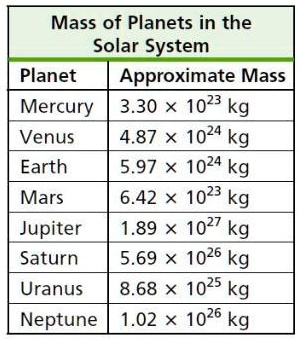
Consider the masses of the following planets in our solar system:
Order them from smallest mass to greatest mass
Earth
Venus
Mercury
Neptune
Mars
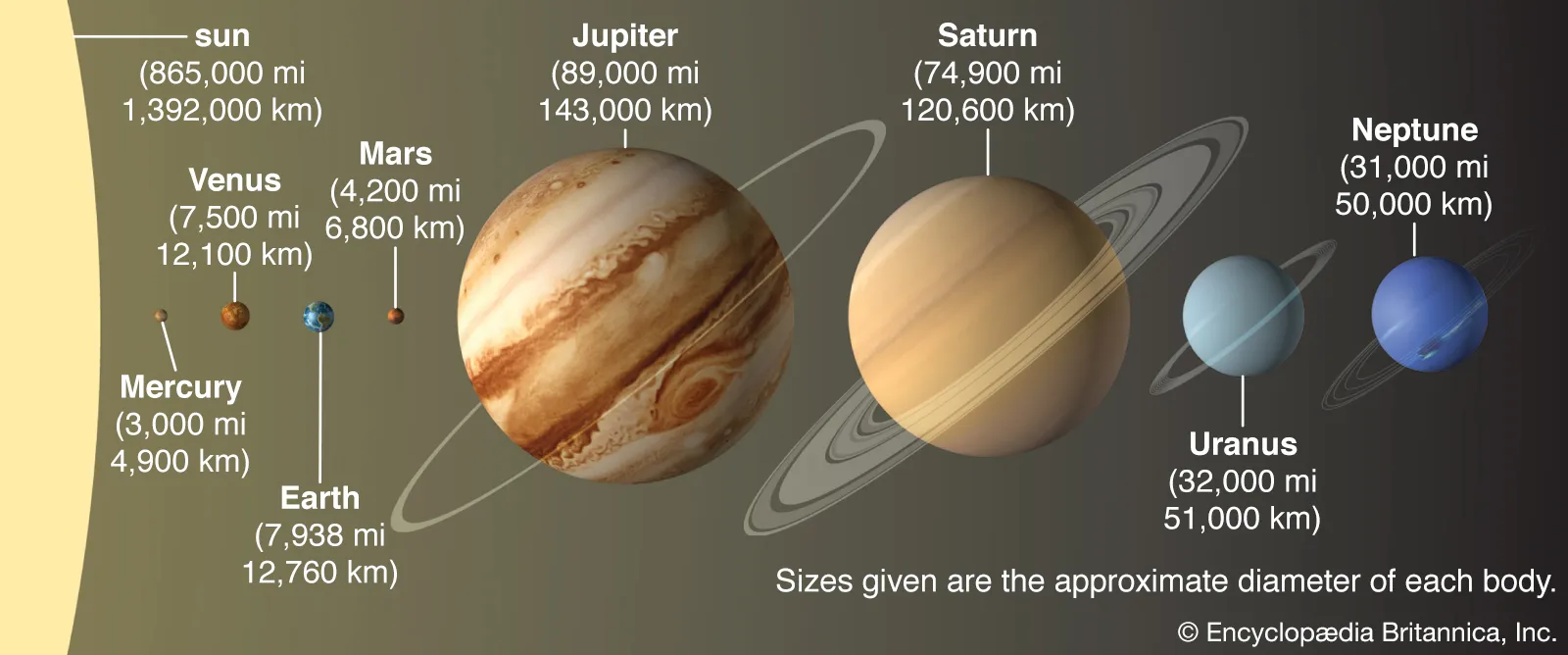
Order the planets from smallest to largest (diameter)
Earth
Mercury
Mars
Neptune
Venus
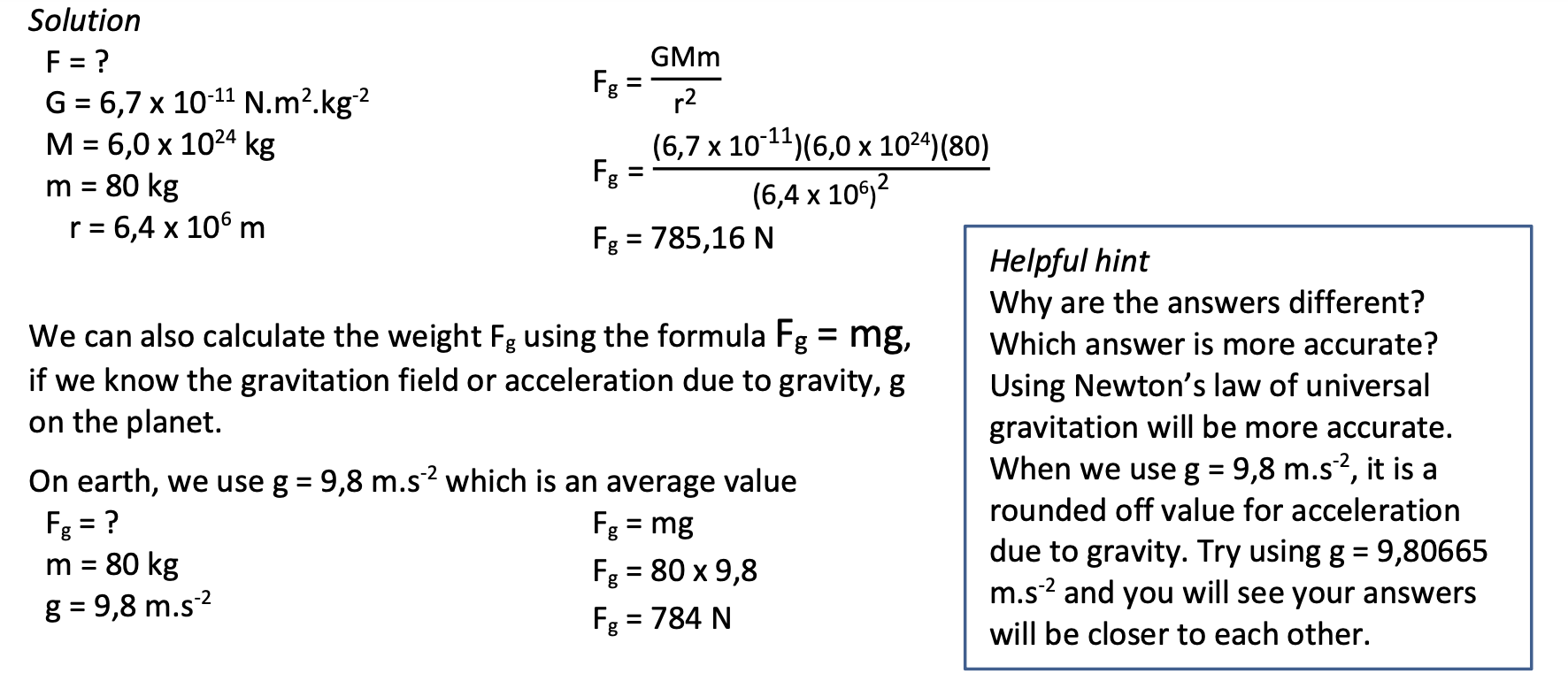
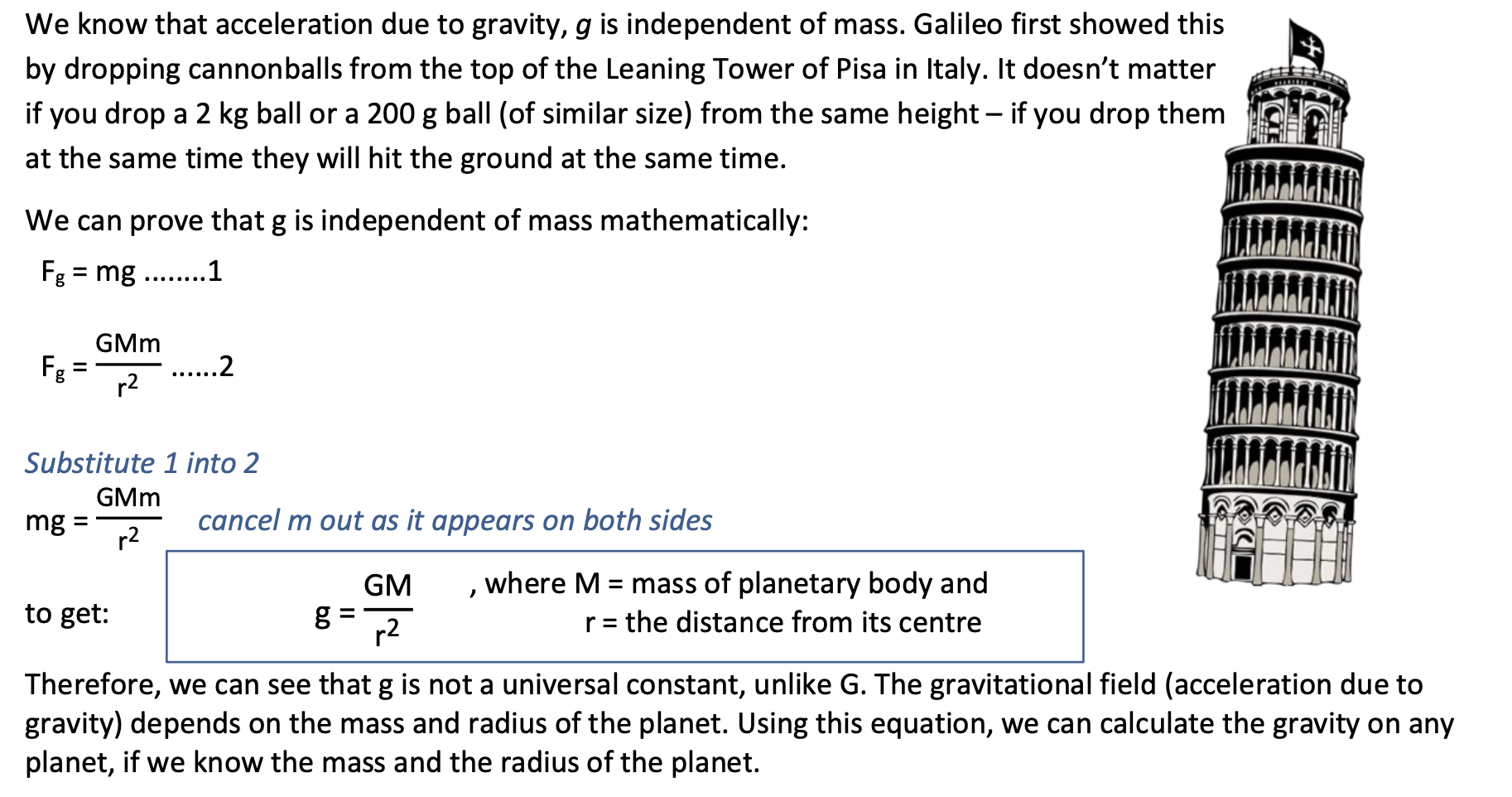
Calculate the value of the acceleration due to gravity "g" on Mars, by following this reasoning:
Mars has a mass of
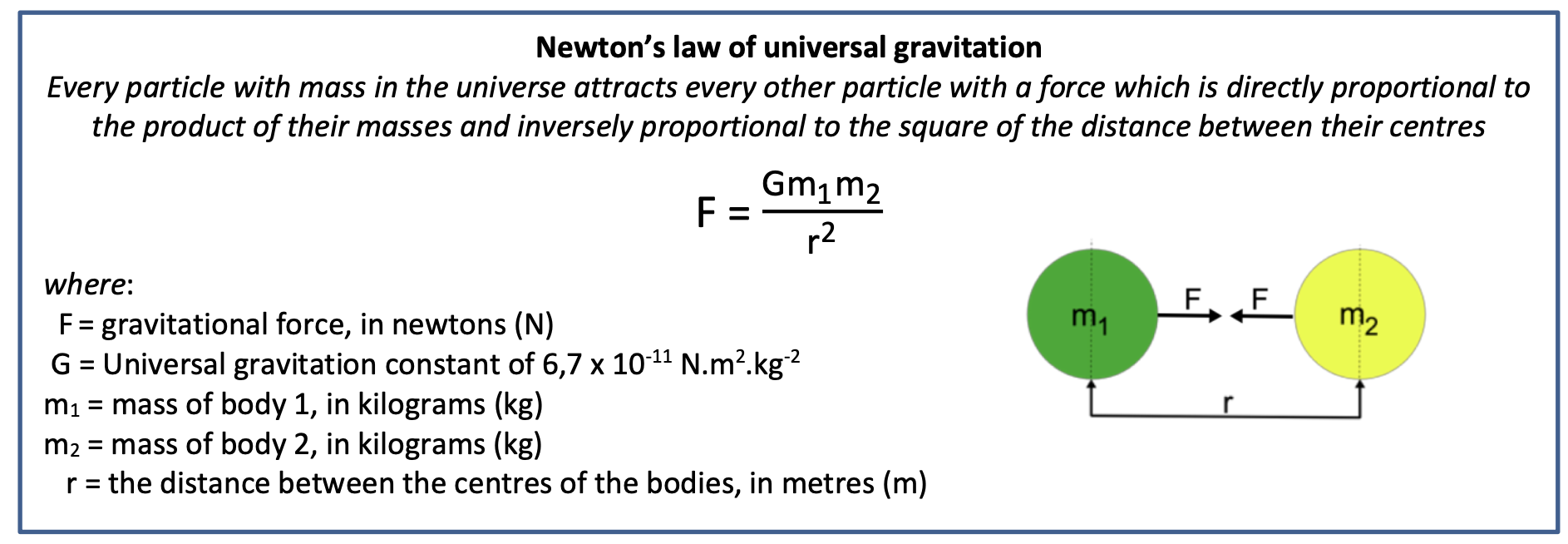
Using the equation:
Remember that big "G" = 6,7 x 10⁻¹¹
g can be calculated to be
We are now going to calculate the gravitational force (F) between Earth and Venus when they are 61 000 000 km apart, using Newton's law of universal gravitation:
m1 = mass of Earth =
m2 = mass of Venus =
To calculate "r":
HINT: Look above at the information provided to remind yourself what 'r' is.
Use the information in the image above (sizes of the planets) and the fact that they are 61 000 000 (or 6,1 x 10^7 km) apart.
∴ r =
Gravitational force is therefore:
∴ F =
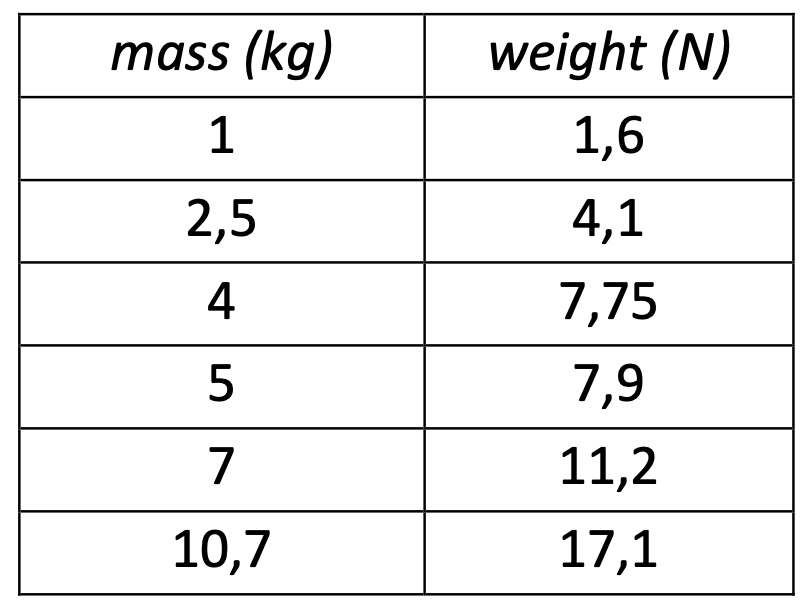
The following data was collected on a particular planet during an investigation to calculate the acceleration due to gravity (g) on that planet. The weight of each mass was measured and the results were recorded in the table below:
Plot a graph of weight vs mass on your piece of graph paper. Draw a line of best fit.
On the back of your graph, calculate the gradient of your line. Be sure to show the values you used ON YOUR ACTUAL GRAPH (circle them) and also include the appropriate unit for this gradient (as per the graph)
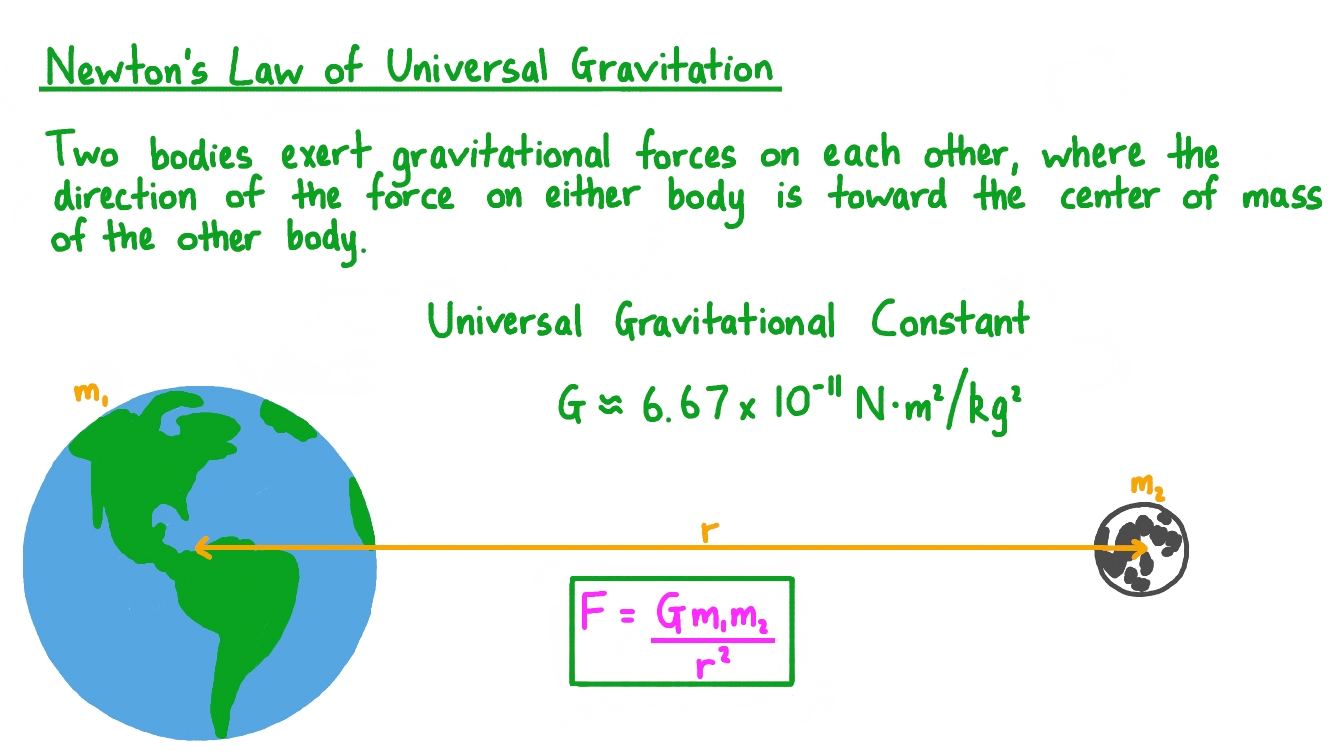
Watch the video on Newton's law of universal gravitation. Here is the link if this video is not working on Formative: video
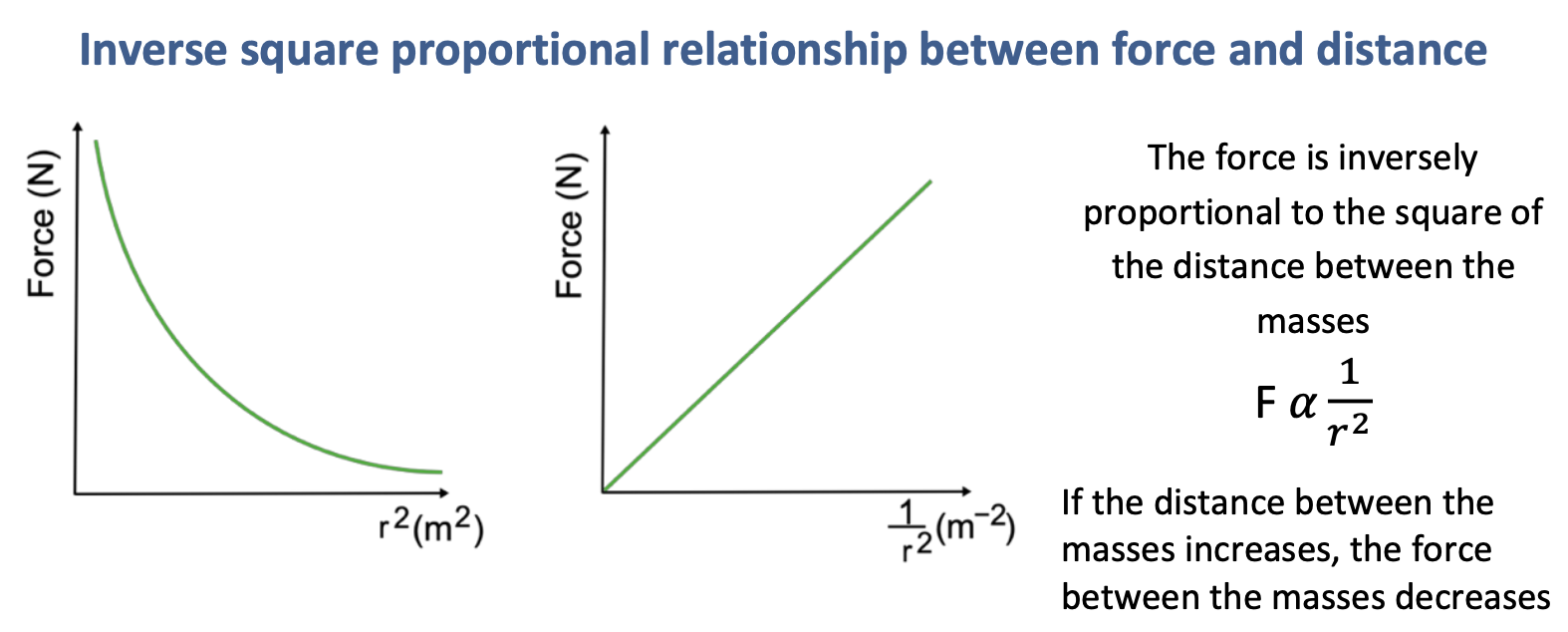
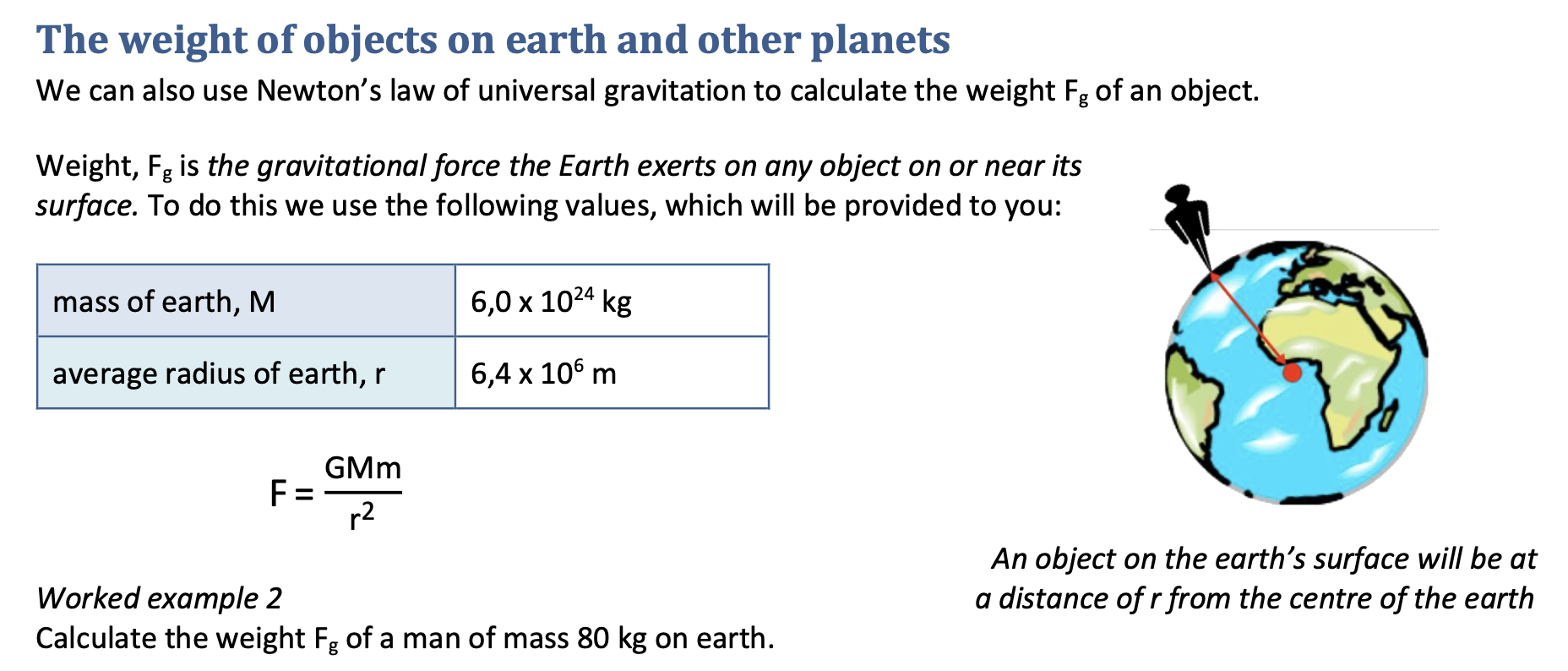
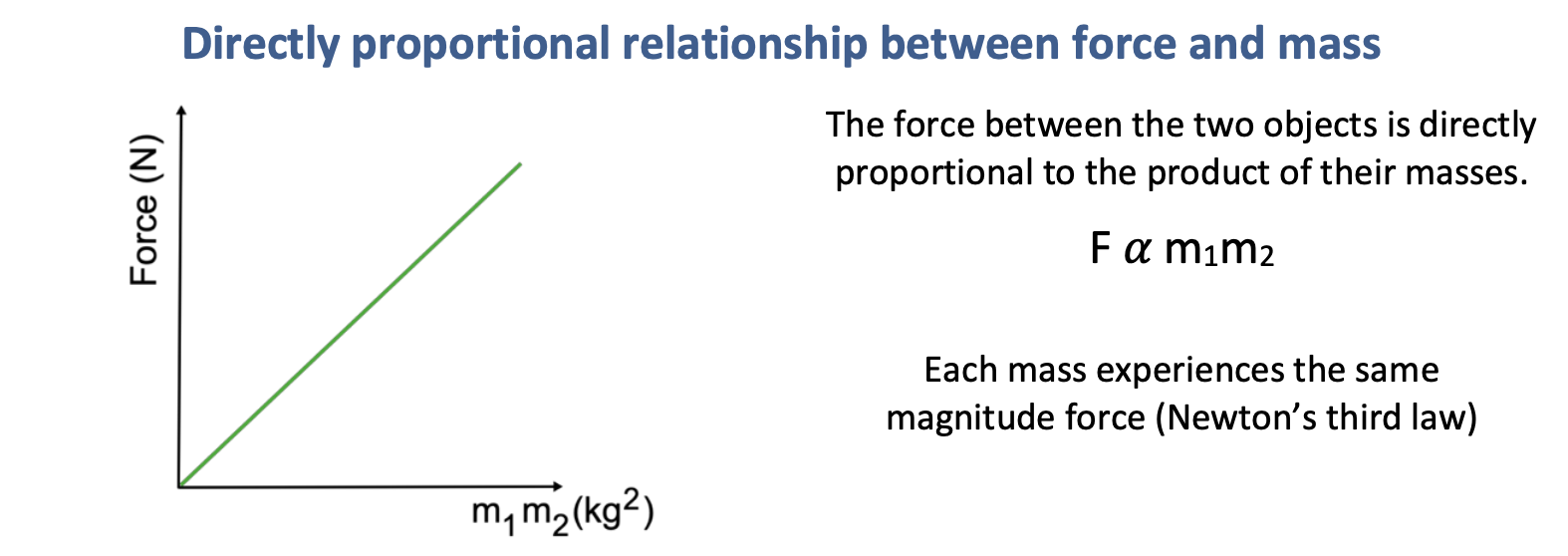
Newton's law of universal gravitation is described below too:
What happens to an object's weight when it is taken to a location with higher gravity, such as a planet with greater mass?
Identify the variables in this investigation.
The dependent variable is and the independent variable is .
What is the acceleration due to gravity (g) on this planet? Use the appropriate unit.
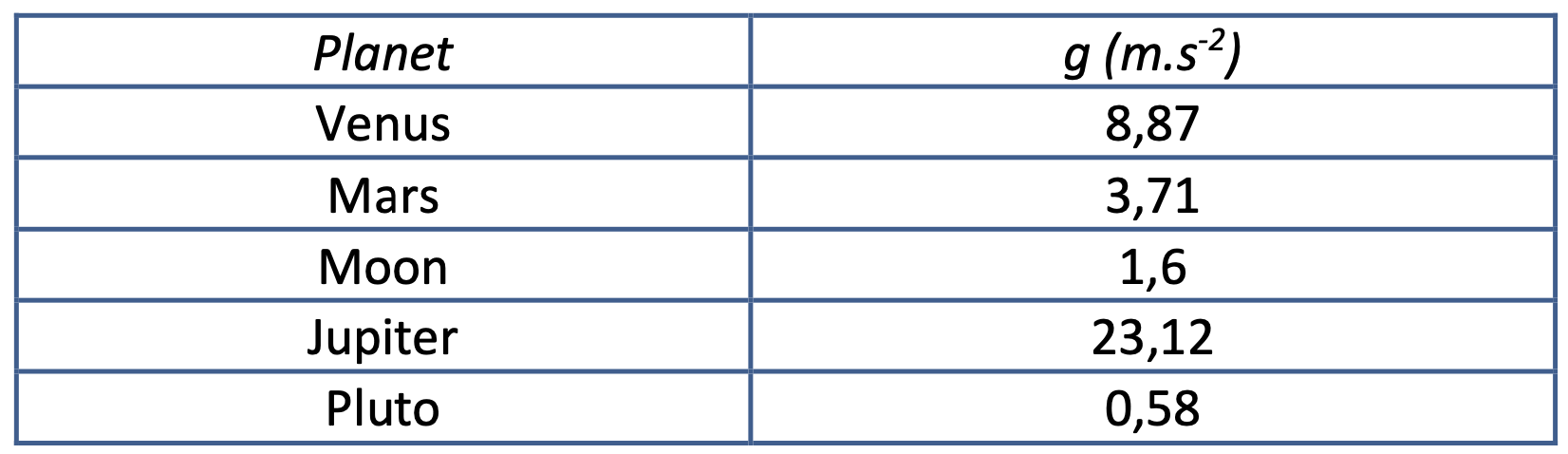
Hence, use the following data to identify the planet used in this investigation: