Non-Contact Forces (Electricity and Magnetism)
star
star
star
star
star
Last updated over 4 years ago
68 Nsɛmmisa
0
1
1

1
1
0
1
0

1
1
1
1
1
1
1
1
1
1
1
1
1
1
1
0
1
1
1
1
1
1
1
1
1
9
5

1
1
1
1
1
1
1
1
1
1





Our big question is:
1. Welcome Activity
2. Video - Electric forces in action
3. Wrap-up - What do you want to know?
This week, we're diving into the world of noncontact forces! Please choose the force gif you find most appealing.
I think the fire started because...
Refresh my memory. What's a force again?
Watch this video to find out more:
How do you think static electricity can apply a force (a push or a pull)?
Use what you learned in the video to support your answer.
Wrap-Up:
We saw some really interesting phenomena today and we've only scratched the surface on this topic!
Write at least one question/wondering you have going into this unit about noncontact forces?
Our big question is:
1. Welcome Activity
2. Parts of the atom
3. Charges exert forces
4. Wrap-up: Adding notes to your notebook
This week, we're diving into the world of noncontact forces, such as magnetism!
What is this magnet attracting?! (Draw something!)
Read:
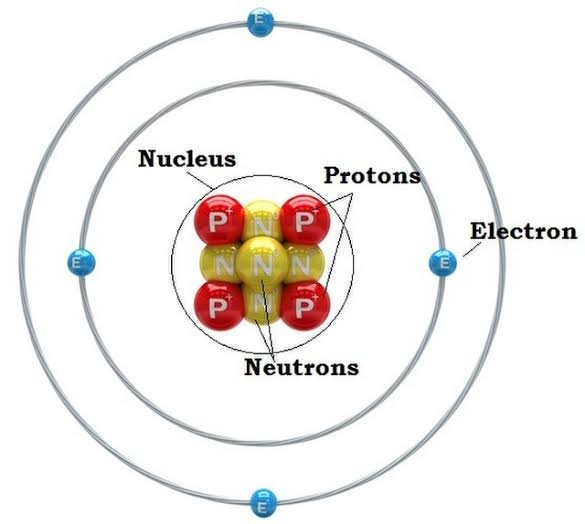
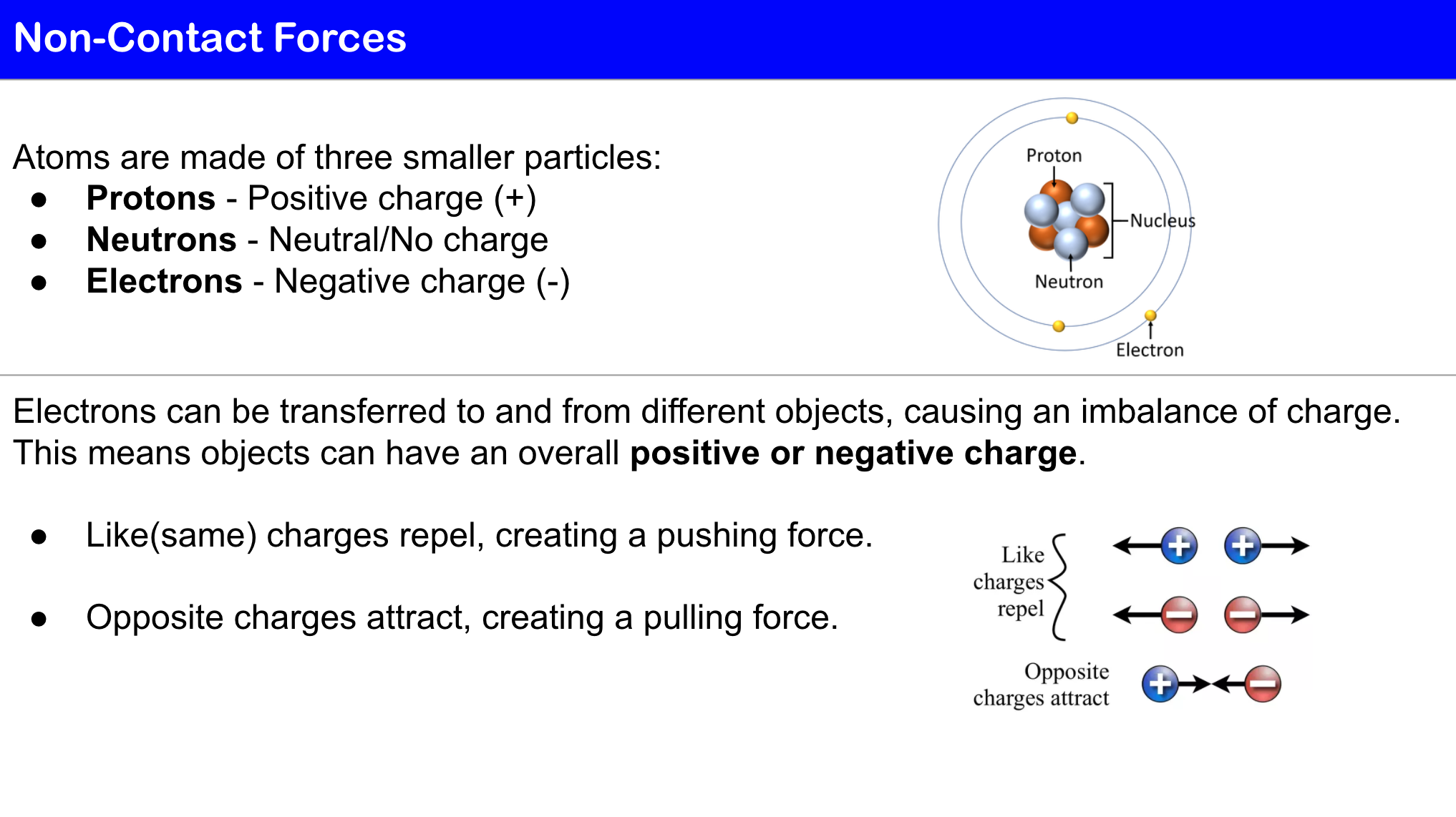
All matter is made up of very small particles called atoms. Atoms are made of even smaller particles called protons, neutrons and electrons.
Protons and neutrons make up the center of the atom, the nucleus. Electrons are found outside the nucleus.
Protons and electrons are charged particles. Neutrons are not.
Protons are positively charged (+)
Electrons are negatively charged (-)
Charge is a physical property.
An object can have a positive charge, a negative charge, or no charge (neutral).
Charged objects exert a force – a push or a pull – on other charged objects
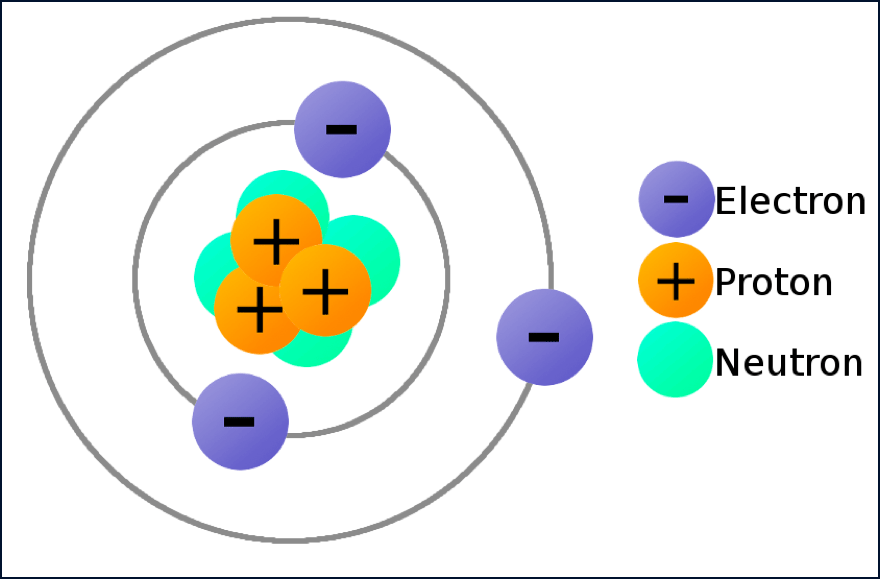
Neutrons and protons are...
Objects that have the same charge repel each other (push each other away). Each object exerts a force on the other object, which pushes the objects apart.
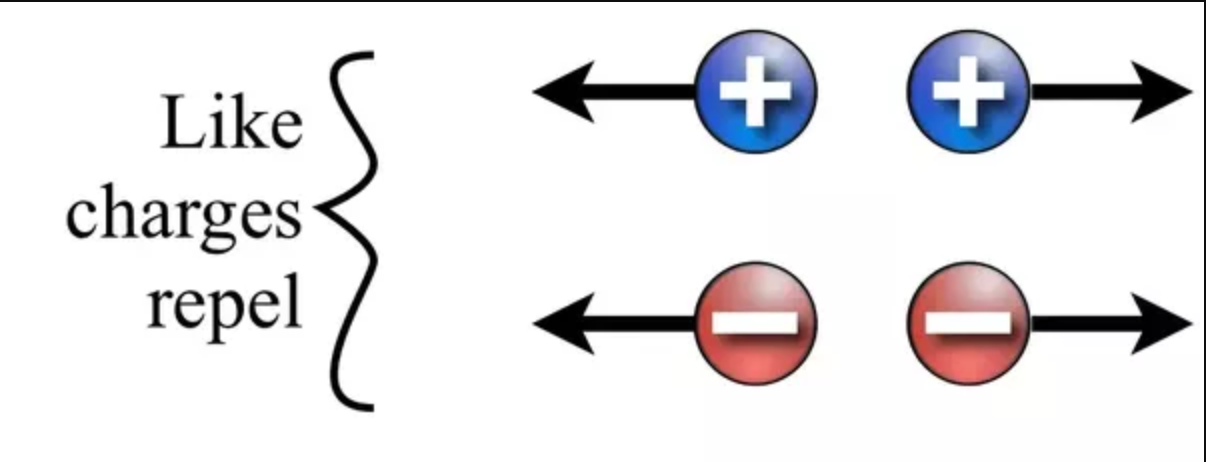
Objects that have opposite charges are attracted to each other. Each object exerts a force on the other object. These forces pull the objects together.

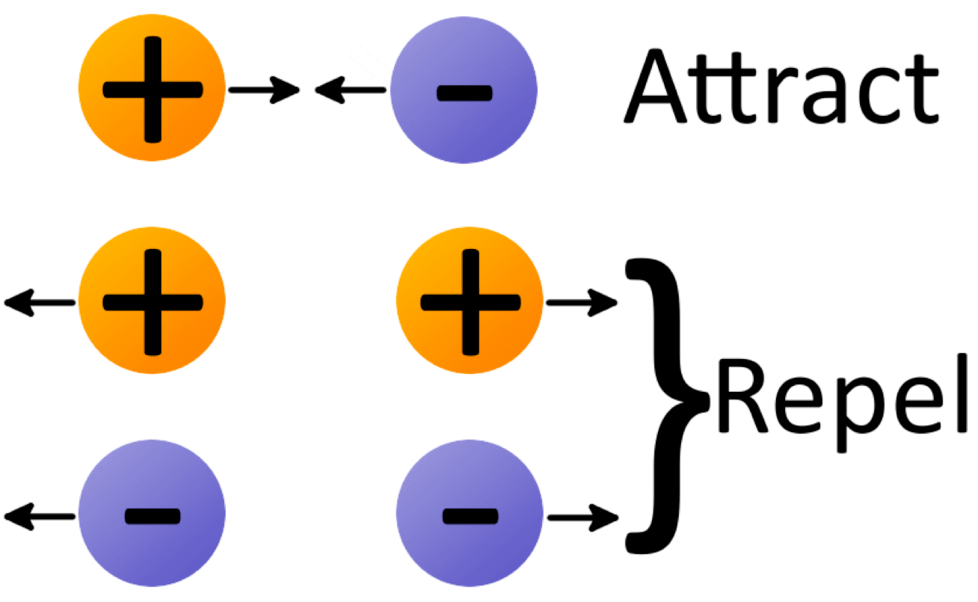
This is an example of two objects that have the same charge and are attracted to each other.
This is an example of two objects that have the opposite charge and are attracted to each other, creating a pull.
Now that we have done some learning around electric forces, take what you know and use science to explain how the fire at the gas pump started in the video on question 2.
Words that you could use: electrons, negative charge, positive charge, attract, repels
Add the following notes to your science journal. These important concepts will be on a quiz at a later date.
Our big question is:
1. Welcome Activity
2. Quick review
3. Balloon and sweater lab
4. Wrap-up
This week we are continuing our studies of non-contact forces. Since today we'll be doing a balloon lab, draw a person (or furry being) with some staticy balloon hair!
(Hint: If you click the little hand tool, you can move the balloon up for more drawing space)
Which particles are found in the nucleus (center) of an atom?
Which particles have a positive (+) charge?
Which particles have a negative (-) charge?
When objects with like (same) charges meet, they will.....
When objects with opposite charges meet, they will.....
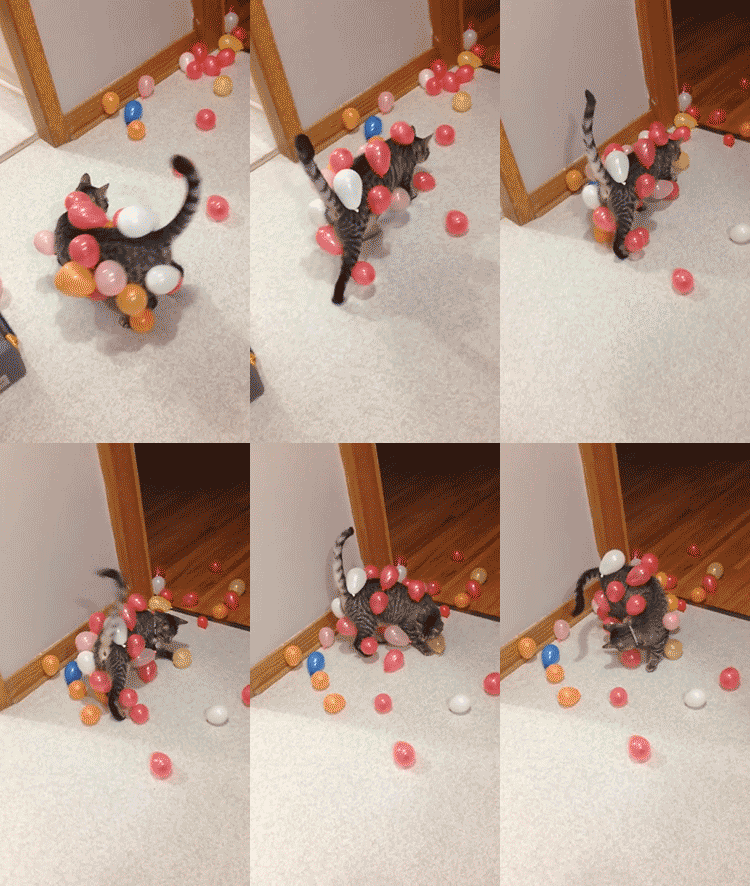
Did you know?
An object's charge can change by transferring electrons (negatively charged) from one object to another. Charges cannot be created nor destroyed, only transferred.
DIRECTIONS:
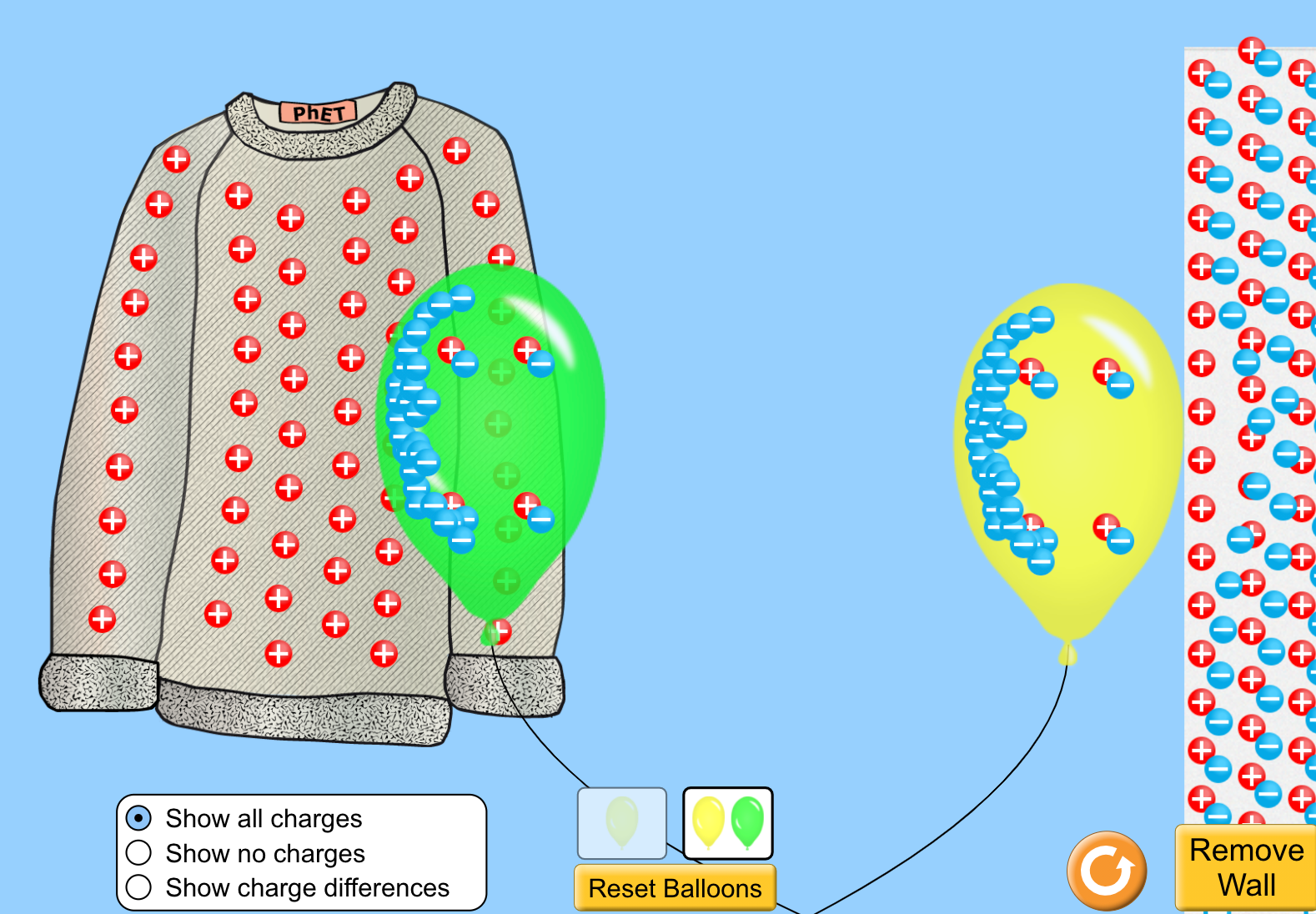
Use PhET simulator below to help you respond to each of the questions below.
Rub the yellow balloon on the sweater. What happens?
Collect all of the negative charges from the sweater by rubbing the balloon on the sweater. Attach the yellow balloon to the wall.
What do you notice about the charges interaction with the wall? Record your observations
1. Select the yellow and green balloon button at the bottom of the
screen.
2. Rub the yellow balloon on only the top half of the sweater to
collect only half of the negative charges. Attach the yellow balloon to
the wall at the center.
3. Rub the green balloon on the bottom half of the sweater to collect the other half of the negative charges. Attach the green balloon to the right side of the sweater in the center.
Click the remove wall button.
What happens to the yellow balloon?
Click on the yellow balloon and move it away from the sweater.
How can you use the green balloon to keep the yellow balloon from attaching to the sweater?
How do objects become positively charged?
How do objects become negatively charged?
What type of interactions did you observe between objects of the same electrical charge?
What type of interactions did you observe between objects with different electrical charges?
Did objects have to touch to interact?
What causes this?
Today's big question was "How do electric charges exert forces on one another?"
Rate how you're feeling about this topic so far.
Our big question is:
1. Welcome Activity
2. Video observations and responses
3. Things to think about (Peardeck)
4. Wrap-up
Circle how you are feeling on a scale of duck!
Write two thoughts or questions you have about the phenomena you just watched.
How does the distance between objects affect the strength of magnetic attraction?
Wow! Seeing those forces in action was pretty awesome! Let's see what you know about magnetic forces using Peardeck!
Live class today? Use this Peardeck!
On-demand? Use this Peardeck
Our question today is "How do magnetic forces work?" Rate how you're feeling about this topic below.
Our big question is:
1. Understanding Magnetic Behaviors
Listen while you read the text below and answer the questions that follow.
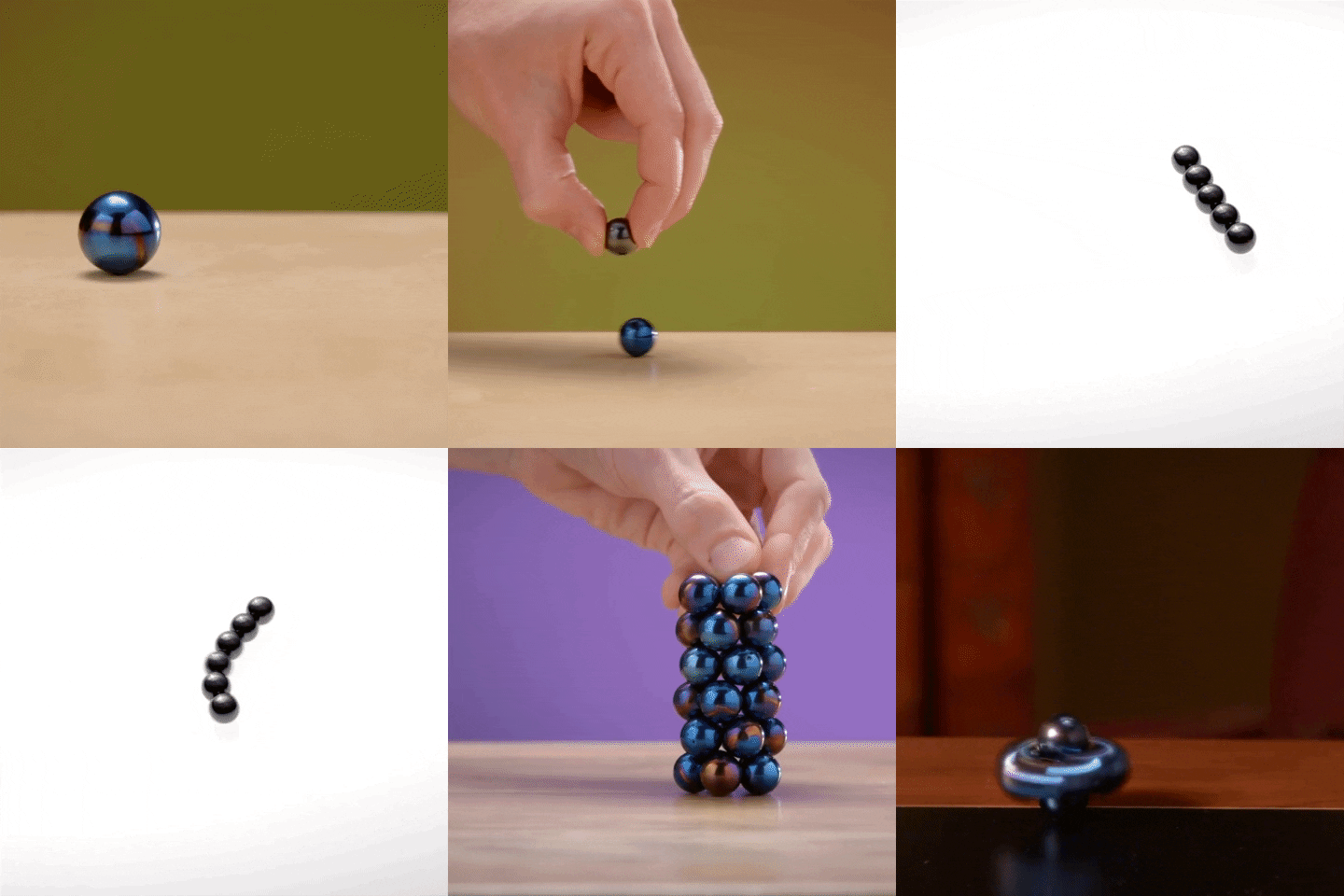
Every magnet has two poles - a north and a south pole. No matter what shape a magnet come in, it has two poles, no more and no less. By seeing what you can do with the poles of a magnet, you can learn how magnets behave.
If you hold two magnets together, what happens? The answer depends upon which poles you hold together.
"LIKE" POLES REPEL
If you hold two north poles together, they push apart. The same thing will happen if you hold two south poles together. We say that two north poles are "like" poles. Two south poles are also "like" poles. "Like" poles always repel each other.
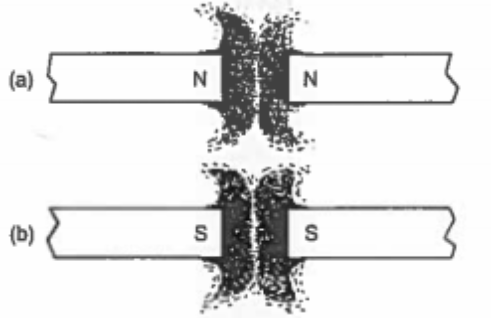
"UNLIKE" POLES ATTRACT
What happens if you hold a north and a south pole together? They pull toward each other. A north pole and a south pole are "unlike" poles. "Unlike" poles always attract each other.
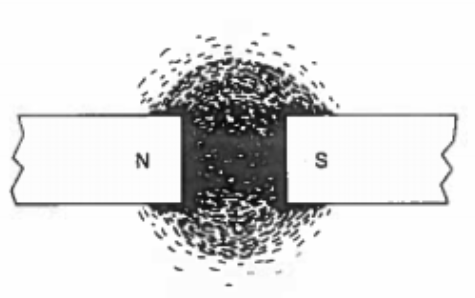
Like poles
Unlike poles
The push or pull that you feel when you hold two magnetic poles together is magnetic force. Every magnet can push or pull other magnetic material. The magnetic force is strongest at the magnet's poles. The space around a magnet where magnetic forces can act is called the magnetic field. Lines of magnetic force reach through space from a magnet's north pole to its south pole. These lines of force are closest together at the poles of a magnet. You cannot see magnetic lines of force. They are invisible.
A magnetic field becomes stronger the closer you get to the magnet. The magnetic field grows weaker the farther you get from the magnet. A magnet can push or pull a magnetic material that is in its magnetic field. A magnet can do this without touching the other object. This ability is why we say that magnets have magnetic energy.
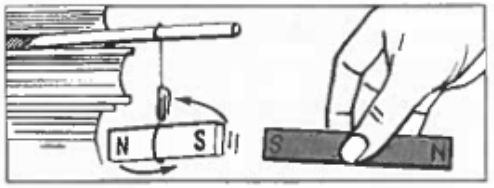
The hand is holding the south pole close to the _______________ pole of the hanging magnet.
The ________ poles are closest together.
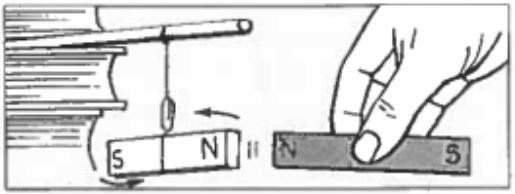
The hand is holding the north pole close to the _______________ pole of the hanging magnet.
The ________ poles are closest together.
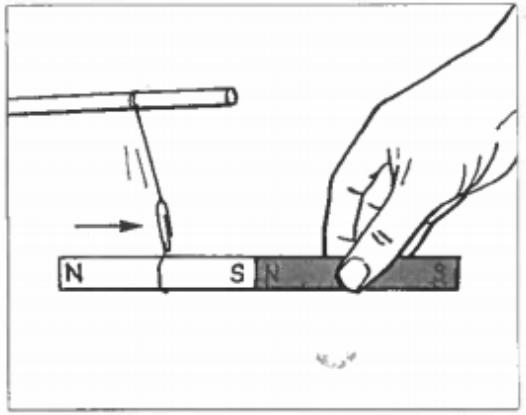
The hand is holding the north pole close to the _______________ pole of the hanging magnet.
The ________ poles are closest together.
Like poles __________.
Unlike poles __________.
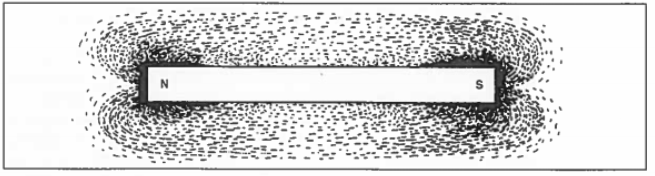
A magnetic field is strongest ___________ a magnet.
As you move away from a magnet, the magnetic field becomes ___________________.
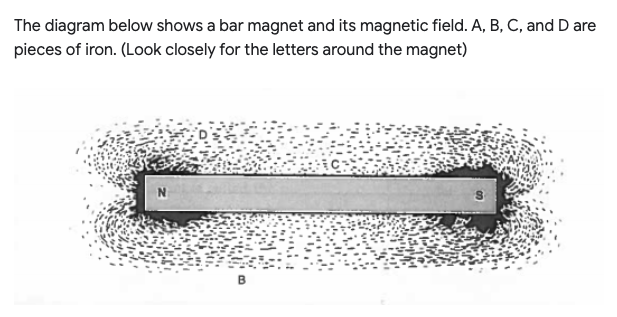
Which pieces of iron are outside the magnetic field?
Match the magnetic terms and descriptions below.
| Draggable item | arrow_right_alt | Corresponding Item |
|---|---|---|
like poles | arrow_right_alt | A magnet is strongest at the ___________. |
attract | arrow_right_alt | One end of a magnet is called the _____________; and the other is called the __________. |
north pole; south pole | arrow_right_alt | A south pole and south pole, or a north pole and north pole are called ______________. |
poles | arrow_right_alt | A north pole and south pole are called _____________. |
magnetic field | arrow_right_alt | Two north poles or two south poles will _______________. |
repel | arrow_right_alt | A north pole and a south pole will _________________. |
unlike poles | arrow_right_alt | Where the power of a magnet is felt is called its ________________. |
Match the magnetic terms and descriptions below.
| Draggable item | arrow_right_alt | Corresponding Item |
|---|---|---|
center of magnet | arrow_right_alt | repel |
iron, nickel, cobalt | arrow_right_alt | attract |
like poles | arrow_right_alt | make up magnetic field |
unlike poles | arrow_right_alt | weakest part |
lines of force | arrow_right_alt | magnetic substances |
A north pole and a north pole are like poles.
Two north poles are the only like poles
Like poles attract
A north pole and a south pole are unlike poles.
Unlike poles repel.
Lines of force are invisible.
A magnet is strongest at the middle.
Glass and paper are magnetic substances.
Iron is a magnetic substance.
The big question is, "How do magnets behave?" Choose the gif below that best illustrates how much you feel like you have learned about magnetism.
Electrons are...
This is an example of two objects that have the same charge, which is creating a push.
These poles will _______.
These poles will _______.
These poles will _______.
Most of the iron filings are at ______________.
There are fewer iron filings at ______________.
A magnet is strongest at _______________.
A magnet is weakest at _______________.
Most iron filings are _______________ the magnet.
As you move away from the magnet, there are ______________ iron filings.
Which pieces of iron are inside the magnetic field? (Check all)
Look at the pieces that are inside the magnetic field. Which one does the magnet attract the most?