1
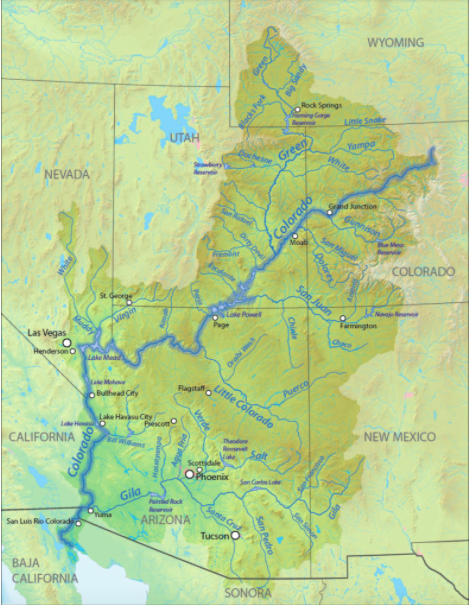
The Colorado River provides and transports water between how many US states?
The Colorado River provides and transports water between how many US states?
1
Students will analyze, compare and constrast mathematical models of snowfall in Colorado and its affects on the western United States
Students will investigate the cycle of water in the western US and droughts affetcts on disruption of human and environmental systems
Students will connect past, present, and future models of megadrought conditions in order to provide solutions
Students will analyze, compare and constrast mathematical models of snowfall in Colorado and its affects on the western United States
Students will investigate the cycle of water in the western US and droughts affetcts on disruption of human and environmental systems
Students will connect past, present, and future models of megadrought conditions in order to provide solutions
Match the terms to their definitions.
| Draggable item | arrow_right_alt | Corresponding Item |
|---|---|---|
Precipitation | arrow_right_alt | Water vapor condensed in the atmosphere |
Condensation | arrow_right_alt | Liquid water that covers over 70% of Earth's surface |
Transpiration | arrow_right_alt | Large stores of frozen fresh water |
Percolation | arrow_right_alt | Large underground stores of fresh water |
Glaciers | arrow_right_alt | Water vapor becomes a liquid |
Infiltration | arrow_right_alt | Water falling from the atmosphere in the form of rain or snow |
Ocean | arrow_right_alt | When water reaches the solid surface of the Earth and travels downhill due to gravity (not absorbed in the ground) |
Cloud | arrow_right_alt | When precipitation lands on a plants |
Evaporation | arrow_right_alt | When water reaches the solid surface of the Earth and is absorbed into the top layer of soil |
Interception | arrow_right_alt | Water moves through the deeper layers of the ground (soil, bedrock) |
Surface Runoff | arrow_right_alt | When water goes from a liquid to a gas |
Aquifer | arrow_right_alt | When a plant sucks up water from the surrounding soil |
The Colorado River provides and transports water between how many US states?
Go here to look at some snowfall data and use it to answer the following questions: https://www.weather.gov/bou/SeasonalSnowfall
Start at the year 1990. What differences do you see over time?
Has cumulative snowfall increased or decreased over time?
Has snowfall shifted to certain months?
What conclusions can you draw from the data from 1990 and about today? What differences have occurred over time? Name at least 3.
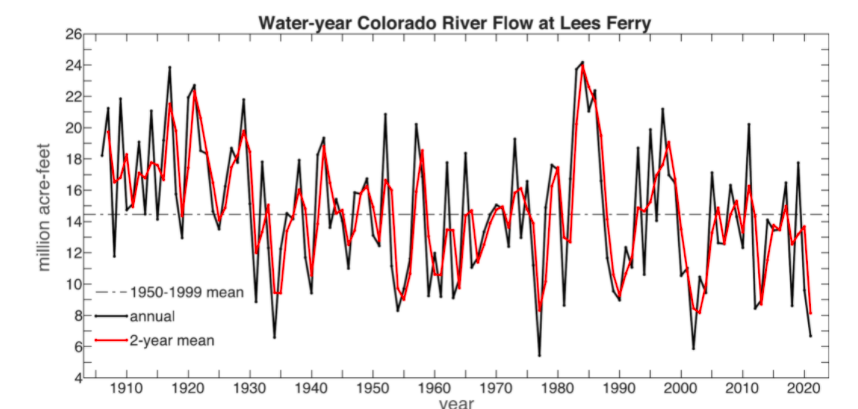
Based on the graph, does the Colorado River have more or less water now that it did 100 years ago?
How do you know? Use evidence from the graph to support your answer to the previous question.
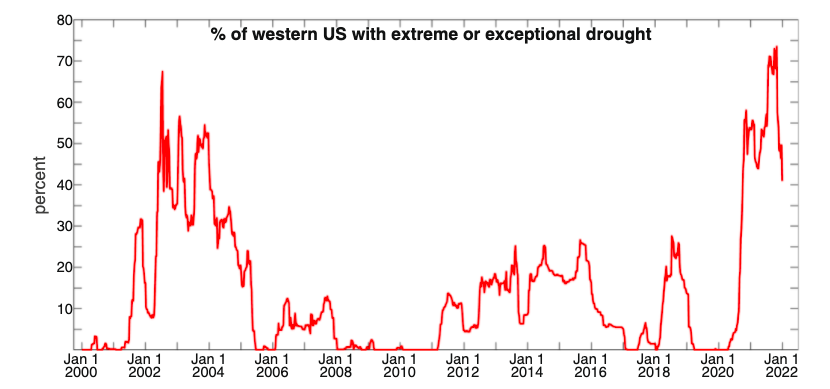
Approximately what percent of the Western US is currently experiencing extreme or exceptional drought?
What ideas do you have about what could be causing the drought?
Water levels at Lake Powell, the United States' second-largest reservoir, have dropped by more than 150 feet during the ongoing megadrought.
Shrunk reservoirs. Depleted aquifers. Low rivers. Raging wildfires. It's no secret that the Western U.S. is in a severe drought. New research published Monday shows just how extreme the situation has become.
The Western U.S. and northern Mexico are experiencing their driest period in at least 1,200 years, according to the new study, published in the journal Nature Climate Change. The last comparable — though not as severe — multidecade megadrought occurred in the 1500s, when the West was still largely inhabited by Native American tribes.
Today, the region is home to tens of millions of people, massive agricultural centers and some of the fastest-growing cities in the U.S. — all in an area where there's less water available than there was in the past, partially due to human-caused climate change.
"We have a society that's relying on there being the amount of water there was in the 1900s," said the study's lead author, Park Williams, a bioclimatologist at the University of California, Los Angeles. "But now with the number of water molecules available to us declining, it really is time for us to get real about how much water there is for us to use."
Williams looked at tree ring data from thousands of sites to conduct the research. The researchers sampled data collected from live trees, dead trees and wood beams preserved at Native American archeological sites. The tree rings gave Williams insight into drought events dating back to A.D. 800, around the time Charlemagne was being crowned emperor of Rome.
He identified four other megadroughts in that time period, the most notable being a 23-year drought that ended in the late 1500s. There were hopes during a wet 2019 that the current megadrought was following a similar pattern, Williams said.
"And then from summer 2020 through all of 2021, it was just exceptionally dry across the West ... indicating that this drought is nowhere near done."
Western water managers were again hopeful for a change at the beginning of this winter. In December, California's Sierra Nevada had record-breaking snowfall, and big snowstorms blanketed the northern Rockies. But a hot, dry start to the year has since dropped snowpack levels to below average in many places.
Water sparkles on a shrinking Lake Powell near the Cathedral in the Desert monument in Glen Canyon.
Lake Mead and Lake Powell, the country's two largest reservoirs, are filled at only about one-third of their total capacity. Communities, ranchers and farmers have depleted groundwater stores to meet demands.
Federal water managers declared the first-ever water shortage along the Colorado River last year, triggering cuts to some of the river's 40 million users. It was a recognition "that the hydrology that was planned for years ago — but we hoped we would never see — is here," said Bureau of Reclamation Commissioner Camille Touton.
"The Colorado River Basin no longer has the privilege of time," said Kim Mitchell, senior water policy adviser at Western Resource Advocates, an environmental nonprofit, after hearing about the new research. "It's imperative for water managers in the West to incorporate a smaller [Colorado] River into future operations and pull out all the stops in scaling up basin-wide conservation. Incremental solutions just won't be enough."
Existing management guidelines for the Colorado River are set to expire in 2026. The seven states that draw from the watershed are negotiating with the federal government, Native American tribes and Mexico over what future management should look like.
Last December, Nevada, Arizona and California agreed to take less water from the Colorado River in an effort to prop up Lake Mead, and more cuts could follow.
"This is a wake-up call for everyone," Adel Hagekhalil, general water manager for the Metropolitan Water District of Southern California, told KUNC. "For all of us. We are facing a new normal when it comes to climate change."
Williams, the study author, said roughly one-fifth of the current megadrought can be attributed to human-caused climate change. Greenhouse gas emissions are warming the world, speeding evaporation and disrupting weather patterns.
He described water patterns in the West as a yo-yo — sometimes high, sometimes low. Climate change has put that yo-yo on an escalator heading down, he said, "and we cannot let ourselves get tricked by a few wet years into giving up on the progress we've been making."
"We actually have to change our relationship with water."
Summarize the article in 5-7 sentences.
The Colorado River starts in Colorado. Where do you think the majority of the water that feeds into the Colorado River comes from?
How many people lack access to clean drinking water?
By 2025, how many people worldwide will be living in water-stressed areas?
What are some reasons to explain the water shortages?
What are some things anyone can do to conserve water?
What is a desalination plant? What are some pros and cons to desalination plants?