Log in
Sign up for FREE
arrow_back
Library

British Policies

star
star
star
star
star
Last updated over 4 years ago
11 questions
2
2
2
2
20
2
2
2
2
2
2
Question 1
1.

Question 2
2.

Question 3
3.

Question 4
4.

Question 5
5.

Draggable itemarrow_right_altCorresponding Item
arrow_right_alt
arrow_right_alt
arrow_right_alt
arrow_right_alt
arrow_right_alt
arrow_right_alt
arrow_right_alt
arrow_right_alt
arrow_right_alt
arrow_right_alt
Question 6
6.

Question 7
7.

Question 8
8.

Question 9
9.

Question 10
10.

Question 11
11.

Base your answer to the question below on the map below and on your knowledge of social studies
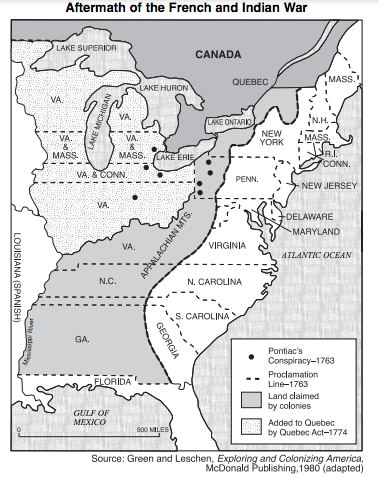
Many colonists were angered by the Proclamation of 1763 because it
limited their freedom to move west
took too much land from Canada
gave Florida to the French
encouraged raids by Native American Indians
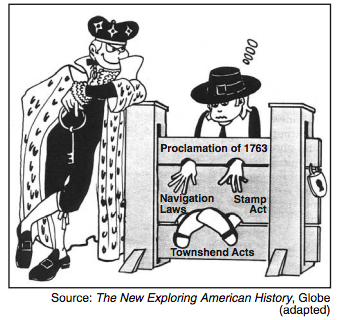
Base your answer to the question on the illustration below and on your knowledge of social studies.

What is the main idea of this illustration?
The colonists were restricted by the laws passed by the British government.
The King of England wanted the colonists to have a greater voice in government.
Repeal of unpopular laws was the only way out of the stocks.
King George III put many American colonists in stocks.
What was the major effect of the Stamp Act (1765) on colonial trade?
The colonists no longer needed British goods.
The British refused to sell certain products to the colonists.
The law led to a decline in the value of colonial currency.
Many colonists boycotted British goods.
Which statement is most consistent with the views of Loyalists in the 1770s?
The colonists should be grateful to be under British rule and protection.
Taxation without representation is tyranny.
Citizens, under British rule, have the right to declare independence.
The king is violating the rights of British citizens.
Choose the correct term for the correct definition
Introloerble Act
Seven Years' War, which pitted the North American colonies of the British Empire against those of the French, each side being supported by various Native American tribes.
Stamp Act
In a confrontation in Boston on March 5, 1770, nine British soldiers tried to annihilate killed colonists.
French and Indian War
Was an American protest by the Sons of Liberty in Boston, Massachusetts, on December 16, 1773 Sons of Liberty Dressed up like Native Americans.
Townshed Act
The King put into place a new law that will allow colonists to be taxed on sugar or unrefined sugar.
Sugar Act
Any crimes that are committed in the 13 colonies that rise to the level of a capital offense, such as Murder or Treason, within the Colony of Massachussetts, it will be up to the Governor appointed by the King to decide how the trial shall proceed. The Governor will have the authority or power to decide whether or not a fair trial can be had within the Colonies. If a fair trial cannot be held in the colony the offense took place the Governor has the authority to move the trial in another Colony or to Great Britain to be sure a fair trial is had
Boston Tea Party
A law that will allow a place for army soldiers to stay. Carriages and other items that the army will need on marches must be stored and quartered by the colonists. Anyone who refuses will be penalized. Towns are going to be responsible places where soldiers can have a place to eat and rest.
Proclamation of 1763
The loyal subjects of the King of England, the members of the British Government, Parliament, have made the following laws.
It has been decided to give, charge, and pay to the King, several new taxes, that will be mentioned here. The taxes will be based on the following system and scale.
Tea- for every 16 oz of tea, a tax of three pence will be charged.
Paper- For every ream of paper 12 shillings will be charged. (1 shilling = 12 pence)
Silk Handkerchiefs- 1 square yard, will be taxed 1 penny.
Quartering Act
An act or law that will remove the tax on his Tea in his Majesty’s colonies or plantations in America. This is being done to increase the amount of Black Tea sold through the British East India Trading Company. It gives the power to the British East India Trading Company to have a monopoly on Tea in the British Colonies.
Tea Act
A law that allows the colonies to be taxed because they received protection during the French and Indian War.
Colonists will be taxed two shillings for every sheet of paper and writing utensils used. Furthermore, playing cards, stamps, dice which shall be used or sold within the colonies will be taxed by the pack, for one shilling.
Boston Masacre
This establish a Western Border for the 13 Colonies at the Appalachian Mountains. It was a boundary that colonists were not allowed to pass.
Many American colonists believed that British tax laws were unfair because
colonists lacked representation in Parliament
the British treasury had a surplus of funds
Native American Indians were exempt from British tax laws
taxes were higher in the colonies than in England
Which statement expresses an opinion about the causes of the Revolutionary War?
Colonists participated in triangular trade.
The Boston Massacre took place on March 5, 1770.
The Quartering Act was a serious violation of the colonists’ liberties.
Samuel Adams founded the Sons of Liberty
The slogan “No taxation without representation” referred to taxes enacted by
colonial legislators
the English Parliament
town meetings
the First Continental Congress
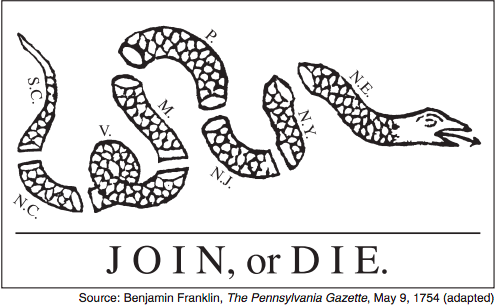
Which statement most accurately expresses the main idea of this illustration from the 1750s?

Colonies cannot survive unless they are united.
Colonies that do not unite are not loyal.
Each colony should maintain its independence.
Any colony that does not unite will be attacked.
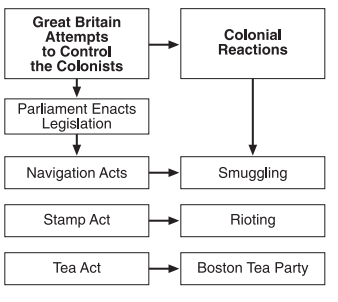
Base your answer to the question on the chart below and on your knowledge of social studies.

Which conclusion is best supported by the chart?
The Stamp Act led to widespread smuggling.
Colonists raised revenue by imposing new taxes.
British policies were opposed by many colonists.
The colonists reacted to British laws in a nonviolent way.
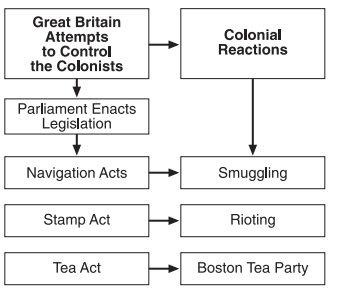
Base your answer to the question on the chart below and on your knowledge of social studies.


The series of events shown in the chart led directly to the
start of the French and Indian War
outbreak of the American Revolution
formation of a colonial alliance with Prussia
rejection of the Albany Plan of Union