In the 1920s, Dr. Edwin Hubble made a discovery that profoundly changed our understanding of the universe and its origin. He showed that some of the numerous distant, faint clouds of light in the universe were actually entire galaxies—much like our own Milky Way. The realization that the Milky Way is only one of many galaxies forever changed the way astronomers viewed our place in the universe.
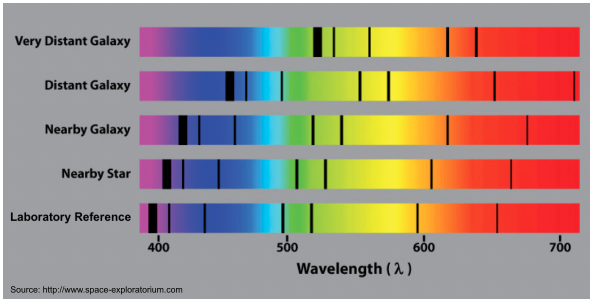
Hubble wanted to learn more about these galaxies beyond our own and began to closely examine their light spectra, the black lines on the spectrums (also known as absorption lines). These spectra are like the spectra from stars within our galaxy that we analyzed and interpreted as part of our stars investigation, but it comes from the light of an entire galaxy, not just one star.
Analyze the light spectra from other galaxies, a nearby star, and a laboratory reference of hydrogen and helium gas, then answer the questions that follow.
1 point
1
Question 1
1.
What similarities or patterns do you notice for individual wavelengths of light across all the spectra? What do you think might cause these patterns?
1 point
1
Question 2
2.
What is different about each spectra?
1 point
1
Question 3
3.
Is there a relationship between the absorption line wavelengths and the distance of the galaxies from Earth? If so, what is it?
Exploring the Doppler Effect - The Doppler Ball
1 point
1
Question 4
4.
Describe your experiences as the Doppler Ball was thrown around the room.
1 point
1
Question 5
5.
Why do you believe this phenomena happens?
What is the Doppler Effect
1 point
1
Question 6
6.
Summarize the video here.
Model 1 - What happens when a sound source is moving?
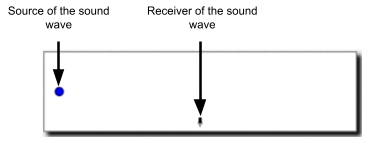
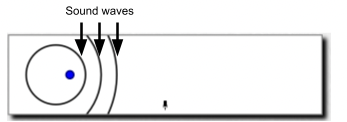
Visit this site, which shows a sound wave being emitted from a souce.
source
1 point
1
Question 7
7.
Mute(uncheck) the Snare drum sound. Try snapping your fingers every time a sound wave is produced by the blue dot.
Does the way you snap your fingers get faster, slower, or is it constant as the source moves along the screen?
1 point
1
Question 8
8.
Now re-check the snare drum sound and turn on your speakers. As the blue dot moves towards the receiver, what happens to the speed of the drumming sound?
1 point
1
Question 9
9.
How do the waves provide evidence of that?
1 point
1
Question 10
10.
As the blue dot moves away the receiver, what happens to the speed of the drumming sound?
1 point
1
Question 11
11.
How do the waves provide evidence of that?
Model 2: What is the relationship between the pitch of a sound and its wavelength?
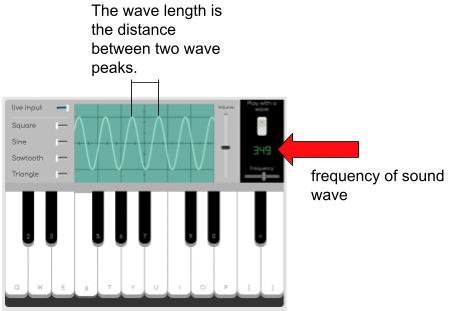
Open Model 2. Use the simulator to study the relationship between the sound (pitch) and the characteristics of the wave. Play with the keys and take notes about what you observe in the graph. Use the concepts of frequency and wavelength (highlighted in the image below) to describe the patterns in the relationship between pitch and wave characteristics.
1 point
1
Question 12
12.
What happens to the sound you hear as the frequency increases?
1 point
1
Question 13
13.
What happens to the wavelength as frequency increases?
1 point
1
Question 14
14.
Think back to model 1. How did the wavelength change relate to the time between hearing a snare sound?
Model 3: What happens to light waves when they travel from their source to an observer?
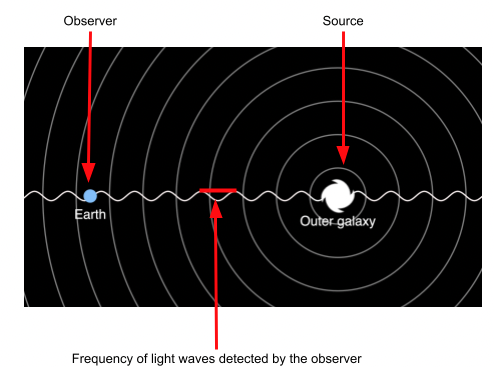
Goal of this activity: The perceived change in frequency of sound waves you heard as the sirens came toward and away from you is called the doppler effect.In this investigationyou will use a computer simulation to investigate the change in frequency and wavelength of light.
The doppler effect influences all waves, like sound or light. In the case of light, instead of perceiving changes in pitch (like sound), we perceive changes in color. If something of a particular color is moving at a very high speed away or towards us, you will see a wave associated with a different color. This is the case with objects in the universe, they move at a really high speed. Let’s work on this simulator to understand this better.
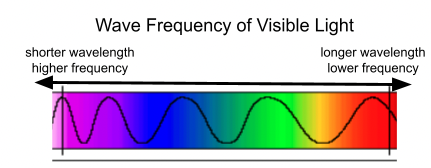
The above image shows that when the frequency of light is high, its color is closer to the blue end of the spectrum, and when the frequency of light is low, its color is closer to the red end of the spectrum. Now let's imagine two objects in the universe, one source of light (e.g., a galaxy) and one observer (you on Earth!), as illustrated in Model 3.
Open Model 3 and make observations about the change in frequency in each of the situations in the table below.
Also predict the change of color perceived by the observed in a particular situation. For example, according to the Wave frequency of visible light graph below, if the frequency of waves detected by the observer is higher, the color should move towards the blue; if it is lower, it should move towards the red.
Required
1 point
1
Question 15
15.
Change of color perceived by the observer on Earth?
(shift toward red, blue or no shift?)
Redshift
Blueshift
No Shift
The galaxy is not moving, but close to the Earth.
The galaxy is moving toward Earth.
The galaxy is moving away from Earth.
Required
1 point
1
Question 16
16.
Is there a change in frequency of the light waves perceived by the observer on Earth?