#1 - 6: Tell whether the ordered pair is a solution of the inequality. Show work/Justify your answer.
1 point
1
Question 1
1.
1 point
1
Question 2
2.
1 point
1
Question 3
3.
1 point
1
Question 4
4.
1 point
1
Question 5
5.
1 point
1
Question 6
6.
Graph the inequality:
1 point
1
Question 7
7.
1 point
1
Question 8
8.
Select all the ordered pairs that are solutions to the inequality in #7.
1 point
1
Question 9
9.
1 point
1
Question 10
10.
Select all the ordered pairs that are solutions to the inequality in #9.
1 point
1
Question 11
11.
1 point
1
Question 12
12.
Select all the ordered pairs that are solutions to the inequality in #11.
1 point
1
Question 13
13.
1 point
1
Question 14
14.
1 point
1
Question 15
15.
1 point
1
Question 16
16.
Write an inequality of the graph shown. You may use slope-intercept form, point-slope form, or standard form.
1 point
1
Question 17
17.
1 point
1
Question 18
18.
1 point
1
Question 19
19.
1 point
1
Question 20
20.
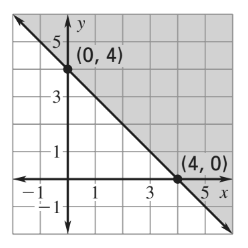
Select all the points below that are in the solution to the inequality graphed:
1 point
1
Question 21
21.
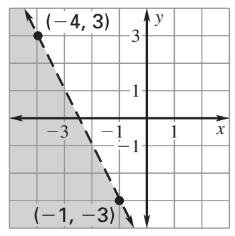
Select all the points below that are in the solution to the inequality graphed:
You are going clothes shopping and can spend at most $130 on clothes. It costs $30 for a pair of pants and $22 for a shirt. Let x represent the number of pairs of pants you can buy. Let y represent the number of shirts you can buy.
1 point
1
Question 22
22.
Write an inequality (in standard form) that describes the different number of shirts and pants you can buy.
1 point
1
Question 23
23.
Graph your inequality here:
We have released a new and improved Graphing question type! Students will no longer be able to answer this question.
1 point
1
Question 24
24.
Give three possible combinations of pants and shirts you can buy.