Asemmisa {{asɛmmisaAhyɛnsode}}
1.
Answers to free response questions can be found using the "Hint" button
Answers to free response questions can be found using the "Hint" button
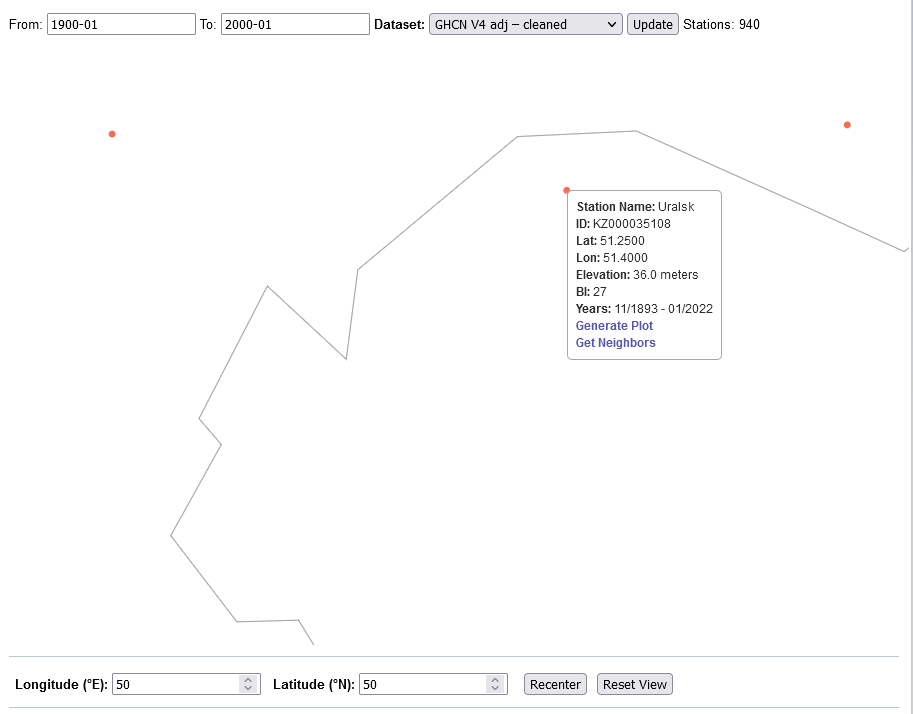
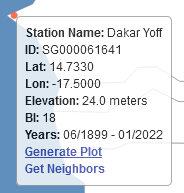
Hover over your station and click "generate plot"
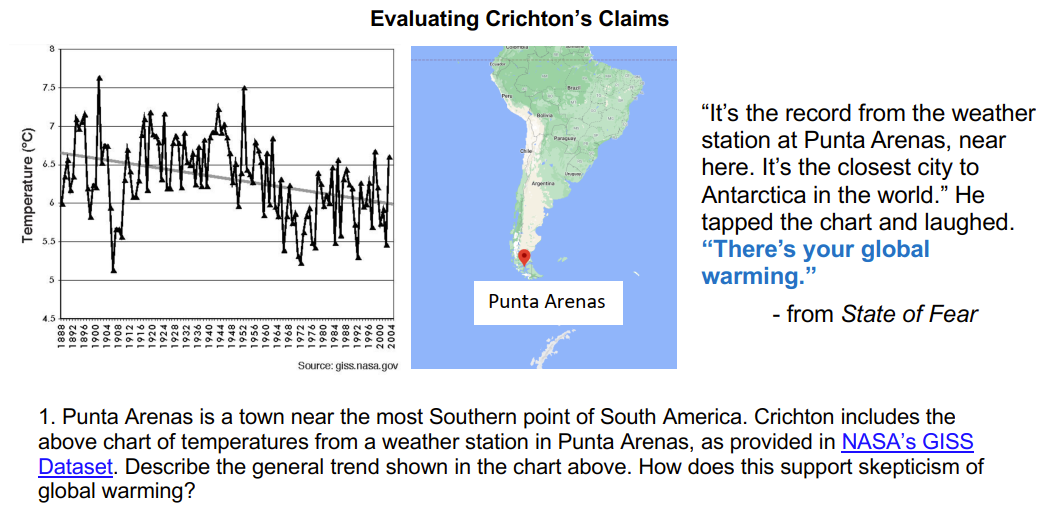
Take a look at the plot of temperates and describe the general trend you see. Is this evidence that would support or contradict climate change?
Scroll down below your plot and click on "Download monthly data as text"
You should see a table of temperatures. The very last column to the right is labeled as "metANN" and is the "meteorological annual mean". Enter the meteorological annual mean temperature of your station in 1900 below.
Round to the nearest hundredth. If your data says 999.99, pick the nearest year with real data.
Enter the meteorological annual mean temperature of your station in 2000 below
Round to the nearest hundredth. If your data says 999.99, pick the nearest year with real data.
As people answer questions 3 and 4, Oliver will type the data in for everyone on the board.
Once all the data is in, but before making any calculations, does it appear that there is evidence supporting the idea of climate change?
Well, Oliver isn't here, so we will work with last year's data:
Here is the data from student # 1-16. Each column represents a single location, with the mean temperature in 1900 in row 1 and the mean temperature in 2000 in row 2.
Does it appear that there is evidence supporting the idea of climate change?
Assume the data meets all conditions.
Using your calculator, calculate the 2-sample T Interval (95% confidence) for the difference in average temperature in 1900 and 2000 (T1900-T2000) and input it below.
(
Round to the nearest tenth
Does the confidence interval provide convincing evidence that the temperature in 1900 is different from 2000?
Explain.
While the data looks convincing, our 2 sample t-interval did not give us convincing evidence to match our gut reaction to the data.
The data we collected is paired data. We know this because every data point for 1900 has a specific data point in 2000 that is from the exact same location.
When our data is paired, we can get more accurate results by performing a Paired t Interval for a Mean Difference
Instead of treating the data as two separate samples as we did above, we start our process by finding the difference between each pair of values. Take each data point for 1900 and subtract the corresponding data point from 2000. This new set of data is called the "Difference"
Fill in the middle values:
2:
11:
15:
Round to the nearest hundredth
We will use the mean and standard deviation of the differences to create a confidence interval for the true difference.
Type the difference data into L1 of your calculator.
What is the average of the differences? (Use Stat->Calc->1-VarStats)
=?
Round to the nearest hundredth
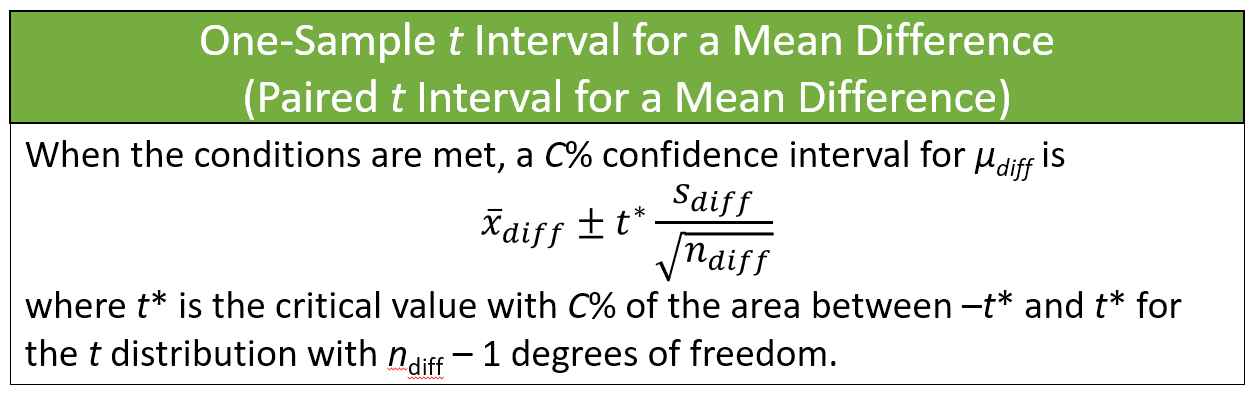
You can now use TInterval (the same function we used for 1 sample mean intervals in 10.1) to calculate a 95% confidence interval for the DIFFERENCE in temperature between 1900 and 2000.
(
Round to the nearest tenth
Does the confidence interval provide convincing evidence that the temperature in 1900 is different from 2000?
Explain
(Or use TInterval on Calculator)
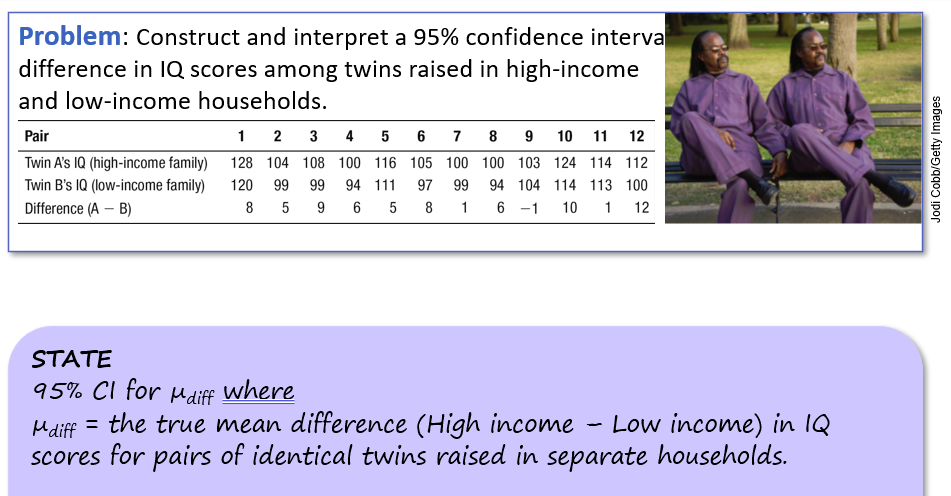
STATE
PLAN
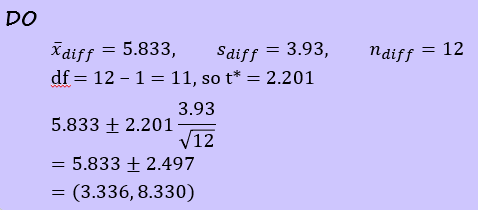
DO
(
Round to the nearest hundredth
CONCLUDE
Just find the interval, no need to STATE, PLAN, DO, and CONCLUDE again
(
Round to the nearest Hundredth
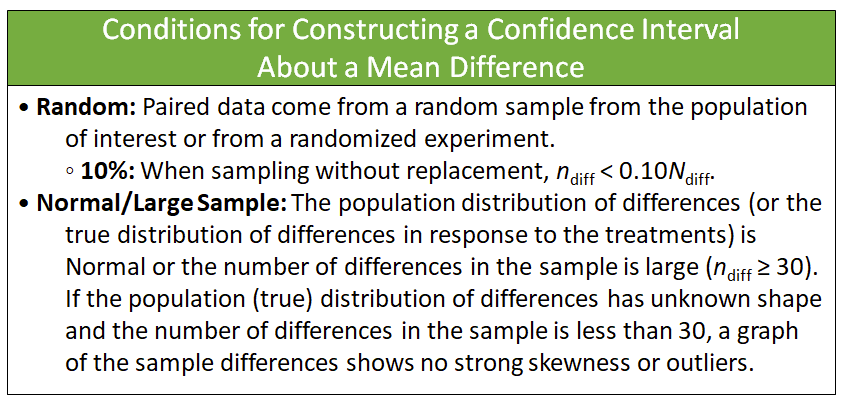
Are the conditions met?
Explain
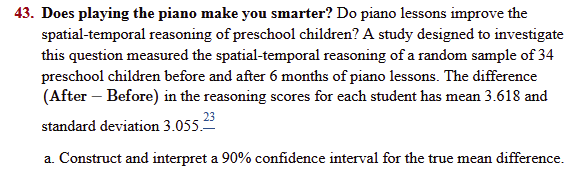
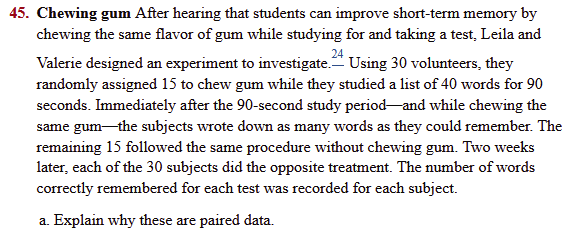
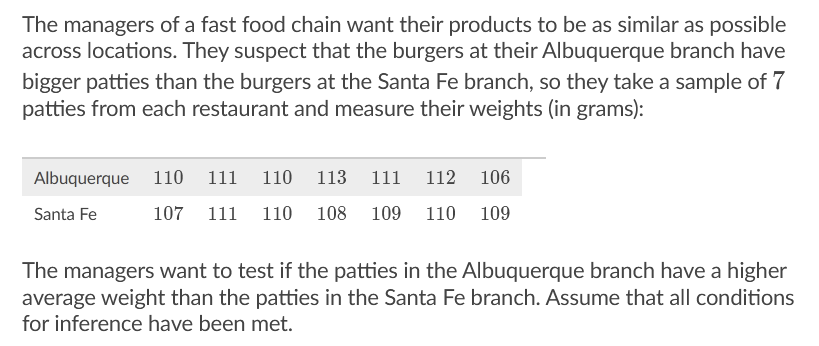
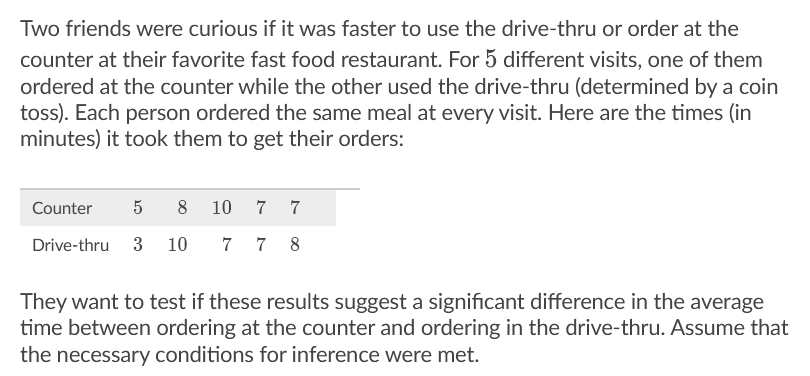
In each of the following settings, decide whether you should use two-sample t procedures to perform inference about a difference in means (last class) or paired t procedures to perform inference about a mean difference. (today's class)
The main way to tell is to ask yourself "Are the data points able to be paired in any logical way?". A common method of pairing is measuring two different variables using the same location/subject. Or taking two "identical" subjects and giving each a different treatment.
Luke’s taco shop is considering a switch to a new tortilla that supposedly has a larger diameter. To test this claim, Luke takes a random sample of 50 of the old tortillas and 50 of the new tortillas and records the diameter of each.
Luke’s taco shop wants to be sure that the new tortillas taste better than the old tortillas. Luke selects a random sample of 20 regular customers. Each customer is asked to try both tortillas and then record a “taste” score for each. The order in which the customers try the two tortillas is randomized.
Luke’s taco shop is not sure whether to cook the tortillas in the oven or on the grill. The chefs want tortillas to cook as quickly as possible. Luke sets up an experiment taking a batch of 50 tortillas and randomly assigning half of them to be cooked one at a time in the oven and half of them to be cooked one at a time on the grill. The time it takes until ready to serve is recorded for each tortilla.
Owen lives in New York City and his brother Karson lives in Boston. They both complained about the high prices of avocado in their neighborhoods, so they decided to test whether there's a difference in the average price of avocado.
Each of them took a random sample of shops in their neighborhoods and got the price of avocado from each shop.
An exercise scientist wanted to test the effectiveness of a new program designed to increase the flexibility of senior citizens. They recruited participants and rated their flexibility according to a standard scale before starting the program. The participants all went through the program and had their flexibility rated again after a month.
The scientist wants to test if the flexibility ratings are significantly higher after a month of the program.
Are there any problems above that you would like to go over in class? Indicate the question numbers below (Numbers refer to the Formative question number). I'll try to cover anything that is highly requested.