Log in
Sign up for FREE
arrow_back
Library

Shortened Biology 1 Review

star
star
star
star
star
Last updated almost 2 years ago
40 questions
1
1
1
1
1
1
1
1
1
1
1
1
1
1
1
1
1
1
1
1
1
1
1
1
1
1
1
1
1
1
1
1
1
1
1
1
1
1
1
1
Question 1
1.

Question 2
2.

Question 3
3.

Question 4
4.

Question 5
5.

Question 6
6.

Question 7
7.

Question 8
8.

Question 9
9.

Question 10
10.

Question 11
11.

Question 12
12.

Question 13
13.

Question 14
14.

Question 15
15.

Question 16
16.

Question 17
17.

Question 18
18.

Question 19
19.

Question 20
20.

Question 21
21.

Question 22
22.

Question 23
23.

Question 24
24.

Question 25
25.

Question 26
26.

Question 27
27.

Question 28
28.

Question 29
29.

Question 30
30.

Question 31
31.

Question 32
32.

Question 33
33.

Question 34
34.

Question 35
35.

Question 36
36.

Question 37
37.

Question 38
38.

Question 39
39.

Question 40
40.

Which element is found in all organic molecules, is used by plants for photosynthesis and is recycled by decay and burning?
A. carbon
B. hydrogen
C. oxygen
D. nitrogen
What is the monomer for carbohydrates?
A. nucleotide
B. amino acid
C. monosaccharide
D. fatty acid
What is a function of carbohydrates?
A. short term energy
B. provide structure and support, and speeds up chemical reactions
C.long term energy and insulation
D. stores genetic information
An example of carbohydrates are?
A. phospholipids and oils
B. glucose and sucrose
C. helicase and lipase
D. DNA and RNA
What is the monomer of proteins?
A. nucleotide
B. amino acid
C. monosaccharide
D. fatty acid
What is a function of proteins?
A. short term energy
B. provide structure and support, and speeds up chemical reactions
C. long term energy and insulation
D. stores genetic information
An example of proteins are?
A. phospholipids and oils
B. glucose and sucrose
C. helicase and lipase
D. DNA and RNA
What is the monomer of lipids?
A. nucleotide
B. amino acid
C. monosaccharide
D. fatty acide
What is a function of lipids?
A. short term energy
B.provide structure and support, and speeds up chemical reactions
C. long term energy and insulation
D. stores genetic information
An example of lipids are?
A. phospholipids and oils
B. glucose and sucrose
C. helicase and lipase
D. DNA and RNA
What is the monomer of nucleic acids
A. nucleotide
B. amino acids
C. monosaccharides
D. lipid
What is a function of nucleic acids?
A. short term energy
B.provide structure and support, and speeds up chemical reactions
C. long term energy and insulation
D. stores genetic information
The molecule is a
A. carbohydrate
B. lipid
C. protein
D. nucleic acid
The molecule is a
A. carbohydrate
B. lipid
C. protein
D. nucleic acid
What is the function of enzymes?
A. store energy
B. speed up reactions
C. provide insulation
D. provide protection
Living things maintain a balance between their cells and their environment in a process called
A. reproduction
B. growth
C. homeostasis
D. translation
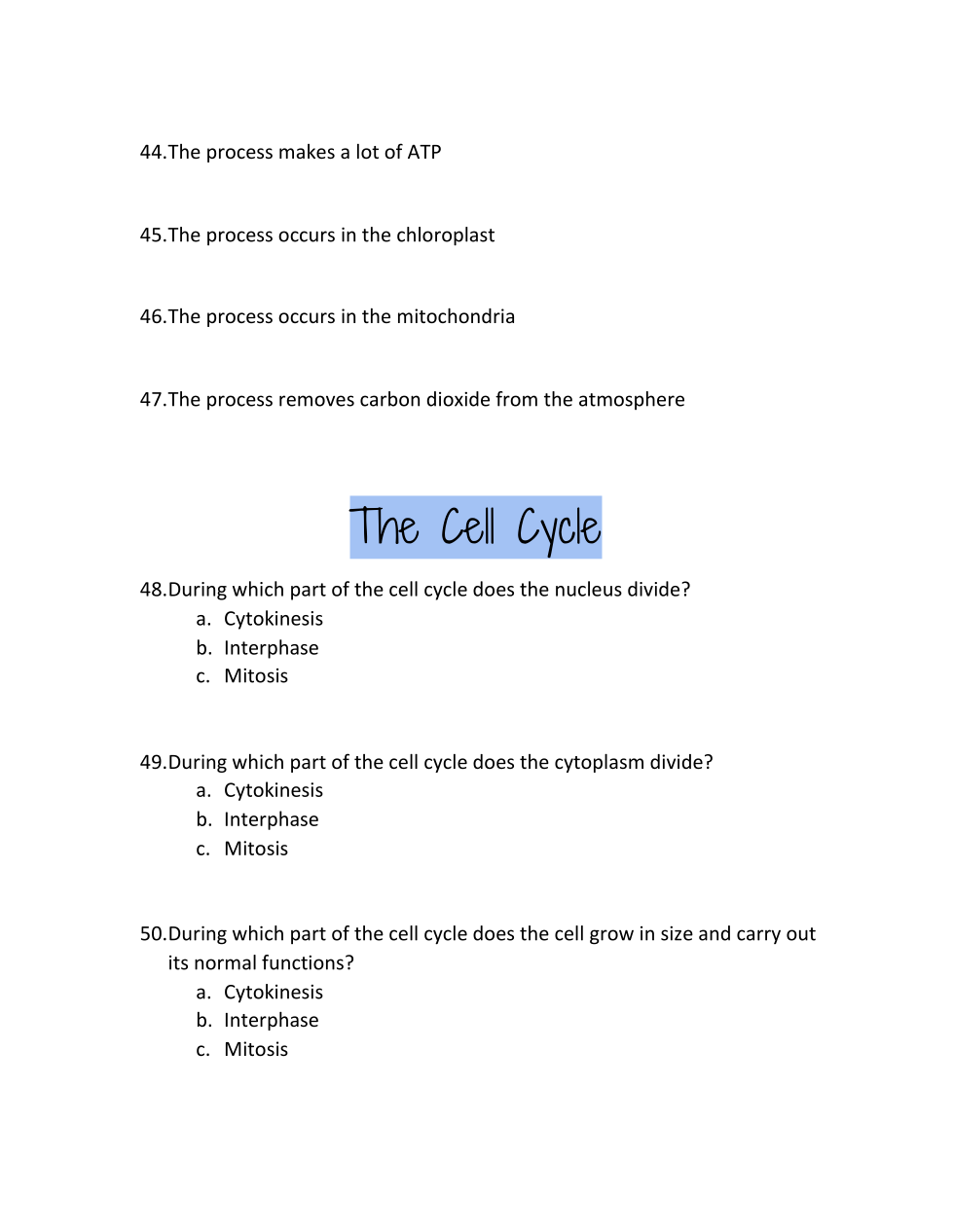
During which part of the cell cycle does the nucleus divide?
A. cytokinesis
B. interphase
C. mitosis
During which part of the cell cycle does the cytoplasm divide?
A. cytokinesis
B. interphase
C. mitosis
During which part of the cell cycle does the cell grow in size and carry out its normal functions?
A. cyotkinesis
B. interphase
C. mitosis
The process that makes a lot of ATP is
A. cellular respiration
B. mitosis
C. photosynthesis
D. osmosis
The process occurs in the chloroplast
A. cellular respiration
B. mitosis
C. DNA replication
D. photosynthesis
The process occurs in the mitochondria
A. cellular respiration
B. mitosis
C. translation
D. photosynthesis
The process removes carbon dioxide from the atmosphere
A. combustion
B. cellular respiration
C. photosynthesis
D. decomposition
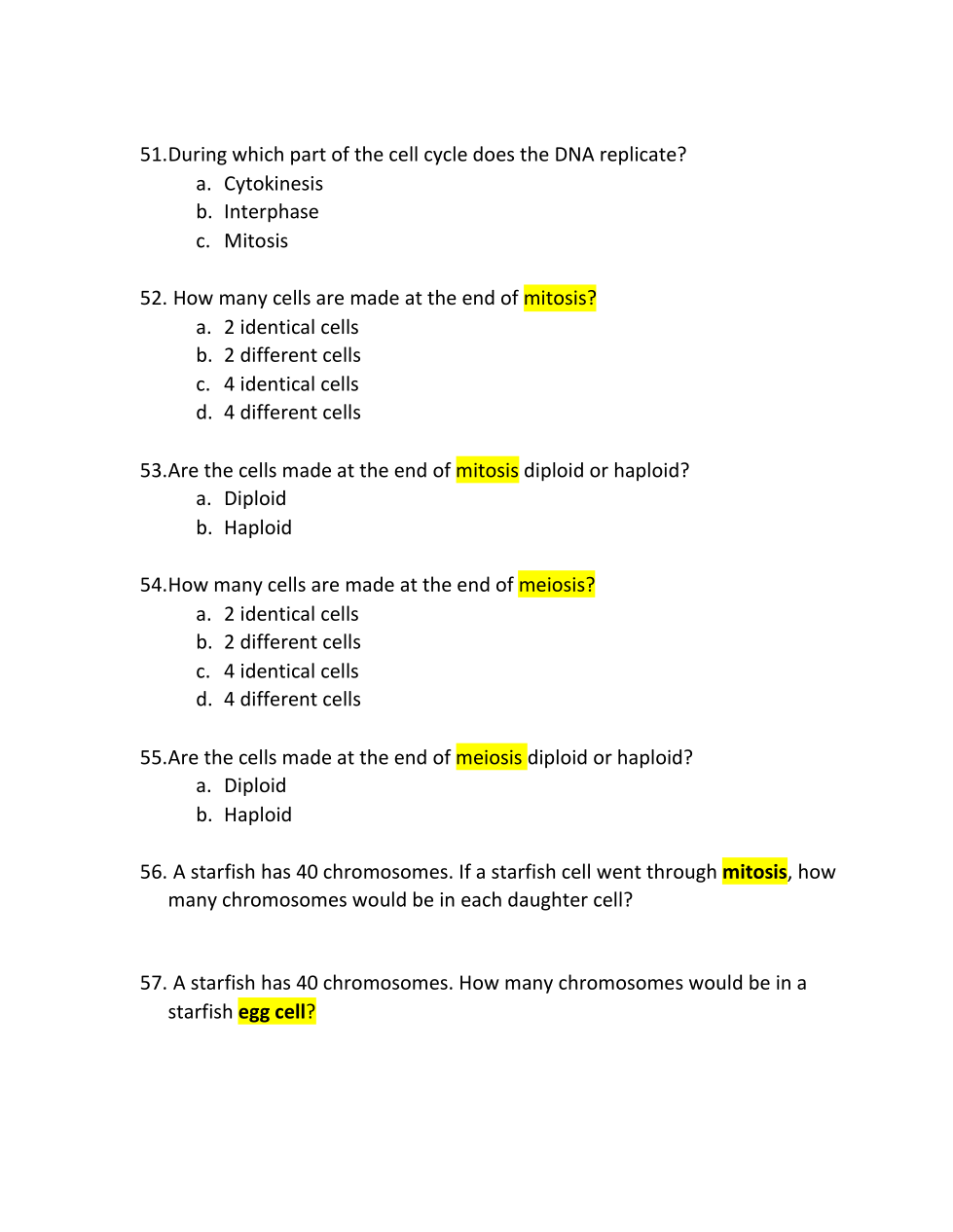
During which part of the cell cycle does the DNA replicate?
A. Cytokinesis
B. Interphase
C. mitosis
How many cells are made at the end of mitosis?
A. 2 identical cells
B. 2 different cells
C.4 identical cells
D. 4 different cells
Are the cells made at the end of mitosis diploid or haploid?
A. diploid
B. haploid
How many cells are made at the end of meiosis?
A. 2 identical cells
B. 2 different cells
C. 4 identical cells
D. 4 different cells
Are the cells made at the end of meiosis diploid or haploid?
A. diploid
B. haploid
A starfish has 40 chromosomes. If a starfish cell went through mitosis, how many chromosomes would be in each daughter cell?
A. 20
B. 10
C. 40
D. 80
A starfish has 40 chromosomes. How many chromosomes would be in a starfish egg cell?
A. 20
B.10
C.40
D. 80
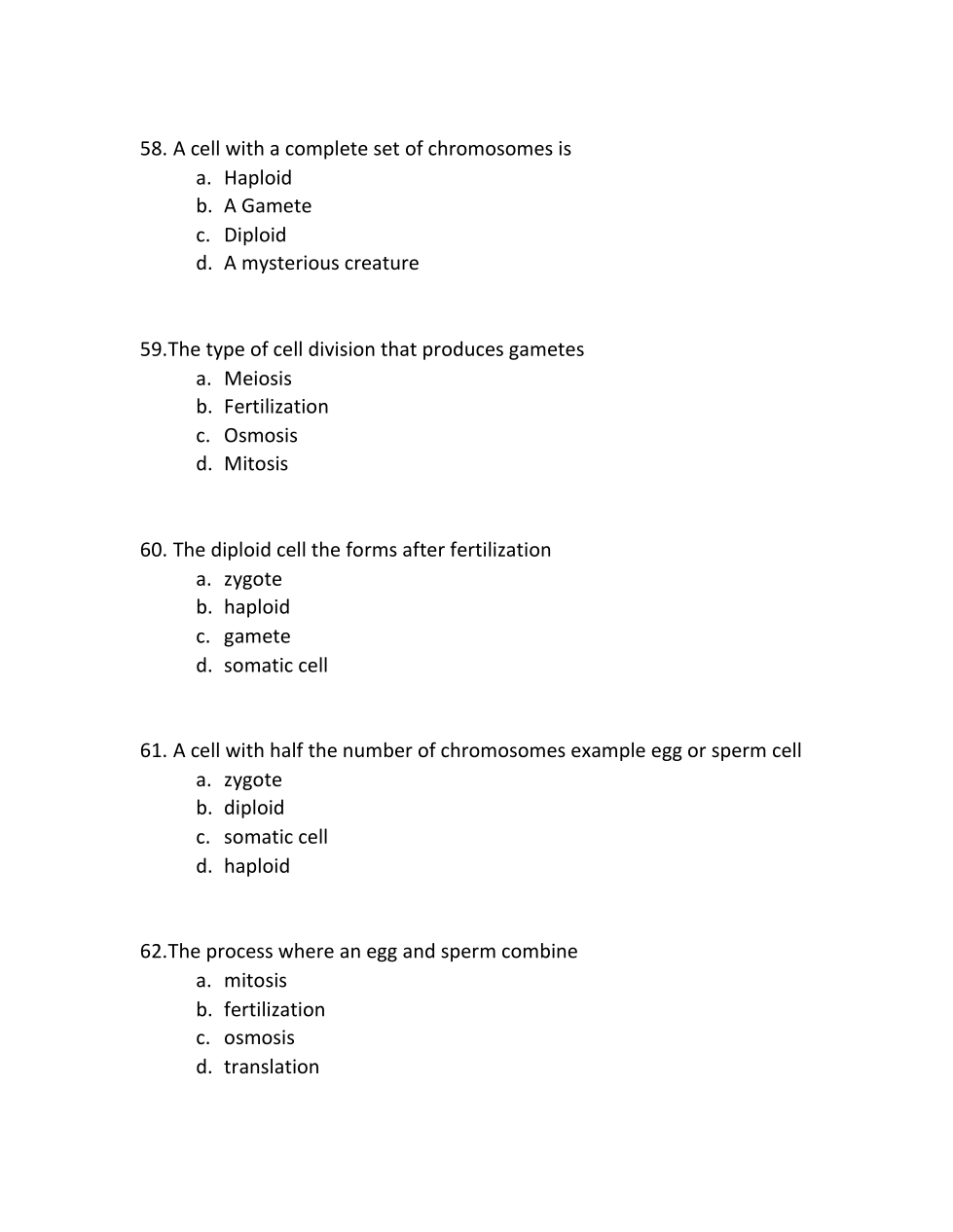
A cell with a complete set of chromosomes is
A. haploid
B. a gamete
C. diploid
D. mysterious creature
Type of cell division that produces gametes
A. meiosis
B. fertilization
C. osmosis
D. mitosis
The diploid cell that forms after fertilization
A. zygote
B. haploid
C. gamete
D. somatic cell
A cell with half the number of chromosomes example egg or sperm cell
A. zygote
B. diploid
C. somatic cell
D. haploid
The process where an egg and sperm combine
A. mitosis
B. fertilization
C. osmosis
D. translation
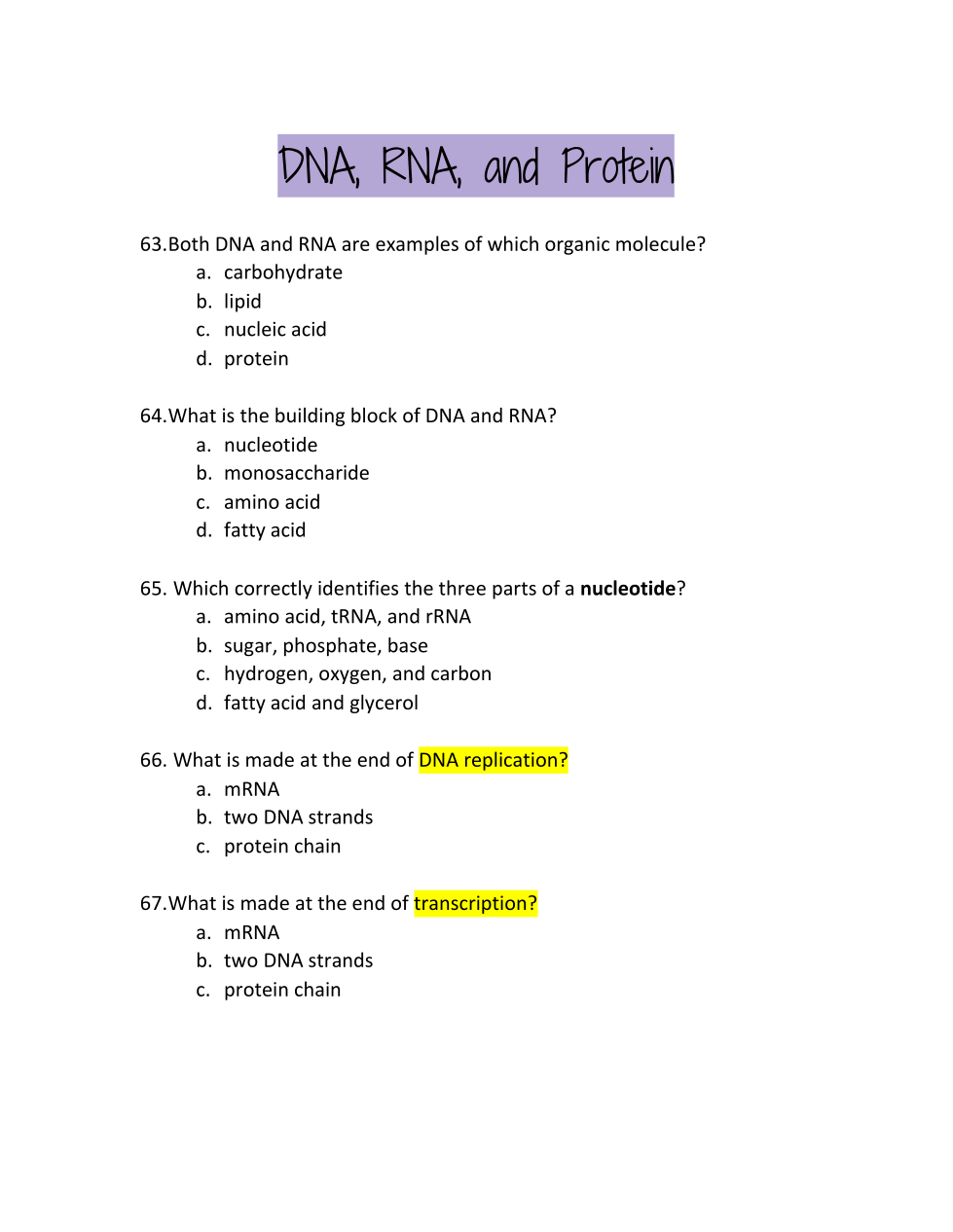
Both DNA and RNA are examples of which organic molecule?
A. carbohydrate
B. lipid
C. nucleic acid
D. protein
What is the building block of DNA and RNA?
A. nucleotide
B. monodsaccharide
C. amino acid
D. fatty acid
What is made at the end of translation?
A. mRNA
B. two DNA strands
C. protein chain
What is made at the end of DNA replication
A. mRNA
B. two DNA strands
C. protein chain
What is made at the end of transcription?
A. mRNA
B. two DNA strands
C. protein chain