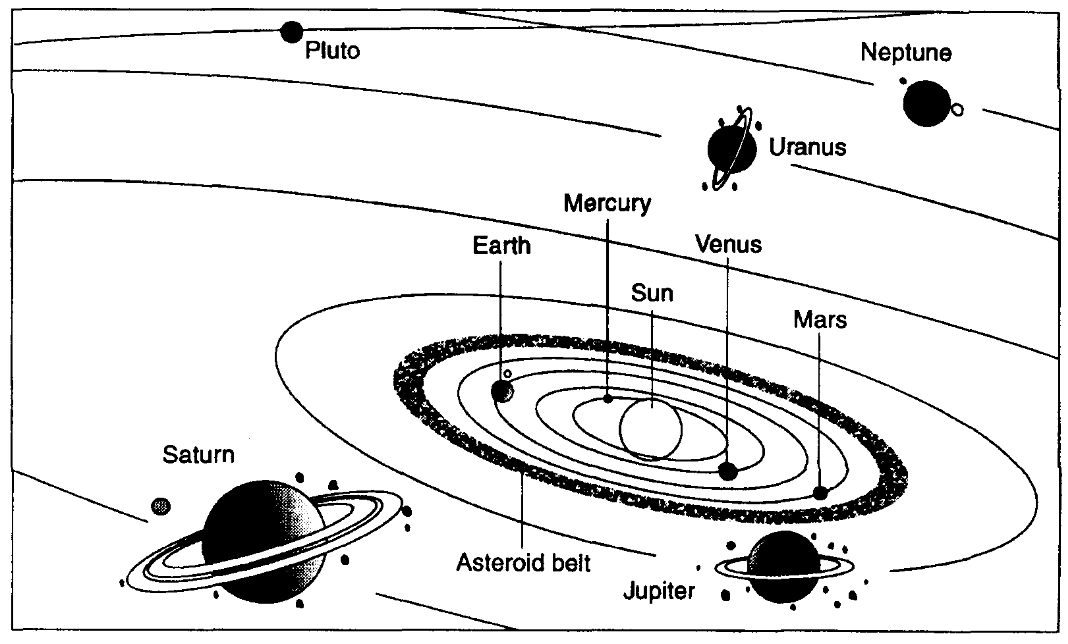
Drag the model to the appropriate system name.
Drag the model to the appropriate system name.
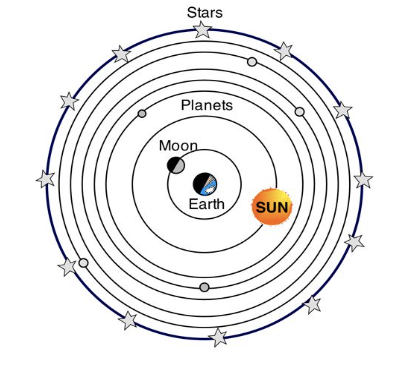
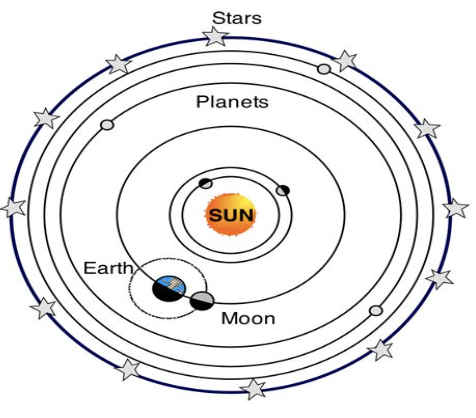
Heliocentric
Geocentric
The sunrises in the and sets in the
Geocentric Model
Early civilizations were aware of how celestial objects, such as the sun and moon, appeared to move through the sky from east to west. Because these people could not feel the Earth moving, they believed that Earth was located at the center of the universe, and the sun and planets revolved around it. Their model of the universe was geocentric, or Earth-centered.
Heliocentric Model
Detailed observations by astronomers in the 16th and 17th centuries eventually made the geocentric model difficult to accept. When the paths of the planets were carefully measured and plotted in an Earth-centered model, some of the planetary motions were very complex and hard to explain. Astronomers
began to prefer a similar model. In the Heliocentric model, the eight planets, including Earth, revolve around the sun while rotating on axes. This model accounts for the apparent motion of the sun, moon, and stars across the sky.
Where is the Earth located in a geocentric model?
What is one motion that was explained by the geocentric model of the solar system?
Drag the model to the appropriate system name.
Heliocentric
Geocentric
Which object orbits Earth in both the Earth-centered (geocentric) and Sun-centered (heliocentric) models of our solar system?
Which model of the solar system is best represented by this diagram?