A force of 1 N is the approximate force needed to lift ....
Question 2
2.
What law is described by:
"An object continues to remain in a state of rest or uniform motion unless an unbalanced force acts on it"
Question 3
3.
What is another name for Newton's first law of motion?
Question 4
4.
A 2 000 kg car is sitting at rest in a parking lot.
A bike and rider with a total mass of 60 kg are traveling along a road at 10 km.h-1.
Which system has more inertia? Why?
Question 5
5.
What is the net external force on an object in free-fall on Earth if you were to ignore the effect of air?
Question 6
6.
One object exerts a force of magnitude F1 on another object and experiences a force of magnitude F2 in return. What is true for F1 and F2?
Question 7
7.
Two objects rest on a uniform surface. A person pushes both with equal force. If the first object starts to move faster than the second, what can be said about their masses?
Question 8
8.
A 55 kg woman stands on a bathroom scale inside an elevator. The scale reads 600 N. What do you know about the motion of the elevator?
Question 9
9.
If a lift is moving upwards but experiences a downwards acceleration we can say that it is
Question 10
10.
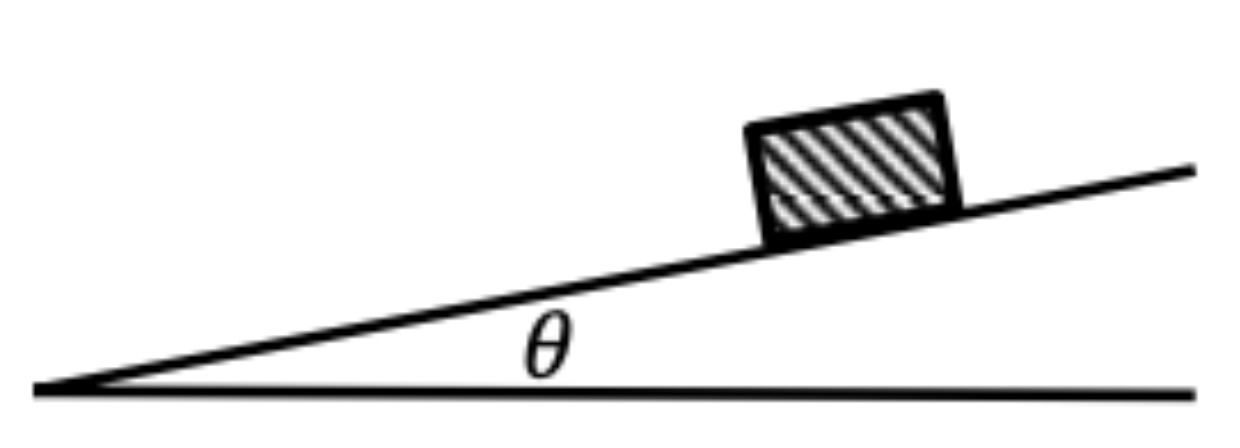
When an object rests on an inclined plane that makes an angle θ with the horizontal, what is the expression for the component of the object's weight force that is parallel to the incline?
Question 11
11.
If an object moves with a constant velocity, we can conclude that
Question 12
12.
A block rests on an inclined rough surface that makes an angle θ with the horizontal. The block remains at rest at θ is slowly increased. Which is the best description of how the magnitudes of the normal force and static frictional force of the rough surface on the block change as θ is slowly increased?
increases
decreases
remains the same
Normal force
Static frictional force
Question 13
13.
When a force of F acts on an object of mass m, it experiences an acceleration a. If the force is doubled and the mass of the object is halved, what is the new a?
The bike has more inertia, as its speed is faster than the car.