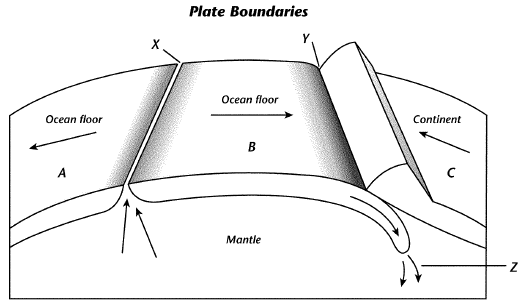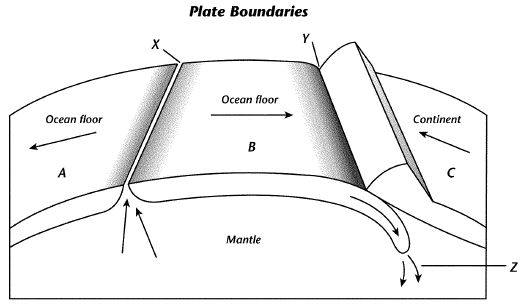
What feature occurs at X and how does it form?
What feature occurs at X and how does it form?
The transfer of energy through the air is called
Old oceanic crust is more dense than new oceanic crust because it is
According to Wegener’s hypothesis of continental drift,
A place where two plates slip past each other, moving in opposite directions, is known as a
In which location would you most likely find volcanoes?
Particles of hot soup rise slowly in a pot simmering on a stove. As the hot soup nears the surface, it begins to cool. The cooler soup sinks, forming a constant movement of soup that moves energy toward the surface of the pot. This constant movement of the soup in the pot is called a(n)
A collision between two pieces of continental crust at a converging boundary produces a
In sea-floor spreading, molten material rises from the mantle and erupts
The geological theory that states that pieces of Earth’s lithosphere are in constant, slow motion is the theory of
At what point does magma become lava?
What is Pangaea?
Which of the following is evidence for sea-floor spreading?
What technology did scientists use in the mid-1900s to map the mid-ocean ridge?
A string of islands known as a(n)
oceanic plates.
The hypothesis of
When continental plates pull apart at a divergent boundary on land, a(n)
The process of
When you touch a hot plate, the transfer of heat from the plate to your hand is called
One major belt of volcanoes is called the
Along a divergent boundary, two plates slip past each other, moving in opposite directions.
Alfred Wegener provided evidence from landforms, fossils, and climate in support of his theory of the Continental Drift.
If subduction occurs faster than oceanic crust can be created, an ocean will expand.
Oceanic crust near the mid-ocean ridge is younger than oceanic crust farther away from the ridge.
Volcanoes that form along a mid-ocean ridge occur at a(n) diverging plate boundary.
Mid-ocean ridges form the longest mountain ranges on Earth.
What feature occurs at X and how does it form?
Describe what is happening at point Z in the illustration.
Name the three types of evidence geologists have found for sea-floor spreading.
Cite evidence from a landform and fossil to support the hypothesis that Africa and South
America were once joined.
During Continental Drift, name the continent that moved the farthest.