Figure 5-1 shows a portion of a blank periodic table. Identify the segments labeled A and B.
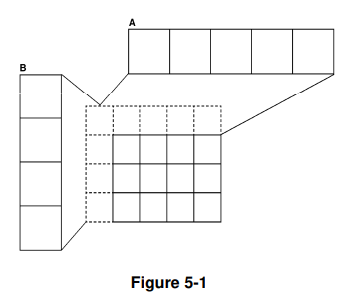
Figure 5-1 shows a portion of a blank periodic table. Identify the segments labeled A and B.
This is a summative assessment that covers the following topics:
History of Chemistry
Matter and changes (physical and chemical)
Atomic structure
Atomic Theory
History of the Periodic Table
Classification of elements and their characteristics.
It is defined as the discipline that studied matter as early as 400 BC. It had the purpose of finding the way to the perfect health and the transformation of materials of lesser value into the perfect metal.
Area of science that studies matter and the changes it can go through as well as its composition, properties and structure.
Select those that are contributions of Lavoisier
It is defined as knowledge acquired in a systematic way, based on careful and methodical experimentation.
Which of the following are pure substances?
A substance represented by a chemical formula is known as:
State of Matter is a chemical property of matter
Classify the following into Pure Substances and Mixtures
Liquid soap
Paracetamol
Water
Tomato Sauce
Potassium
Pepto Bismol
Table sugar
Shampoo
Copper
Milk
Pure substance
Mixture
A substance is made up of only one kind of atom is a (an)
Which of the following is a characteristic of a mixture?
Which of the following is a chemical change?
Which state of matter has a definte volume?
Separating a solid from a liquid by evaporating the liquid is called...
What is the difference between a mixture and a compound?
Its appearance may be uniform or not.
It may contain more than one phase
Can only be separated by chemical means
Scatters light
Varied composition
Can be separated by physical means
Fixed composition
Mixture
Compound
A is a change where some physical properties change but the composition remains the same.
A occurs when the substance changes its composition completely.
What happens to matter during a chemical reaction?
Which of the following phase is an endothermic change?
Which of the following phase is an exothermic change?
On the sun, where temperatures are extremely high, matter exists in a state know as plasma
Smallest particle of matter that still retains its properties is called:
Which of the following was originally a tenet of Dalton's atomic theory, but had to be revised about a century ago?
Match the item with the statement
Positively charged subatomic particle
the number of them is the same as the atomic number of an element
the smallest particle of an element that retains the properties of that element
Negatively charged subatomic particle
the central part of the atom, positively charged.
atom
electron
proton
nucleus
Match each item with the correct statement.
| Draggable item | arrow_right_alt | Corresponding Item |
|---|---|---|
isotope | arrow_right_alt | total number of particles that make up the nucleus of an atom |
mass number | arrow_right_alt | the weighted average of the masses of the isotopes of an element |
atomic mass | arrow_right_alt | number of protons in the nucleus of an atom |
atomic number | arrow_right_alt | atoms with the same number of protons, but different numbers of neutrons in the nucleus of an atom |
Match the person to the proposed model of the atom
| Draggable item | arrow_right_alt | Corresponding Item |
|---|---|---|
Ernest Rutherford | arrow_right_alt | Billiard Ball Model |
John Dalton | arrow_right_alt | Plum pudding Model |
JJ Thomson | arrow_right_alt | Nuclear Atom |
Werner Heisenberg stated the "uncertainty principle" that you can't know both position and velocity of a particle
| Draggable item | arrow_right_alt | Corresponding Item |
|---|---|---|
group | arrow_right_alt | horizontal row in the periodic table |
electrons | arrow_right_alt | vertical column in the periodic table |
period | arrow_right_alt | A repetition of properties occurs when elements are arranged in order of increasing atomic number |
electronegativity | arrow_right_alt | subatomic particles that are transferred to form positive and negative ions |
periodic law | arrow_right_alt | ability of an atom to attract electrons when the atom is in a compound |
Categories of elements in the periodic table
Figure 5-1 shows a portion of a blank periodic table. Identify the segments labeled A and B.
What is another name for the representative elements?
What is the charge of a cation?
How many valence electrons does antimony have?
Classify the statement as a characteristic of the type of element
Metals | Nonmetals | |
|---|---|---|
Lose valence electrons when making compounds | ||
Have high electronegativity values | ||
Most are solids | ||
If solid, they're brittle | ||
Most have low boiling points |
The group of elements in the periodic table that is known as the alkali metals is
The noble gases are group
Of the whole periodic table, about
How many elements are in the periodic table?
A fictitious element X is composed of 10.0 percent of the isotope X-55, 20.0 percent of the isotope X-56, and 70.0 percent of the isotope X-57. Estimate the atomic mass of element X.