1
What are mutations and how do they happen?
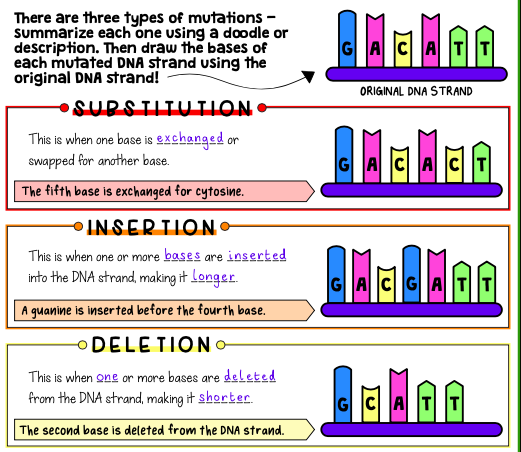
A mutation is a change in an organism’s genetic material. Mutations occur at random. Some factors can increase the risk of a mutation occurring. We call these mutagens. These include ionizing radiation, like gamma rays and UV-light from the Sun. There are also chemical mutagens like tar from cigarette smoke.
DNA is used as a template to synthesize mRNA during the process of transcription. When DNA has a mutation, the mRNA made using it will end up with an altered base sequence. During translation, the mRNA bases are read in groups of three known as a codon. If the bases of the codon are altered, it may code for a different amino acid. This could affect the structure and function of the protein.
SILENT MUTATION
This mutation has no on the coded for. Many amino acids are coded for by multiple codons. An example of a silent mutation is changing a base, yet the amino acid still codes for the same .
MISSENSE MUTATION
This mutation causes a codon to code for a amino acid than the one.
FRAMESHIFT MUTATION
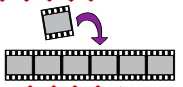
This mutation causes the “reading frame” of the codons to shift forwards or , changing many amino acids.
NONSENSE MUTATION
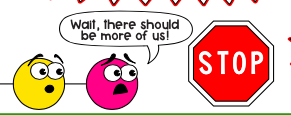
This mutation causes a codon which translation early, often resulting in a non-functional protein.
Complete the Diagram.
The impact of a mutation depends on if it affects a protein’s structure and function. While many mutations have no effect, e.g. a silent mutation, some mutations alter proteins, affecting the organism’s phenotype (its physical characteristics). The organism’s external environment determines if the new phenotype is beneficial, neutral, or negative.
Categorize the following impacts of mutations
A mutation causes a hare living in snowy mountains to have white fur instead of brown fur. This provides camouflage from predators.
A mutation in the CFTR gene causes Cystic Fibrosis in humans. Due to a misfolded protein, sticky mucus forms in the lungs & digestive system.
A mutation causes a dog to have a spotted coat instead of a solid coat color. As a pet, this does not affect its chances of survival.
Beneficial Mutation
Neutral Mutation
Negative Mutation
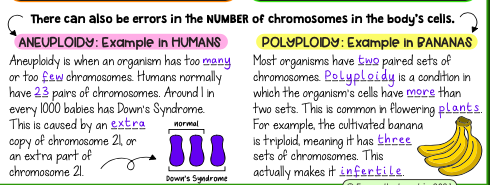
During mitosis and meiosis, DNA is replicated and then divided into daughter cells. Errors during these processes can result in chromosomal mutations. For example, deletion is when part of a chromosome is removed. This and other examples are shown below.
Name each type of chromosomal mutation and describe what is occuring
Word Bank: Duplication Deletion Inversion Translocation