In the diagram of cellular processes provided below, what terms correctly identify the missing labels?
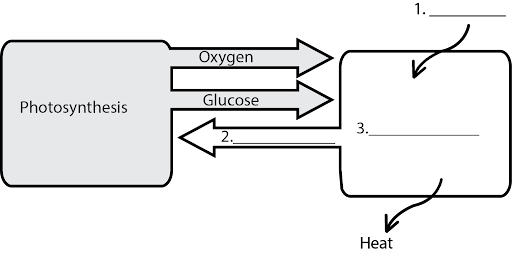
In the diagram of cellular processes provided below, what terms correctly identify the missing labels?
Match the vocabulary words to their definitions.
| Draggable item | arrow_right_alt | Corresponding Item |
|---|---|---|
Glucose | arrow_right_alt | The process of breaking a substance down into smaller parts of organic matter, the process of decay |
Decomposition | arrow_right_alt | A biological process that produces ethanol and CO2 by the conversion of sugars into cellular energy in the absence of O2 - generally used by yeast and bacteria |
Atmosphere | arrow_right_alt | A form of renewable energy source from living or once living plant or animal materials that is often used as fuel, can also be used to describe the weight of all living things in a trophic level |
Organic Matter | arrow_right_alt | One of the primary substances that make up matter and cannot be broken down or converted into other substances; defined by its atomic number |
Adenosine Triphosphate (ATP) | arrow_right_alt | An interaction between organisms where one organism captures and consumes the other |
Photosynthesis | arrow_right_alt | Energy stored in chemical bonds, can be used in a chemical reaction |
Population | arrow_right_alt | A monosaccharide sugar, C6H12O6, that is produced in photosynthesis and used during cellular respiration for energy production |
Element | arrow_right_alt | All water on earth; including oceans, surface water, groundwater, and glaciers |
Aerobic Respiration | arrow_right_alt | The process by which autotrophs capture light energy to convert CO2 and H2O into glucose and O2 |
Resource | arrow_right_alt | Matter that contains the element Carbon (C) |
Chemical Energy | arrow_right_alt | A source or supply that can be used to benefit organisms |
Hydrosphere | arrow_right_alt | All of the organisms of one species within a particular ecosystem |
Trophic Level | arrow_right_alt | The whole mass of air surrounding earth; 78% Nitrogen, 21% Oxygen, and other trace gasses. |
Alcohol Fermentation | arrow_right_alt | An organism's position on a food chain or food web |
Predation | arrow_right_alt | The process by which cells use Oxygen and the chemical energy stored in nutrients to make ATP |
Biomass | arrow_right_alt | The primary molecule used by cells to store chemical energy for cellular processes |
Which of the following describes a survival advantage an individual organism derives from living in a large group with other members of the same species
Since most organisms have more than one food source, food chains are connected into more complex ___________
Glucose produced as a result of photosynthesis is made up of which of the following elements?
Which of the following best summarizes the flow of matter and energy in cellular respiration?
As living systems use energy they transform matter. All of these matter transformations are the result of living systems:
Carbon, in the form of carbon dioxide, moves from the geosphere to the atmosphere during which of the following?
Which of the following processes is more efficient at producing ATP?
It’s possible that a species may exceed its carrying capacity in the short term. Which of the following will most likely be the end result for the species?
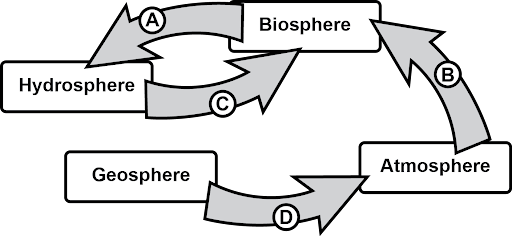
In the diagram of cellular processes provided below, what terms correctly identify the missing labels?
Photosynthesis contributes to the carbon cycle by moving carbon in the way represented by which arrow in the diagram?
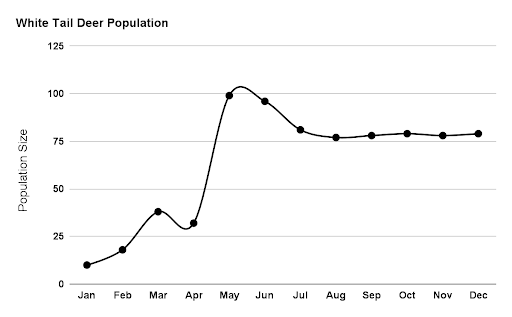
The graph shows changes in the deer population over 12 months. Which population size is most likely the carrying capacity for deer in this ecosystem?
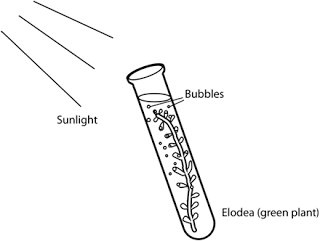
A test tube is filled with water and a green aquatic plant called elodea. When the plant is exposed to sunlight it begins to produce bubbles. Which of the following is the most likely conclusion for the identity of the gas in the bubbles?
Flocking is an example of a group behavior where organisms gather in large groups
The cycling of carbon through the earth’s oceans, atmosphere, and living things is referred to as The Carbon Cycle
Individual behaviors generally provide more benefits to an organisms’ survival than group behaviors
The term products refers to the starting materials in a chemical reaction
Humans can switch to lactic acid fermentation to produce ATP if their cells run out of oxygen.
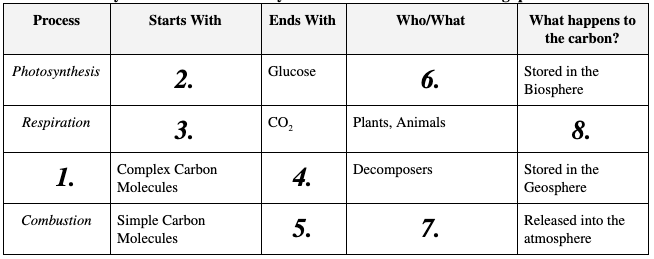
Use the summary chart of the Carbon Cycle to the right to answer the following questions.
Which of the options below fits in box 1?
Which of the options below fits in box 2?
Which of the options below fits in box 3?
Which of the options below fits in box 4?
Which of the options below fits in box 5?
Which of the options below fits in box 6?
Which of the options below fits in box 7?
Which of the options below fits in box 8?
Why are all animals, even carnivores, dependent on plants?
In what process is carbon a reactant or product in the carbon cycle?
Describe the relationship between photosynthesis and cellular respiration.
Describe how decomposers contribute to the cycling of energy in an ecosystem.
Why would a diet of only carbohydrates and water be insufficient for long-term survival?
How is carbon a resource that needs to be properly managed?
Explain the difference between Anaerobic and Aerobic respiration