EMS: 3.1 (2/11) Version B
star
star
star
star
star
Last updated about 3 years ago
7 Nsɛmmisa

0

0
0
0
0
2
2
The images below show the Moon during a new moon phase and the Moon during a lunar eclipse. The images are from Top View.
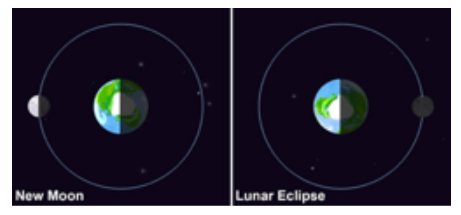
How is the moon similar and different during a New Moon and Lunar Eclipse?
Complete the guided model below
Think: Use your Moon sphere to help you complete the following statement using one of the words below:
A lunar eclipse occurs when the Moon is in ________________________ in its orbit.
Lesson 3.1: Introduction to Lunar Eclipses
Goal:
Find a lunar eclipse in the Earth, Moon, and Sun Simulation and explore the different views to answer the question: What makes the Moon completely dark during a lunar eclipse?
Tips:
• There will be a lunar eclipse in July, August, or September in 2025.
• You may find it helpful to move time slowly, using the day and hour timeline sliders.
Lunar Eclipse:
Draw the position of the Moon in a lunar eclipse
Describe the precise location of the Earth, Moon, and Sun which allow a lunar eclipse to occur.
CFS:
accurately identifies the position of the Moon to predict the correct Moon phase
accurately describes the cause and effect relationship between rotational movements and illuminated objects
"In order for a lunar eclipse to happen the Earth, Moon and Sun must...
(think: what about the alignment of the three objectes is special for a lunar eclipse?)
Draw the side view (system view) diagram for a full moon and a lunar eclipse below.
1. Identify the correct location for a full moon and lunar eclipse
2. shade in the appropriate amount of moon for that specific moon.
Describe the phenomenon that allows eclipses to be so rare in our solar system.
CFS:
accurately identifies the position of the Earth, Moon, and Sun
accurately describes the cause and effect relationship between rotational movements/orbits and illuminated objects