EMS: 3.2b (2/23)
star
star
star
star
star
Last updated about 3 years ago
9 Nsɛmmisa

0

0
0
0
0
0
2
1
1
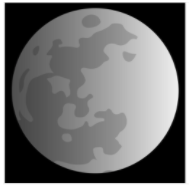
On February 27 you can look up at the sky and see a full moon. Approximately how long will it take until you will see another full moon?
Read and annotate the following article: An Ancient Machine for Predicting Eclipses
Active Reading Guidelines:
Accurately identifies the central idea from the primary source of evidence
Write any questions you may have in each paragraph
Circle any words you may not know.
Imagine diving 150 feet beneath the sea. You are looking for sponges, which is not very exciting, but it’s your job. Now imagine coming across the wreck of an ancient ship! That’s what happened to some divers off the island of Antikythera (an-tee-KITH-er-ah) in the Mediterranean Sea. The ship had been on the seafloor for almost 2000 years. Divers found coins, statues, musical instruments, and many other precious items in the shipwreck. The greatest treasure of all, however, was a collection of corroded metal gears. Nothing like them had ever been found before or has ever been found since. They seem to fit together in a complicated way. They are part of a machine that scientists call the Antikythera mechanism.
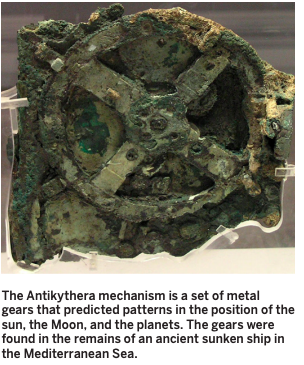
It took scientists many years to figure out what the mysterious machine was for. Eventually, scientists used x-rays to view the gears and other parts inside the machine. They were also able to read ancient Greek writing on some of the parts. Using this new information, scientists realized the Antikythera mechanism was built by ancient astronomers to predict patterns in the appearance of the sun, the planets that people were able to observe, and especially the Moon.
What was the Antikythera machine used for?
CFS:
accurately states a claim based on textual evidence
accurately describes and provides supporting rationale that support the stated claim
Ancient Greek astronomers had been observing the Moon and keeping track of its appearance for hundreds of years. Looking over all their observations, they noticed patterns. The astronomers assumed the same patterns that had been going on for hundreds of years would keep going into the future. They built the Antikythera mechanism to predict events in the future based on the patterns they had observed.
A user of the Antikythera mechanism could turn a dial on one side of the mechanism to choose a date and time, either in the past or in the future. The gears would spin into place, predicting the appearance and position of the Moon and other bodies at that time. The machine had pointers and other displays to show its predictions. For example, ancient astronomers knew there would be a full moon every 29 and a half days. There was a ball on the Antikythera mechanism that traced the phases of the moon. The ball was white on one side (representing the side of the moon illuminated by the sun) and black on the other (representing the dark side of the moon). As the user turned the date dial of the machine, the little moon ball would spin to show what phase the moon would be in on that date.
The Antikythera mechanism also traced patterns that took much longer to repeat. For instance, ancient astronomers knew that occasionally, on the night of a full moon, a lunar eclipse happens. During a lunar eclipse, the fully illuminated face of the full moon goes dark for a time. However, they noticed that this didn’t happen every full moon—in fact, over a year would sometimes pass between their observations of lunar eclipses. Through careful record-keeping, the ancient astronomers realized that eclipses, although rare, happened in patterns. They kept track of the patterns and recorded that knowledge in the workings of the Antikythera mechanism. As a user turned the date dial of the Antikythera mechanism, the mechanism counted the days and displayed exactly when people in Greece could expect to observe a lunar eclipse.
What information did ancient astronomers know about the Moon?
CFS:
accurately states a claim based on textual evidence
accurately describes and provides supporting rationale that support the stated claim
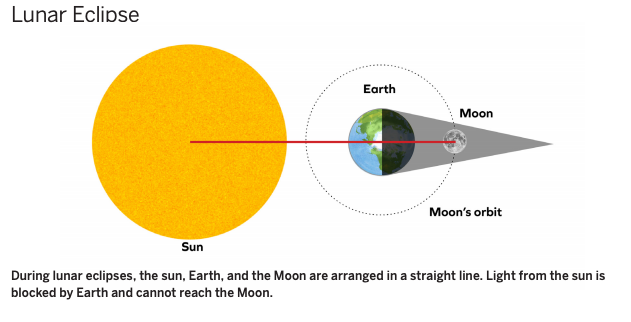
The mechanism showed WHEN an eclipse would happen, but it didn’t show WHY an eclipse would happen. The astronomers who made the Antikythera mechanism knew that the Moon seems to shine because it is illuminated by light from the sun. They also knew that an eclipse of the Moon happens when Earth blocks the sunlight and makes a shadow on the Moon. They did not know exactly why this happened at some times and not others.
What was the ancient invention able to show about eclipses
CFS:
accurately states a claim based on textual evidence
accurately describes and provides supporting rationale that support the stated claim
Why was the ancient invention not able to show about eclipses
CFS:
accurately states a claim based on textual evidence
accurately describes and provides supporting rationale that support the stated claim
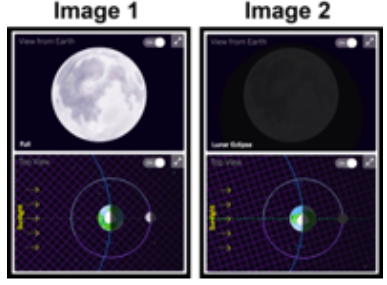
Today astronomers can explain why lunar eclipses happen when they do. Lunar eclipses are caused by Earth blocking sunlight from reaching the Moon. For Earth to block the sunlight, it has to be between the sun and the Moon. Not only that, but the sun, Earth, and the Moon have to line up exactly, with Earth in the middle. When they line up in this way, Earth blocks the sunlight and the Moon goes dark. Eclipses only happen on the night of a full moon, because the full moon is the phase when the sun, Earth, and the Moon line up with Earth in the middle.
If this is true, why don’t lunar eclipses happen every time the Moon is full? Why did the ancient astronomers have to wait so long between observations of eclipses? It’s because the Moon’s orbit around Earth is slightly tilted out of alignment. During most full moons, the sun, Earth, and the Moon are lined up, but they are not lined up EXACTLY. For the three bodies to line up exactly, the Moon has to be exactly in the right spot on its tilted orbit. That happens very infrequently. The makers of the Antikythera mechanism knew how unusual this was, but they didn’t understand the reason—now you do!
Why are lunar eclipses rare?
CFS:
accurately states a claim based on textual evidence
accurately describes and provides supporting rationale that support the stated claim
Which image does a lunar eclipse happen in? What causes a lunar eclipse to happen in this position rather than a full moon?
How does light travel?
Which statement describes the Moon’s movements?