Background: William Butler Yeats (1865-1939) was an Irish poet and an important 20th century figure in literature. The Second Coming is the Christian idea that Jesus will someday return to earth. The following poem imagines the Second Coming as apocalyptic in order to describe the atmosphere of Europe after World War I.
The Second Coming
by William Butler Yeats
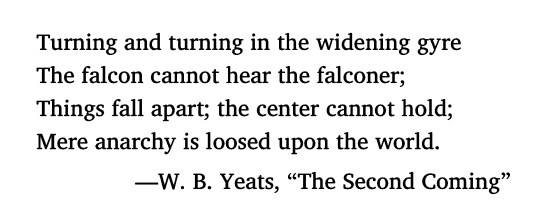
Turning and turning in the widening gyre*
The falcon cannot hear the falconer*;
Things fall apart; the centre cannot hold;
Mere anarchy is loosed upon the world,
The blood-dimmed tide is loosed, and everywhere
The ceremony of innocence is drowned;
The best lack all conviction, while the worst
Are full of passionate intensity.
Surely some revelation is at hand;
Surely the Second Coming is at hand.
The Second Coming! Hardly are those words out
When a vast image out of Spiritus Mundi*
Troubles my sight: somewhere in sands of the desert
A shape with lion body and the head of a man*,
A gaze blank and pitiless as the sun,
Is moving its slow thighs, while all about it
Reel shadows of the indignant desert birds.
The darkness drops again; but now I know
That twenty centuries of stony sleep
Were vexed to nightmare by a rocking cradle,
And what rough beast, its hour come round at last,
Slouches towards Bethlehem* to be born?
FOOTNOTES:
*A gyre is a revolution or a circuit (a full circle). Yeats wrote about gyres in his work A Vision, in which this particular gyre was a period of about 2,000 years after Christ (the 20th century).
*A falconer is a person who keeps and trains falcons or other birds of prey.
*According to W. B. Yeats, “Spiritus Mundi” is a spiritual world, which is accessible to perceptive people.
*A sphinx is a mythic creature, known for its cunning and mercilessness. Yeats may also be directly referencing the Great Sphinx of Giza, an ancient Egyptian monument in the Al Giza Desert.
*Bethlehem is believed to be the place of Jesus’ birth