30.1 - Homework - Mutations

Last updated 11 months ago
24 questions
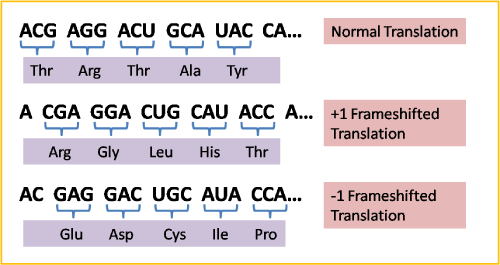
Frameshift mutations are when a DNA base is added or removed. This causes all of the bases to move forward or backward. When DNA is frameshifted by a deletion or insertion of a DNA base, the amino acids translated will be different as well. This can produce a non-functional protein and could be harmful to the organisms livelihood.

1
1

Which of the following would result in a frameshift mutation?

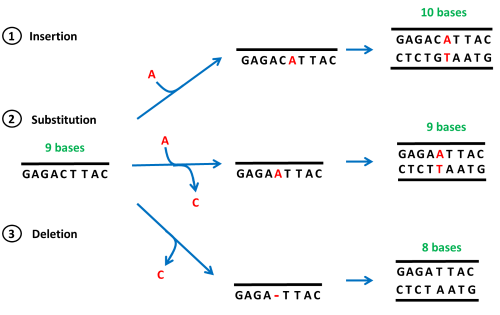
Substitution: A substitution is when one of the DNA bases is changed to another base, e.g. a cytosine base becomes a thymine base.

Deltetion: A deletion is when one of the DNA bases is deleted from the strand.

Insertion: An insertion is when an extra DNA base is added to the strand.

Deletions and insertions are more harmful than substitutions because they change all of the codons from the mutation on down the line, which changes the amino acid sequence. A substitution my or may nor change an amino acid sequence, but if it does, only one amino acid will be effected and this may not effect the protein at large.

1

Original DNA:
CAT GAT CCA
New DNA:
CAT TGA TCC A
What mutation occurred?

1
1

What mutation has occurred here?
T-G-A-C-C-A
T-G-A-G-C-A

1

DNA molecule segment is :
TTACGCAAG
The mutated DNA segment is:
TTACGCAAC

This is an example of ___ mutation.

1

DNA molecule segment is : TTA-CGC-AAG
The mutated DNA segment is TTC-GCA-AG.

This is an example of ___ mutation.

1

ATT-TGA-GCC- Original
ATT-GAG-CC - Mutated
The example above is an example of a

1

What type of gene mutation has occurred here?
Normal-
AGA-TTC-ATA-GCG
Mutant-
AGA-TTC-AAT-AGC-G

1

Why are insertion and deletion mutations so harmful?

A mutation is any change in the base sequence of DNA. Mutations can be caused by mistakes in replication or exposure to environmental substances. Changing the base sequence in the DNA can effect the messenger RNA transcribed and the amino acid sequence translated, thus effecting the protein that is made.

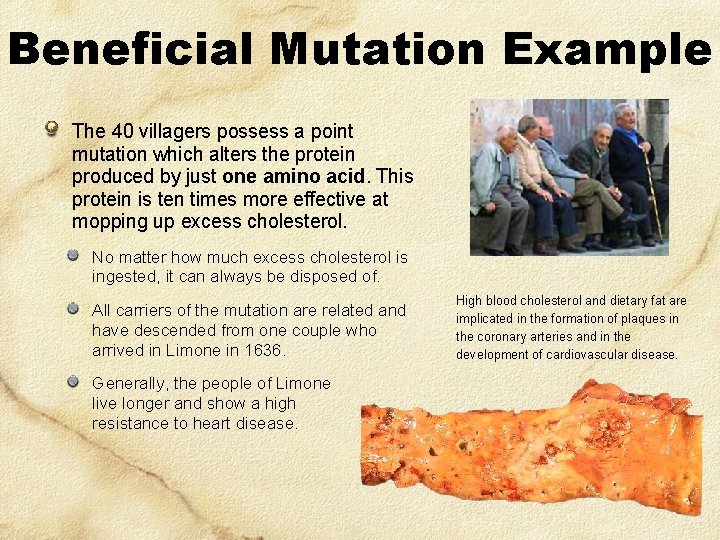
Mutations are not all bad! Mutations can be harmful, neutral, and/or beneficial. Mutations can beneficial, as they can make an organisms more suited to live in its environment. Mutations can be harmful if it makes it harder for an organisms to live and adapt to its environment. Mutations can be neutral if a mutation doesn't help or hinder an organisms ability to live in its environemnt and reproduce.


1
1

Any change in the sequence of DNA is...

1

What do gene mutations change?

1

Mutations can benefit humans because they can:

1

Are all mutations bad?

1

What causes mutations?

1

The survival of a species depends on its ability to adapt to changes in the environment. Which statement correctly describes a way that mutations increase the likelihood that a species will survive in a changing environment?

1

A rabbit that has short deformed legs and cannot jump or run fast would have a____

1

Mutations are__________

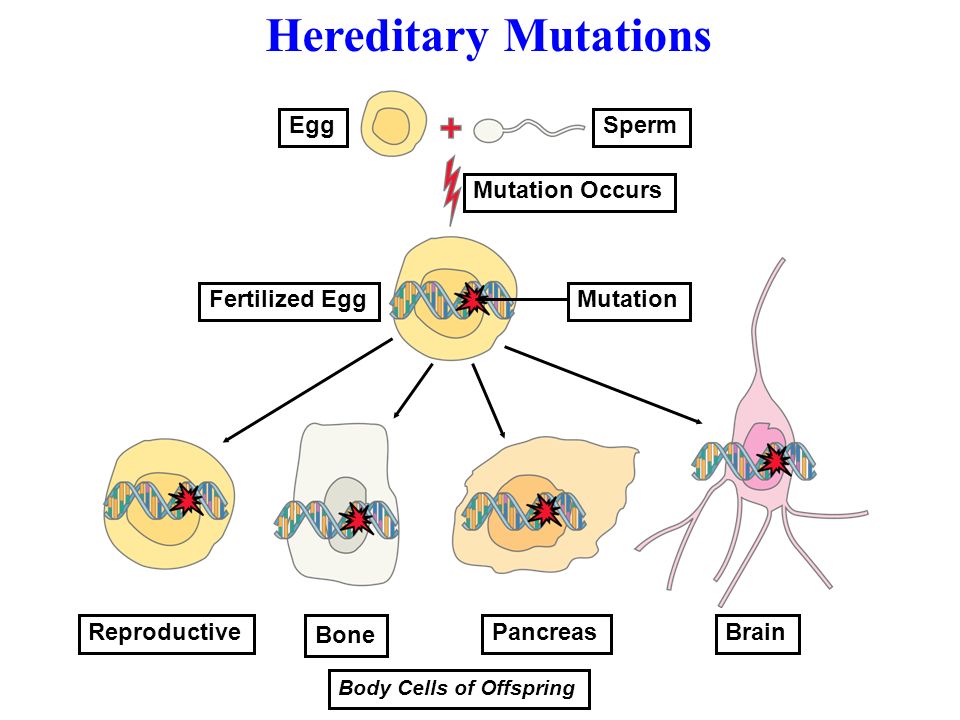
In order for offspring to get a genetic mutation, the mutation must occur in the sex cells, the egg (females) or sperm (males).

Mutations can be inherited or acquired during a person's lifetime. Mutations that an individual inherits from their parents are called hereditary mutations. They are present in all body cells and can be passed down to new generations.

Acquired mutations occur during an individual’s life. If an acquired mutation occurs in an egg or sperm cell, it can be passed down to the individual’s offspring. Once an acquired mutation is passed down, it is a hereditary mutation. Acquired mutations are not passed down if they occur in the somatic body cells, meaning body cells other than sperm cells and egg cells. Some acquired mutations occur spontaneously and randomly in genes. Other mutations are caused by environmental factors, such as exposure to certain chemicals or radiation.
1
1
1

In order for offspring to get a genetic mutation, the mutation must occur in what type of cell?

1

Would a mutation in the DNA of a skin cell be passed on to an organism's offspring?

1
Word bank: offspring hereditary lifetime body

Acquired mutations are developed during a person's _______. Mutations in somatic _______ cells are not passed down. Mutations that a person acquires can be passed down to their _______ through the sex cells; such as the egg and sperm. Acquired mutations, once passed down are now called _______ mutations.