Period 6, Day 5-6: The Sherman Anti-Trust Act (1890)
star
star
star
star
star
Last updated over 1 year ago
10 questions
Note from the author:
Content Objective: I will be able to evaluate the relationship between trusts and the U.S. government in the Gilded Age.
Standard Objective: I will be able to draw reasonable inferences from a text.
Content Objective: I will be able to evaluate the relationship between trusts and the U.S. government in the Gilded Age.
Standard Objective: I will be able to draw reasonable inferences from a text.
0
Warm Up: Please rate how well you understood last night's pre-work on a scale from 1 to 4. If you have any questions, drop them in the "Show Your Work" area.
1
Warm Up: Do you think corporations have too much power in the United States? Explain why or why not. Try to come up with specific examples as necessary.
0
Warm Up: One interesting historical fact I learned from the pre-work is…

Required
1
The Sherman Antitrust Act was a law passed by Congress in 1890 that was designed to combat the _______ that were running rampant in American business. Big business had so far gone mostly _______ . Industrial giants were free to form monopolies that drove out _______ . Price fixing, pools, and cartels were commonplace. Finally, the government instituted a degree of regulation with the Sherman Antitrust Act.
Think-Pair-Share: Is there a difference between a “trust” and a big corporation?

1
The Sherman Antitrust Act was the first federal law that placed _______ on concentrations of power deemed _______ to trade and competition.
At first, the Act was largely _______ at stopping industrial monopolies; most companies were not held liable. In fact, in its early years, the most commonly prosecuted organizations were not trusts, but trade _______ , which the courts ruled were illegal combinations.
Despite these early setbacks, the Sherman Antitrust Act was important in setting the stage for more strict government _______ of big business – most notably under the administration of President Theodore or “_______ ” Roosevelt as a “trust-buster.”
Applying Knowledge Together: Today, we are going to analyze a political cartoon from the time that the Chinese Exclusion Act was passed. Recall the persuasive techniques of political cartoons that we learned last week
1
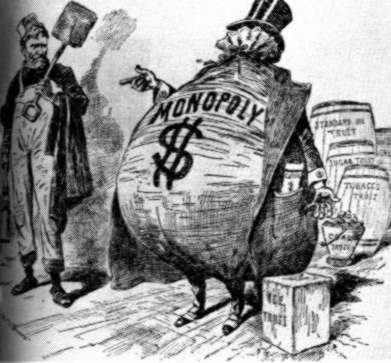
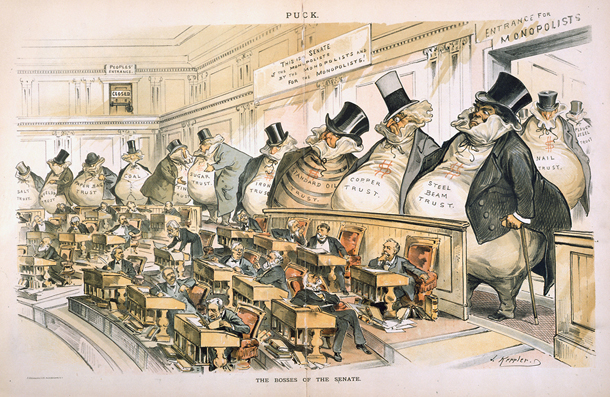
Applying Knowledge: Let's take a look at another political cartoon from the time period we're studying.- Meet the Cartoon: What do you notice first? (Circle the 3 most obvious elements in "Show Your Work")
- Observe the Visuals: List the people, objects, and places. Consider actions or activities as you caption each element. Which ones do you think are symbolic?
- Consider the Words: Which words or phrases are most significant? List adjectives that describe the emotions portrayed in your captions.
Applying Knowledge: Let's take a look at another political cartoon from the time period we're studying.
- Meet the Cartoon: What do you notice first? (Circle the 3 most obvious elements in "Show Your Work")
- Observe the Visuals: List the people, objects, and places. Consider actions or activities as you caption each element. Which ones do you think are symbolic?
- Consider the Words: Which words or phrases are most significant? List adjectives that describe the emotions portrayed in your captions.

1
4. Dig Even Deeper: When was the cartoon created? What was happening historically at the time? Who drew this cartoon? What do we know about them?
1
5. Use as Evidence: What is the overall message of this image?
1
Exit Ticket: The Sherman Antitrust Act was
0
Exit Ticket: Please evaluate how well you understood today’s lesson on a scale from 1 to 4: