Log in
Sign up for FREE
arrow_back
Library
APUSH Period 6.1 (Ch. 23-24) Quiz - SY22
By Haiyen Truong
star
star
star
star
star
Share
share
Last updated over 1 year ago
11 questions
Add this activity
1
IIUR.01
KC 5.3.II
POL 2.0
1
IIRC.02
KC 6.3.II
NAT 2.0
1
IIRC.01
KC 6.3.II
POL 3.0
1
IITE.01
KC 6.3.II
POL 3.0
1
IIUR.01
KC 6.2.II
MIG 2.0
1
CUL 2.0
KC 6.3.I
RAG.03
1
IIUR.01
KC 6.1.I
WXT 2.0
1
KC 6.3.II
RPU.01
WXT 2.0
1
IIUR.01
KC 6.2.II
MIG 2.0
1
IIUR.01
KC 6.1.I
WXT 2.0
0
Question 1
1.
Review:
After Reconstruction ended, Southern whites disenfranchised African Americans with
state laws mandating whites-only voting.
the promise that forfeiting the vote would bring more equal treatment in other areas.
literacy requirements and poll taxes.
fraudulent contracts that tricked individual blacks into signing away their voting rights.
Chapter 23:
Political Paralysis in the Gilded Age (1869-1896)
Question 2
2.
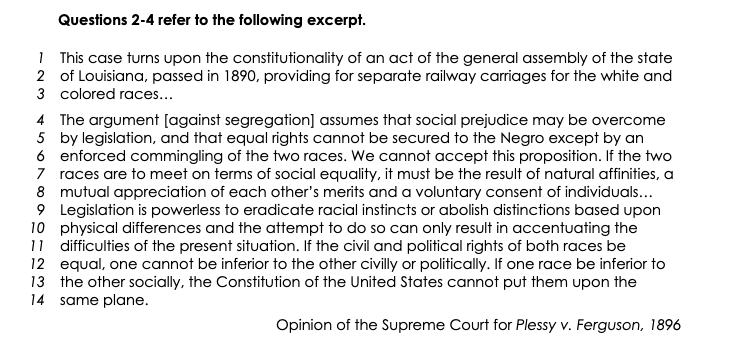
According to the Supreme Court in
Plessy v. Ferguson
, the separation of the races
had to be abolished.
inherently uprooted inferiority.
did not promote inferiority.
was unconstitutional.
Question 3
3.
In terms of society, the Supreme Court ruled
the U.S. Constitution had no place to ensure social equality.
blacks and whites would never be equal.
social equality had to be enforced by the federal government.
legal means were required to ensure social equality.
Question 4
4.
Which choice provides the best evidence for the answer to the previous question?
Lines 9-11 “Legislation is…present situation.”
Lines 1-3 “This case…colored races.”
Lines 5-6 “If the…of individuals.”
Line 12-14 “If one…same plane.”
Question 5
5.
One of the main reasons that the Chinese migrated to the United States was to
create a basis for American cultural relations with China.
establish laundries, restaurants, and other small businesses.
work in gold mining and railroad building.
escape religious persecution.
Question 6
6.
One weapon that caused the downfall and eventual jailing of New York City's infamous Boss Tweed was
New York City's ethics laws.
granting immunity to Tweed's cronies in exchange for testimony.
federal income tax evasion charges.
the cartoons of the political satirist Thomas Nast.
Chapter 24:
Industry Comes of Age (1861-1865)
Question 7
7.
One of the methods by which business leaders in the Gilded Age increased their profits was
elimination of as much competition as possible.
supporting a centrally planned economy.
funding research on new technologies.
elimination of the tactic of vertical integration.
Question 8
8.
The Sherman Anti-Trust Act was originally intended to curb the power of
trusts.
railroad corporations.
state legislatures.
labor unions.
Question 9
9.
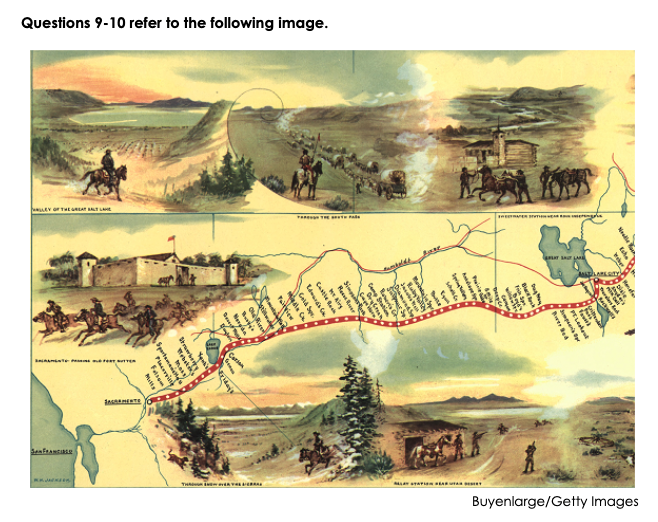
The developments depicted above came about as a result of
the growing American belief in Manifest Destiny.
Union victory in the Civil War.
the growth of the American System.
assimilation policy with regard to American Indians.
Question 10
10.
Which of the following reasons led to the decline of the subject depicted in the image?
There were too many people settling in the area and they interfered with riders.
The killing of the riders by the Native Americans.
The greater efficiency and speed of the stagecoach.
The growth of the railroad and U.S. Steel.
Question 11
11.
Halfway through Period 6 (1865-1898)! How are you feeling? Any feedback, questions or concerns about this unit?
visibility
View drawing