Log in
Sign up for FREE
arrow_back
Library

3.22 - Memoirs Of A Former Migrant Worker

star
star
star
star
star
Last updated almost 4 years ago
19 questions
2
IIRC.02
2
IISM.01
2
IIWD.01
2
CLOSELY READ
1
IIRC.01
1
IIRC.01
5
SQN.01
1
1

1
1
1
1
1
1
1
1
1
1
Question 11
11.

Question 12
12.

Question 13
13.

Question 14
14.

Question 15
15.

Question 16
16.

Question 17
17.

Question 18
18.

In the text, Luis Contreras mentions that the younger generations may be aware of what Cesar Chavez and the NFW were doing, but he and those of his generation made specific efforts to avoid having their children live the same type of life.

1) What have your parents or elder guardians experienced that you are aware of but have not had to experience yourself in your generation?

2) What things are you experiencing in your generation that you will make efforts to prevent the future generations from experiencing?

Question 1
1.
Question 2
2.
Question 3
3.
Question 4
4.
Question 5
5.
Question 6
6.
Question 7
7.
Question 8
8.
Question 9
9.
Question 10
10.
Pertaining to child labor laws The Author's Father says, "It was a different time. It was a different way of thinking among people who did agriculture work - meaning, there wasn't much of an interest in the welfare of the field worker"

Which selection below is the best description of what the father means by this statement.
People in agriculture work at that time prioritized the needs of the individual, over the needs of the entire family.
People in agriculture work at that time priortized the needs of the entire family, over the needs of the individual.
People in agriculture work at that time, priortized the needs of the individual equally with the needs of the family.
People in agriculture work at that time did not have any concern at all for the health and well-being of young people.
Which selection below would be the best summary of the text.
Luis Contreras (Author's Father) believes that life as a migrant farmer was much more pleaseant and enjoyable than most people think or talk about.
While Luis Contreras (Author's Father) missed out on some educational opportunities as a child, he was well cared for and understands why adults of his parent's generation made the decisions that they did back then.

Luis Contreras (Author's Father) feels that the the younger generation today is lazy and does not appreciate the sacrifices of their elders.
Luis Contreras (Author's Father) thinks that migrant workers are not given enough credit for their contribution to the U.S. economy.
Which selection below is the best example of the term "settled" as the Author uses is in paragraph 17?
Finding long-term housing and work in one place
Leaving long-term housing and work for another place
Leaving short-term housing and work for another place
Finding short-term houseing and work in one place
Which selection below best summarizes Luis Contreras (Author's Father) educational experience.
He was smarter than the average student and thus did not need to attend class regularly to achieve academic success.
He did not have a consistent educational experience, however that did not deter him from doing his best to learn when he was in attendance.
He struggled with material becuase of his language barrier and so he lacked confidence and was not motivated to succeed academically.
His family did not believe that education was that important so he had to overcome great challenges in order to attend classes.
Based on the text there were laws against child labor at the time that Luis Contreras (Author's Father) and his family were working in the fields, and law enforcement went to great lengths to enforce these laws.
True
False
Based on the text, the reason there were so few Mexican boys that graduated with Luis Contreras was because at that time Mexican families did not focus on education as much as they did earning income for the family.
True
False
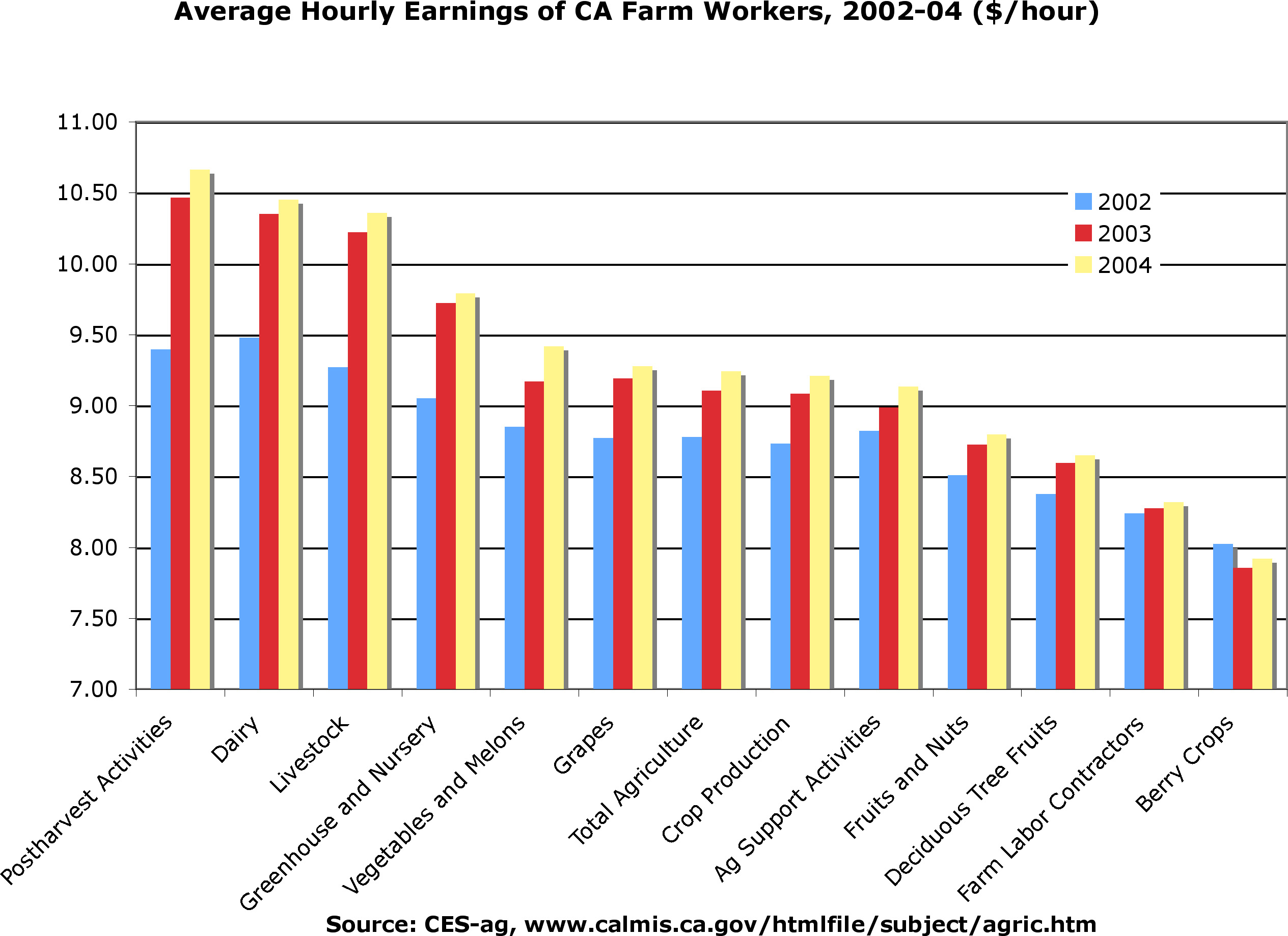
Based on the chart above, select all of the answers below that would be true.
(You can click on the "+" sign in the top right corner of the image above to zoom in)
Average hourly wages for most industries was highest in 2003
For the grapes industry in 2004, and the livestock industry in 2002, the average hourly earnings were about $9.25/hr.
Farm labor contracts saw the largest growth in average hourly income from 2002 - 2004
The total agriculture average hourly wage in the United States was less than $9.00/hr in 2002
With the exception of Berry Crops, average hourly wages of California Farm Workers increased from 2002 - 2004