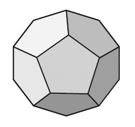
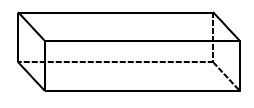
For the figure below, name the polyhedron, then count the number of faces, edges, and vertices.
1
Name the polyhedron
Name the polyhedron
1
Number of faces:
Number of faces:
1
Number of edges:
Number of edges:
1
Match the term on the left with its definition on the right. Not all terms will be used.
Sphere
Platonic Solids
Octahedron
Cylinder
Tetrahedron
Cross Section
Convex Polyhedron
Concave Polyhedron
Cube
Edge
Vertex
Face
Lateral Area
Prism
Pyramid
A polyhedron with two polygon bases and rectangular lateral faces
A solid with two circular bases
A polyhedron with all vertices pointing out
A polyhedron made up of one polygon base and triangular sides that meet at one vertex
A segment at which two faces of a polygon intersect
A polyhedron made up of eight equilateral triangles
A polyhedron made up of six squares
The intersection of three or more edges
The five regular polyhedra
The area of the sides of a polyhedron (Surface Area not including the base(s))
The polygon that makes up a side of a polyhedron
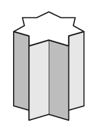
For the figure below, name the polyhedron, then count the number of faces, edges, and vertices.
Name the polyhedron
Number of faces:
Number of edges:
For the figure below, name the polyhedron, then count the number of faces, edges, and vertices.

Name the polyhedron
Number of faces:
Number of edges:
Which of the following solides is NOT a polyhedron?
Use the polyhedron below for the next 2 questions.
Is the polyhedron convex or concave?
Is the polyhedron regular or non-regular?
Use the polyhedron below for the next 2 questions.
Is the polyhedron convex or concave?
Is the polyhedron regular or non-regular?
A polyhedron has 6 vertices and 10 edges. Using Euler's Theorem, determine how many faces it has.
A polyhedron has 20 faces and 36 edges. Using Euler's Theorem, determine how many vertices it has.
Name the solid that can be formed by the net shown below.

Name the solid that can be formed by the net shown below.

Use the rectangular prism below for the next 2 questions.
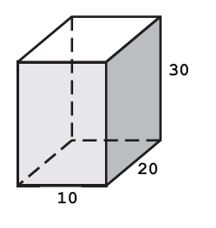
What is the surface area?
What is the volume?
Use the triangular prism below for the next 2 questions.
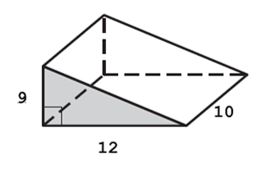
What is the surface area?
What is the volume?
Use the cylinder below for the next 2 questions.
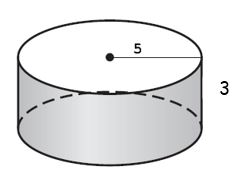
What is the surface area?
What is the volume?
Use the square pyramid below for the next 2 questions.Use the square pyramid below for the next 2 questions.
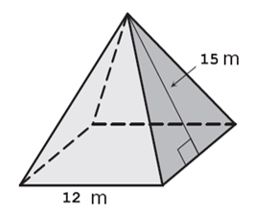
What is the surface area?
What is the volume?
Use the cone below for the next 2 questions.
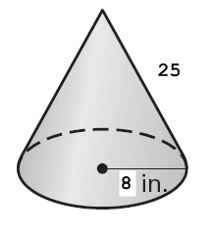
What is the surface area?
What is the volume?
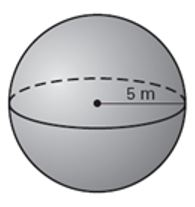
Use the sphere below for the next 2 questions.
What is the surface area?
What is the volume?
The surface area of the rectangular prism below is 450 ft2. Solve for x.
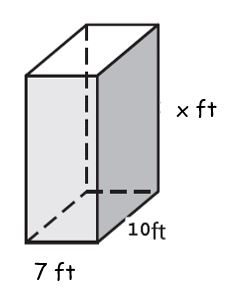
The surface area of the cylinder below is 1407 cm2. Solve for x.
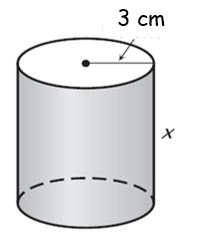
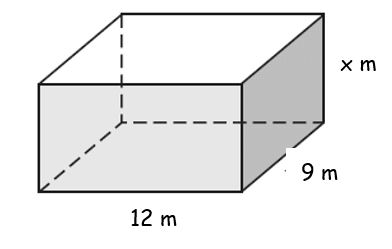
The volume of the rectangular prism below is 1836 m3. Solve for x.
The volume of the cylinder below is 216

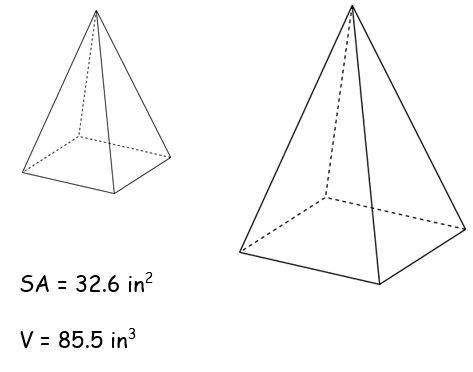
Use the following information for the next 2 questions:
The pyramids shown below are similar with a scale factor of 3:5. The surface area and volume of the smaller pyramid are provided.
What is the surface area of the larger pyramid?
What is the volume of the larger pyramid?
A machinist drilled a conical hole into a cube of metal as shown below. If the cube has sides of length 6 cm, what is the volume of the metal after the hole is drilled?

Number of vertices:
Number of vertices: