EMS EOU Assessment (2/25)- Fields
star
star
star
star
star
Last updated about 3 years ago
7 Nsɛmmisa

1
1
1
1
1
1
3
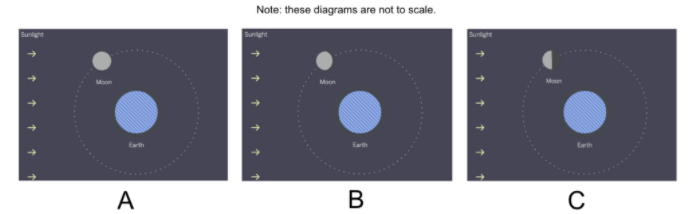
Three students made the diagrams above to show what they think the Moon looks like when it is seen from above (top view). In these diagrams, the sunlight is coming from the left, as shown by the arrows. Which diagram is accurate and why?
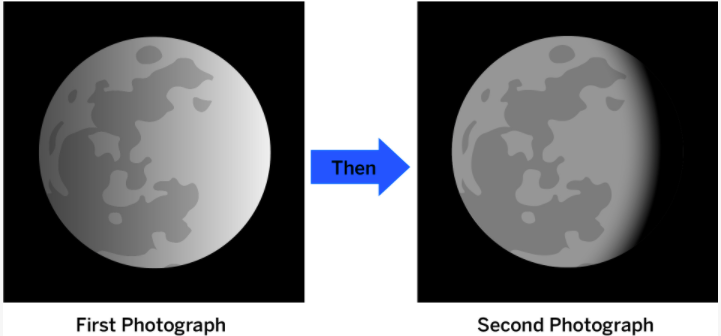
A student astronomer went out and took photographs of the Moon that were several days apart. Images that look like her photographs are shown above. The light part of the Moon appeared to get smaller over time. Why did this happen?
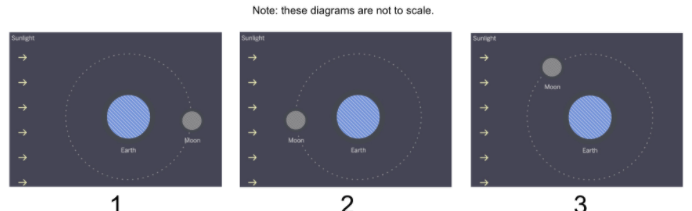
The diagrams above show Earth and the Moon in different positions, as seen from above (top view). Sunlight is coming from the left, but these diagrams do not show what parts of Earth or the Moon are light or dark.
Could the half of the Moon that faces Earth ever be completely dark in any of these diagrams?
Someone said that light bent around a corner to reach an object. Is this possible?
Which of these things is true about the Moon?
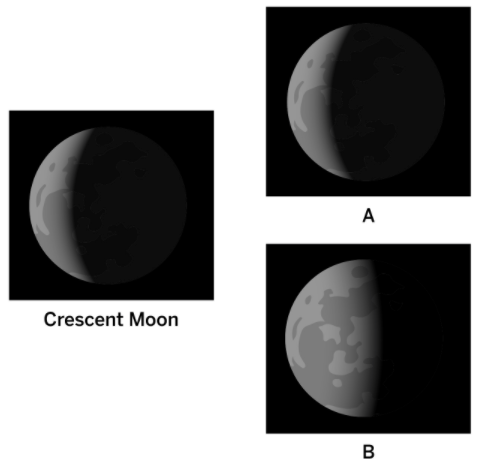
Suki looked up one night and saw a crescent moon.
If Suki looks for the Moon again in one month, what will he see?
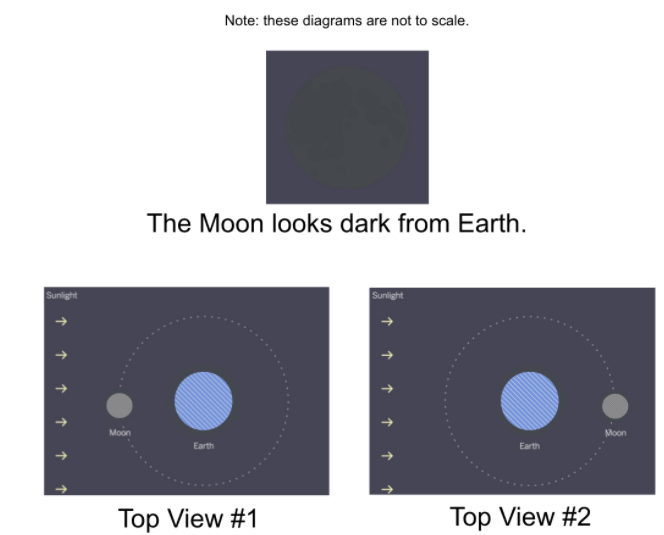
Tanisha says that the Moon looks dark from Earth when the Moon is in two different places: always when it is closest to the sun, as in Top View #1, and always when it is furthest from the sun, as in Top View #2.
Is Tanisha correct? If she is correct, explain why the Moon always looks dark from Earth in both of these positions. If she is incorrect, explain when the Moon looks dark from Earth and how the light on the Moon should look in each of Tanisha’s diagrams.
Written Response CFS:
Accurately identifies the position of the Moon to predict the correct Moon phase
Accurately describes the relationship between light and the appearance of illuminated objects
Accurately describes the relationship between the moons position and the appearance from Earth