EMS 2.4 (3/28)

Last updated over 2 years ago
5 questions
Work in pairs to observe Top View and View from Earth
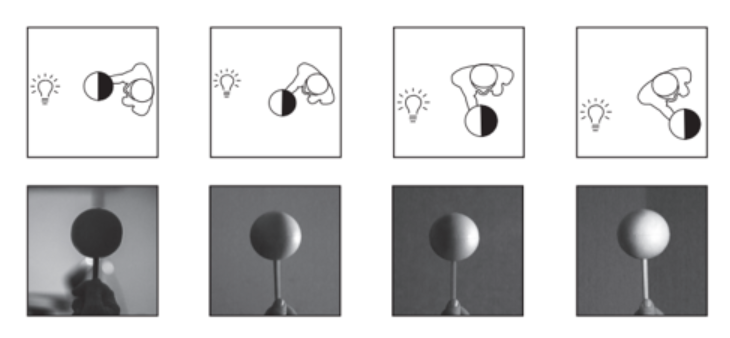
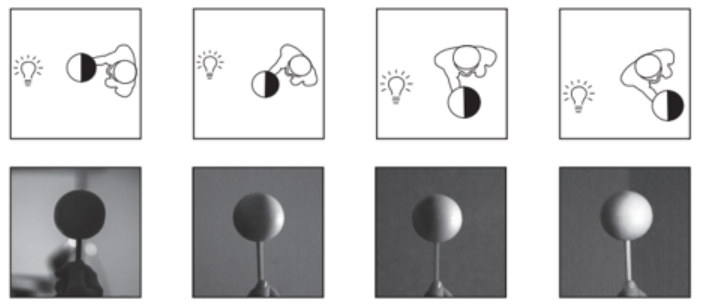
  1. Top View observer: Watch from above while your partner moves the Moon sphere in its orbit.
  2. View from Earth observer: Stop periodically, tell the Top View observer what phase you see “from Earth,” and have the Top View observer share what the Moon sphere looks like from above.
Switch roles and repeat.

0

How did we create each of the different moon phases above? (Hint: how did you change the amount of light you saw on the moon?)

0

How much of the entire moon (sphere) was illuminated in each moon phase? What is the reason for this?

0

What evidence do you have for how the amount of light you see on the moon appears to change?

Evidence Source 1:
Evidence source: “Phases of the Moon” article
“No matter what phase the Moon is in, one thing is the same: half of the Moon is illuminated by the sun. What changes from night to night is how much of that half we can see from Earth. When the entire illuminated half of the Moon is facing Earth, we see a full circle of light, which we call a full moon. Then, as the Moon continues in its orbit around Earth, we see less and less of it until the illuminated half is facing directly away from Earth, and it seems to disappear. This happens when the illuminated half faces entirely away from Earth, and we call this a new moon. But don’t worry-the Moon is never out of sight for very long. As its orbit around Earth continues, the illuminated half of the Moon moves back into our view-just a little at first, but more and more each night until, about a month after the last full moon, it is finally full again.”

Prompt: How can we predict how the Moon will change appearance from day to day?
0

Prompt: How can we predict how the Moon will change appearance from day to day?
CFS:
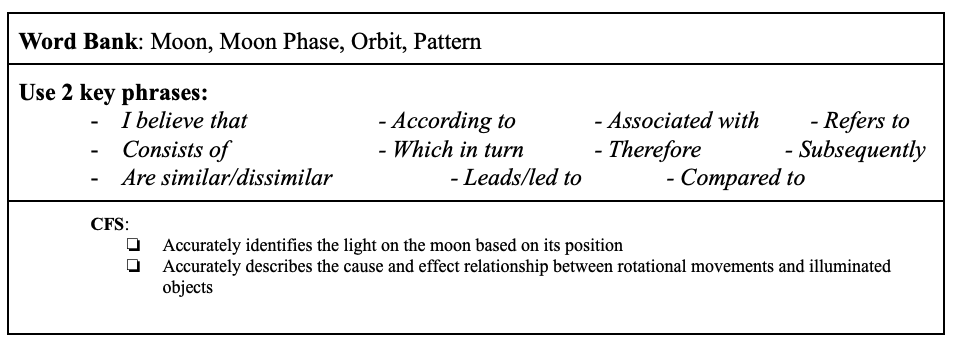
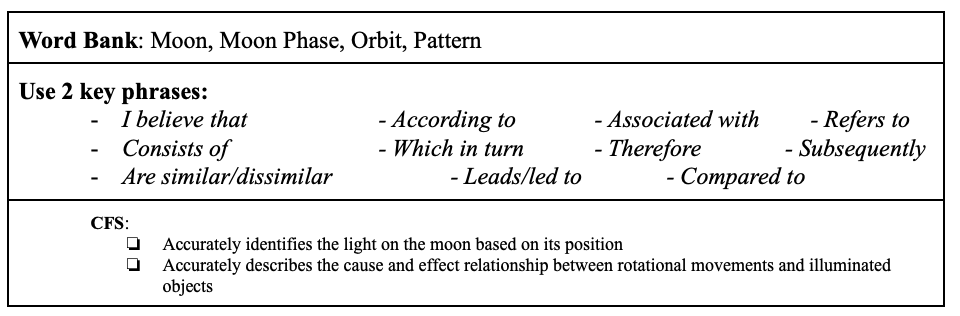
  • Accurately identifies the light on the moon based on its position
  • Accurately describes the cause and effect relationship between rotational movements and illuminated objects

Prompt: How can we predict how the Moon will change appearance from day to day?


0

Prompt: How can we predict how the Moon will change appearance from day to day?
CFS:
  • Accurately identifies the light on the moon based on its position
  • Accurately describes the cause and effect relationship between rotational movements and illuminated objects