Log in
Sign up for FREE
arrow_back
Library

8.1 Lesson 2 CYP Quiz

star
star
star
star
star
Last updated over 3 years ago
10 questions
Required
2
Required
3
Required
2
Required
4
Required
1
Required
1
Required
1
Required
3
Required
1
Required
2

Livin' la Vida (in the) Forest

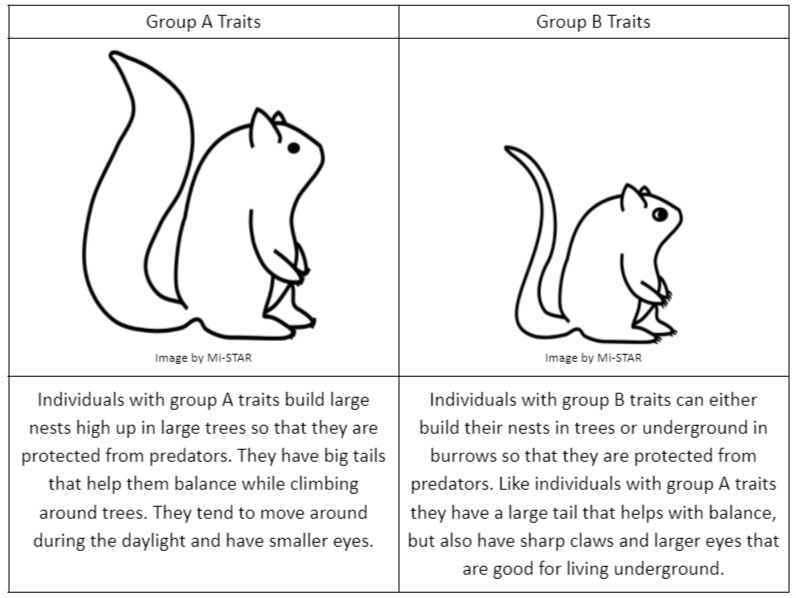
Consider an imaginary animal that lives in forest ecosystems. There are a variety of traits of individuals within this species, much like with other species (for example: humans have many different textures and colors of hair).
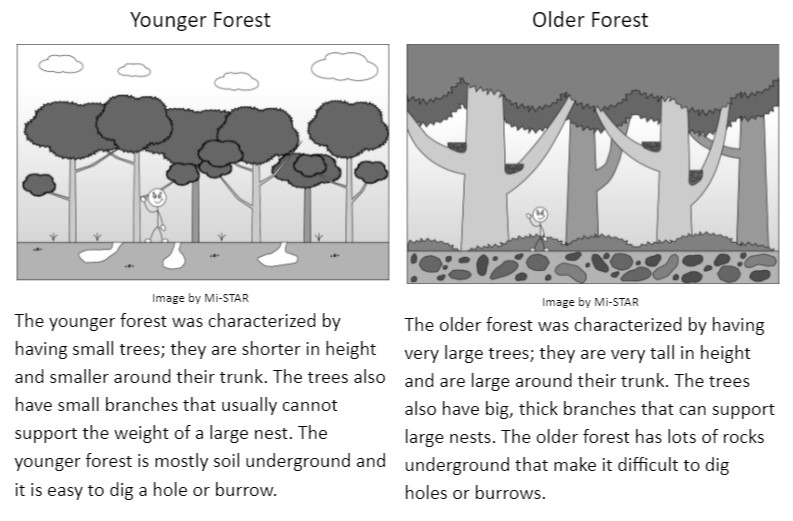
Because of the differences in their traits, some of these animals tend to use different parts of forests for shelter. Read the scenario below, and use the information provided to complete the tasks.
Question 1
1.

Use the information in the reading above to explain how the traits of organisms from Group A are different from the traits of organisms from Group B. (Choose 2 pieces of evidence)

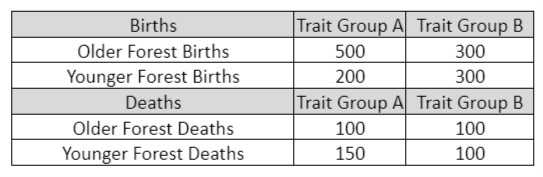
A group of scientists want to understand whether these traits affect the organisms. They gathered data for the number of births and number of deaths of individuals with traits from these three groups in two different environments: an older forest and a younger forest.
Question 2
2.

Use the data that the scientists collected to make some double bar graphs.
Question 3
3.

Create a graph to show how the number of births for trait group A and B were similar or different in older forests compared to younger forests (Hint: to help you out, the first bars for trait group A have been provided for you).

Question 4
4.

Create a graph to show how the number of deaths for trait group A and B were similar or different in older forests compared to younger forests.

Question 5
5.

Look over the graphs and note any patterns or trends you see in the data for each trait group.
Trait Group A: How were the births and deaths for each trait group different when comparing the old forest to the young forest?
Choose the best answer below.

Question 6
6.

Look over the graphs and note any patterns or trends you see in the data for each trait group.
Trait Group B: How were the births and deaths for each trait group different when comparing the old forest to the young forest?
Choose the best answer below.

Make a claim about whether the traits of the organisms affect their survival in the two forests. Support your claims with evidence and reasoning.
Question 7
7.

CLAIM:
The traits of the Group A organisms (choose one):
do / do not
affect how likely they are to survive and reproduce in the forests.

Question 8
8.

Question 9
9.

Claim:
The traits of the Group B organisms (choose one):
do / do not
affect how likely they are to survive and reproduce in the forests.

Question 10
10.

What evidence helps support your claim above for Group B? (Choose 2 pieces of evidence)
Organisms with Group A traits have big tails to help them balance, have small eyes because they move around during the day, and build their nests in trees.
Organisms with Group B traits have big tails to help them balance, have small eyes because they move around during the day, and build their nests in trees.
Organisms with Group B traits also have big tails and can build their nest in trees, but unlike Group A, have sharp claws for digging and large eyes that help them live underground.
Use the information in the reading above to explain how older forests are different from younger forests. (Choose 3 pieces of evidence)
Older forests have lots of big tall trees with big branches that can hold a lot of weight.
The branches on older trees can hold a lot of weight.
The branches on older trees cannot hold much weight.
Younger forests do not have many big trees. Most of the trees in younger forests tend to be smaller and shorter.
Older forests have lots of small short trees with small branches that can hold a little weight.
Younger forests have many big trees. Most of the trees in younger forests tend to be larger and taller.
There were more births in the old forest than in the young forest, and fewer deaths in the old forest than the young forest.
There were an equal number of births in the young and old forests, and an equal number of deaths in the old and young forest.
There were fewer births in the old forest than in the young forest, and more deaths in the old forest than in the young forest.
There were an equal number of births in the young and old forests, and an equal number of deaths in the old and young forest.
What evidence helps support your claim above for Group A? (Choose 3 pieces of evidence)
The Group A organisms have more babies in the old forest than they do in the young forest.
The Group A organisms have more babies in the new forest than they do in the old forest.
The Group A organisms have less babies in the new forest than they do in the old forest.
The Group A organisms have less babies in the old forest than they do in the young forest.
The Group A organisms survive more than the Group B organisms in the forests.
The Group A organisms do not survive more than the Group B organisms in the forests.
The Group B organisms have different number of babies in the old forest and in the young forest.
The Group B organisms have different number of deaths in the old forest and in the young forest.